
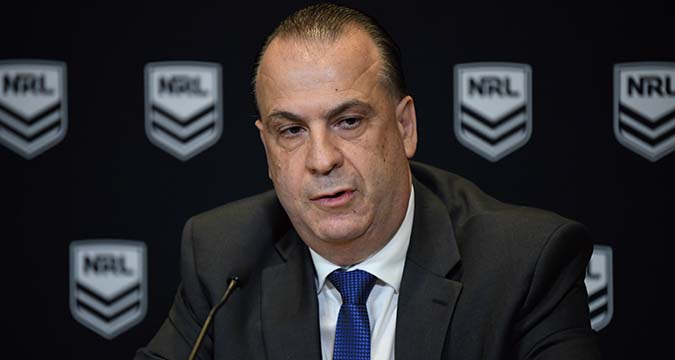
PETER V’LANDYS has told Super League it must improve its financial sustainability and change its governance structure or face a “train crash”.
The chairman of the Australian Rugby League Commission met with officials from some Super League clubs and the RFL on Tuesday.
Speaking to the BBC following the talks, V’landys confirmed the NRL were interested in assisting its northern hemisphere counterpart, including potentially through investment.
However, he suggested clubs will need to have less control over governance and make the English game more like the NRL.
“There has to be structural corporate governance change for that (buying a stake) to happen,” said V’landys.
”You need an independent body to operate the competition and that’s one of the reasons Australia has been so successful in rugby league. It’s totally independent.
“You’ve got to have independent decision-making, because the independent decision-making always acts in the best interests of the game as a whole and not for individual interest groups.”
V’landys acknowledged that as well as having a good product, Super League has made progress in attendances and viewing figures.
But he warned that the finances of the competition do not stack up, especially in light of its expansion for next season and upcoming negotiations over a new TV deal for 2027 and beyond.
“All we’ve done is analyse the financial viability and I can see a train crash if they don’t get the broadcast revenue they need to sustain a 14-team competition,” he said.
“And it all comes back to the finances, and that’s because eventually people will stop wanting to put money in their pockets and sustain losses, and that’s what they’re going to be doing in the short term, unless they can increase their revenue from broadcast.
“There’s been no plan. They’ve got to have a road map and a plan moving forward for the next ten years. Because ten years comes very quickly and unless you have that plan, you’re going in all directions with no purpose.
“There have certainly been some positives. Their attendances have improved, their ratings have improved, but you’ve also got to have a very strong financial base and at the moment that’s not there.”