

Long road trips, limited funding and a tiny player pool would be enough to finish many clubs, but the Tullibigeal Lake Cargelligo Sharks continue to defy the odds in the heart of country New South Wales.
ALTHOUGH country rugby league in Australia appears to be struggling for survival, one club is beating the odds by continuing to operate at a time when small amateur rugby league clubs are gradually disappearing.
That club, with a name that would take a monumental effort to say with a mouth full of sponge cake, is the Tullibigeal Lake Cargelligo Sharks.
From Cooma to Casino, from Kiama to the Kyogle Bush Turkeys, Australian country rugby league clubs are the lifeblood of our game.
The Sharks, who are based on the Lachlan River in a prime wheat, sheep and cattle producing area 590km west of Sydney, are part of a remote town with a population of just 1,500 residents.
The Sharks encompass the towns of Lake Cargelligo, Tullibigeal, Murrin Bridge, Euabalong, Naradhan and surrounding districts.
According to club president Carl Vagg, they are simply just known as “The Tulli’s.”
There are many sheep, cattle and farming properties already established in the area as reflected in the large grain silos which dominate the town’s skyline.
The town began life as a Cobb and Co coach station and remains a quintessential little bush community.
The historical Mayfield Hotel (built in 1919) also has its walls filled with memorabilia from the rugby league team and according to Vagg, “history matters”.
“Despite our club being around for over 50 years, people often forget just how much of a logistical nightmare it can be for teams to even get a game of rugby league in places like ours.
“To stay competitive in our eight-team division, we sometimes travel up to a 250km round trip for games in towns such as Yenda and Hay.
“Factor in not only the players, but our coaches and trainers, volunteers and supporters, it can be quite the journey.”
The sports-mad town has a strong following for rugby league with many players going on to play in the NRL, NSWRL, Country or Riverina Division sides.
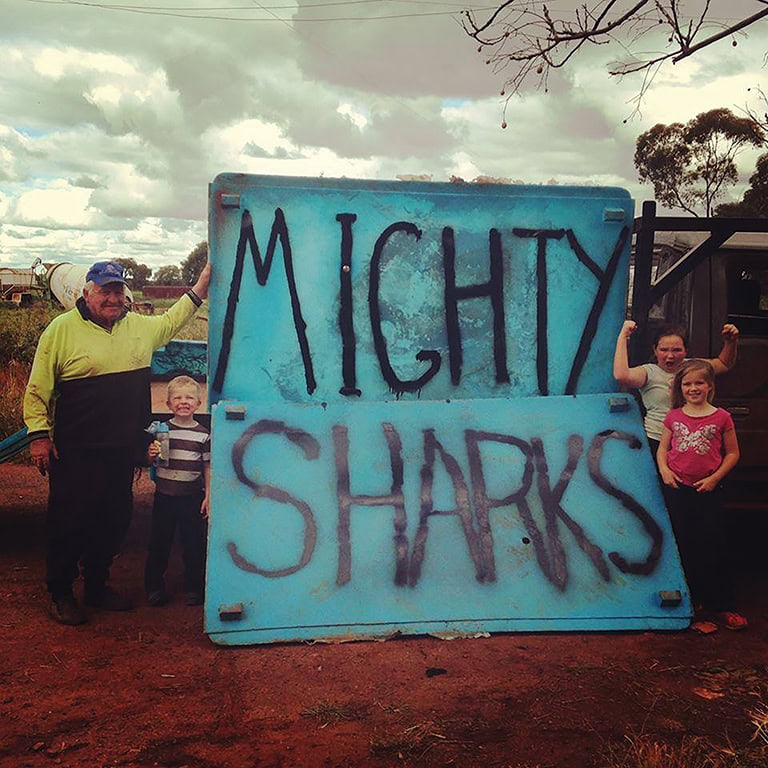
“Several notable players from our club have advanced their careers, including Ron Saddler (Roosters), Barry Glasgow (North Sydney President), Jason Kelly (NSW Country), Jason Wells (Manly Sea Eagles), and local favourite Harry Sanson.
“Plus, recently, two of our Sharks juniors have seen their hard work pay off. Billy Phillips has landed a contract with the Penrith Panthers, and Zak Saddler is contracted to the Canterbury Bulldogs.”
The Sharks currently field teams in First Grade and Reserve Grade in the Group 20 Senior Competition and the local children play for Lake Cargelligo JRL.
“We aim to start a women’s tackle team next season, but we need more players.
“In the meantime, they are playing tag football so that they can remain active.”
With numbers hovering around the 150-mark for player registration at the Sharks, Vagg is optimistic that the club will keep surviving if the support from the local businesses keeps them afloat.
“We don’t get much funding and what money we do get goes into maintaining the club and ensuring that our players are well looked after as best as we can.
“Our lifeblood also comes from the heartbeat of our township’s loyal supporters and sponsors who are some of the most passionate people you will ever meet.”
Tullibigeal Lake Cargelligo United was established through the merger of the Lake Cargelligo, Tullibigeal and Euabalong clubs from Group 17. In 1971, the newly-formed entity entered Group 20 under the name Tullibigeal, Lake Cargelligo & Euabalong United.
At a joint meeting of the clubs at Tullibigeal, the inaugural committee was elected as follows: Fred Leadbitter as President, John Wood as Secretary, Tony Bonham as Treasurer, and Robbie Townsend appointed to serve as caretaker coach.
In this time Euabalong withdrew from the merger and rejoined Group 17 and from then on, the club was to be known as Tullibigeal Lake Cargelligo United.
The Sharks’ first Premiership in Group 20 came in 1972 when John Booth’s Reserve Grade team took home the trophy, defeating Griffith Black & Whites 11-10.
Then, in 1974, the Sharks took out the title of First Grade Premiers, defeating Black & Whites 11-8 in what has been described as a bloodbath and clinching the club’s first ever piece of silverware.
“At the time, TL United was the only team in Group 20 to have no paid players in their side.
“There was a time when players participated just for the love of the game and to keep the club going, which is quite rare nowadays; fortunately, those difficult times are not as bad, but you never know what to expect from year to year.”
Many clubs have lost the fight to survive, simply because funding is non-existent with clubs being left to their own devices through raffles, meat trays and the support of local businesses.
If funding stops, many country rugby league clubs in Australia — already struggling with minimal resources — may not survive.
Vagg describes the club’s financial position as “stable” after some very lean years when the club almost folded.
With rugby league played hard and tough in these remote parts of Australia, you cannot help but fall in love with these country folk who are arguably some of the most loyal supporters anywhere in the world.
Tullibigeal Lake Cargelligo Sharks is one such club who have stuck together in the good times and the bad.
But don’t expect five-star luxury, state-of-the-art facilities or big-name signings in these parts of Australia, what you see is what you get from a remoteness that only the strongest of the strong survive.
“I often think if our club didn’t have the volunteers that we have each year, I don’t know if we would have lasted as long as we have.”
If you ever decide to pay a visit to the mighty Sharks, make sure you come armed with a fold-out chair holding a cold beer, because you’ll feel right at home standing right alongside those passionate “Tulli’s.”
First published in Rugby League World magazine, Issue 521 (June 2026)