I WROTE in last week’s issue that the meeting scheduled for last Thursday in which Alan Smith, the Rugby Football League’s community game senior administrator, was due to meet clubs affected by the National Community Rugby League initiative could turn out to be among the most important in the history of our sport.
That might turn out to be the case, although it’s hard to say right now.
I asked Smith, on the day of the meeting, to let me know the outcome. He replied, speedily: “We will not be in a position to comment with regards to tonight’s meeting until all the clubs have been notified and everything has been ratified by the league management.”
How long that will take, I’m not sure. But it’s unlikely, as League Express readers peruse these notes, that anything will have been announced officially.
As most readers will know well enough, the issue revolves around the scrapping of the four-division National Conference League, which the RFL have replaced with two top divisions and five regional conferences, all underpinned by a number of regional leagues.
The intention is that the new structure will involve a pyramid in which, say, a newly-formed team can see a clear pathway to the very heights of the grassroots game.
It was always intended that a review at the end of the first season be conducted so, with that in mind, the fact that some clubs have declined hard-earned promotions may possibly be seen as part of a teething process, even if not everyone will be inclined to view it that way.
Our next issue of Rugby League World will include a feature on the new competition, and on how clubs themselves view it.
I’ll also be seeking answers to some important questions, for example, how the intensity of the competition compares with the National Conference League, and – again as compared to the NCL – how well the league is run administratively.
Then there are issues surrounding the championship, play-offs and promotion and relegation formats, and whether the pyramid system has passed the litmus test (not least, in that regard, is the fact that the quality of a member team has never been part of the NCL’s criteria.
Meanwhile, I was contacted midway through last week by a long-standing correspondent (who, at this stage anyway, I’d probably best not name), who had some pithy comments to make and some forthright questions to ask.
The individual said: “Come on Mr Hodgson, rattle some cages see if your column can get some answers for the players and clubs.
“The million-dollar question that needs asking for all to read is when are the leaders of the community game going to make public their financial situation, present a balance sheet, and make it available to the players and clubs.
“They should be made accountable to their member players. After all, they all pay player membership. Are they now taking all the youth leagues funds too?”
My correspondent continued: “RFL top community leaders should be completely ashamed by the £10 adult and £5 concessions and under 16 admission for their National League finals at Wakefield (well done BARLA, under 16s free, adults £5 and concessions £3 at the National Cup finals).
“Based on YouTube footage and club photos, medals were quickly handed out by Ben Thaler and a kid. What’s going on? Is that all these players are worth – where was the top-rank community staff or management, surely not everyone is in Australia?
“There were (apparently) two almost-full stands, at least 3,500 spectators over the two games – quite a considerable sum of money, money, money, with the NCRL increasing league costs to £100 per club, fines and all finals takings.
“Players’ membership should be lowered in 2027. What’s the betting they will increase? Make a stand until they disclose their finances.
“Why is everything top-secret? Earn some respect and come clean.”
The stalwart concluded: “Martin Coyd keeps sidestepping the topic at club meetings, who’s to say he doesn’t know what money is being taken from players and clubs – about time he should ask some questions when he comes back from Australia!!
“The community game isn’t a ‘cash cow’. Answers on a postcard, which will either not be answered like emails, or be lost in the post!”
Interesting points. I’ll hopefully be able to publish the RFL’s response in next Monday’s League Express.
Meanwhile, my thanks go to Sasch Brook for sending details of the various winners and runners-up since youth and junior competitions in Hull came under the wing of the city’s two professional clubs back in 2019.
Sasch, who is linked to Hull FC, works very productively with his counterpart at Hull KR, Rob Wilson, and it’s very pertinent that after initial reservations from the folk who have many years of experience of the grassroots game, the City of Hull District Rugby League (to give it its formal name) has been a success.
That was the view given to me at the competition’s impressive 2026 season launch – at the city’s Guild Hall, back in the spring – by none other than the amateur game’s stalwart Alan Parker, and if it’s good enough for Parker it’s certainly good enough for me.
Crucially, Messrs Wilson and Brook bring a player’s perspective to their work, which in my opinion is a major factor (plus, of course, administrative efficiency) as to why the competitions at all age groups seem to run so smoothly.
Onwards and upwards for what is, in truth, a model that Rugby League in other regions could do worse than emulate.
Incidentally, a quick count reveals that the West Hull club are way ahead of others, featuring 29 times as either winners of runners-up throughout the age levels, with Myton and Skirlaugh next up with 13 and 12 showings respectively.
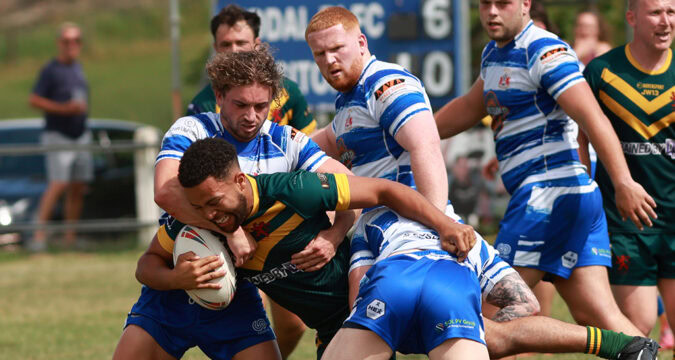
No wonder, you might say, that the Green and Golds not only topped the inaugural National League, but also won the BARLA National Cup, given such a strong production line.