

Our journey around the villages, towns, cities and regions that have rugby league running through their veins returns to West Yorkshire.
LEEDS has always been at the heart of rugby league, with Headingley’s inclusion alongside Wembley and Everton Football Club’s Hill Dickinson Stadium as one of the three venues for this year’s return of the Ashes underlining it.
The city boasted two Northern Union founder members in Leeds and Hunslet, who were once its dominant side.
And at other times in the 130 years since the great breakaway, it has had other professional teams in Bramley, the longest-lasting (from 1896 to 1999) and featured in this column in the September 2023 issue, Holbeck and Leeds Parish Church, spotlighted three editions ago (June 2025).
Hunslet have an intriguing history, including becoming the first side to collect ‘All Four Cups’ in 1907-08, when they were skippered by legendary fullback Albert Goldthorpe, and the fall and rise of 1973, when the original version folded with the loss of the celebrated Parkside ground, and the ‘New’ were hurriedly assembled, with the efforts and enthusiasm of Great Britain forward Geoff Gunney a key factor.
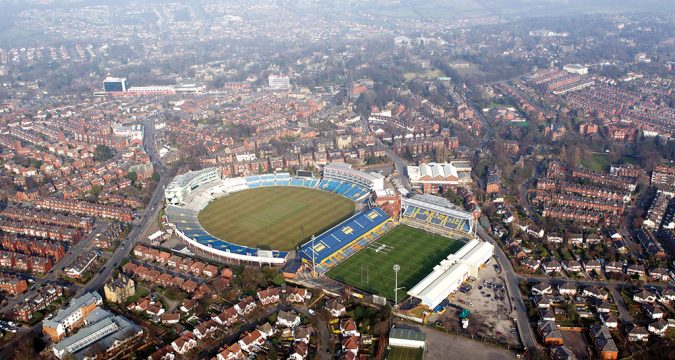
However this instalment of Locations of League focuses north of the River Aire on Leeds (originally with the suffix St John’s and founded in 1870, and since 1997, Rhinos), and Headingley, their well-known home since 1890, since when it has been redeveloped several times.
Indisputably one of the game’s top clubs, their tale mixes progressiveness with tradition, illustrated by two developments in 1980, when they became the first in English rugby league to use an electronic scoreboard at the same time as they became the last to switch matches from Saturdays to Sundays.
Headingley, back-to-back with the world-famous cricket ground, had in 1963 become one of the earliest stadia in Britain, after Everton’s old base Goodison Park and the Murrayfield rugby union arena in Edinburgh, to have undersoil heating.
With rugby league then a winter sport, it provided both an insurance against postponements and an incentive to the powers that be to continue staging big matches, usually televised, there.
Headingley’s use as a neutral venue for internationals goes right back to 1893, when Scotland beat England 8-0, and in league, to 1908, when in the first Test of the first tour, Great Britain (then known as the Northern Union) defeated New Zealand 14-6.
This year’s England v Australia clash, on Saturday, 8th November, will be the 13th Ashes Test at the stadium going back to 1921 (there have been 26 Ashes cricket clashes next door between 1899 and 2023).
And Headingley has also hosted 16 World Cup ties, including the final in 1970, when Australia beat Great Britain 12-7 in a bad-tempered affair, plus four in the women’s tournament.
The ground also has the notable claim of staging the first two Challenge Cup finals in 1896-97 and 1897-98, Batley winning both, plus eleven more between 1900-01 and 1942-43, seven Championship Finals and 46 Yorkshire Cup finals.
Yorkshire cricket captain Lord (Martin) Hawke was a driving force in the creation of Headingley by the ambitious and freshly-incorporated Leeds Cricket, Football and Athletic Company, which he chaired and who bought the 22-acre site in early 1899.
Hawke wanted to challenge the dominance of Bramall Lane in Sheffield as the home of Yorkshire Cricket and was also wary of the rapid development of another dual-ground, Bradford Park Avenue.
Leeds St John’s, who were known as the ‘Old Blue and Ambers’ and had been playing at nearby Cardigan Fields, became the rugby football section, playing their first game at the newly-constructed stadium in September 1890 against Manningham, who were also founder members of the Northern Union in 1895.
While Manningham were to turn to association football, as Bradford City, in 1903, Leeds stuck with the oval ball, although success on the pitch took some time to come.
While the first of 14 Challenge Cup triumphs was claimed in 1909-10, with Hull FC beaten 26-17 in a final replay at Fartown, Huddersfield, following a 7-7 draw there, and the first of a record 17 Yorkshire Cup successes came in 1921-22 (Dewsbury were defeated 11-3 at Thrum Hall, Halifax), the league title proved elusive.
The Loiners (meaning an inhabitant of Leeds), were five times beaten in play-off showpieces, including an 8-2 defeat by Hunslet in front of a then-Championship Final record attendance of 54,112 at the city’s Elland Road football ground in 1937-38, before Joe Warham’s side of 1960-61 finally accomplished the mission with a 25-10 win over Warrington at Odsal, Bradford.
Leeds’ second Championship Final triumph in 1968-69 (16-14 over Castleford at Odsal) came during a period when they topped the table for four seasons in succession.
There was another title in 1971-72, and Challenge Cup glory in both 1976-77 and 1977-78, but the 1980s were relatively barren, and by the arrival of the summer era, Leeds were having to deal with the knock-on effects of having tried unsuccessfully to keep up with big-spending Wigan (they finished third-bottom of the first Super League table in 1996).
With debt of around £6million, some even suggested the only option was to sell Headingley and move in with footballing neighbours Leeds United at Elland Road.
But a takeover by former Loiner and Sheffield Eagles founder Gary Hetherington and businessman Paul Caddick was to turn things around.
Player pathways and community programmes have been developed, as has the club’s foundation, Headingley has been upgraded into a smart modern stadium, and the Rhinos have won eight Grand Finals, three World Club Challenges and four Challenge Cups while establishing women’s and wheelchair sides.
First published in Rugby League World magazine, Issue 512 (September 2025)