The shifting sands of rugby league’s divisional structures are on the move again. The more things change, the more they stay the same as this glimpse back in time to 2002 illustrates.
HUDDERSFIELD held sway, Leigh came up short, there was a glimmer of hope at Hull KR, but York bit the dust.
As we approach the return of two rather than three divisions via the amalgamation of the Championship and League One, it’s interesting to take a look at the second-section scene in 2002, when the game was preparing to go the other way from two to three.
That was the fourth season since the second abandonment of a trio of tiers, which had been in place in 1991-92 and 1992-93, then from the last winter season of 1995-96 to the third summer campaign of 1998.
After a two-season flirtation with two divisions in the 1960s, that format had returned when the long-established single-section system was dropped after 1972-73 (when Dewsbury were memorably the league title winners after toppling Leeds at Odsal in the last of the old-style Championship Finals).
And it was again used in 1993-94 and 1994-95 – who was it who said rugby league can’t make up its mind about much?
In 2002, when the Super League crown was claimed by St Helens, who edged a 19-18 Grand Final win over Bradford at Old Trafford, the second tier was known as the Northern Ford Premiership.
And a Dewsbury side with whom a young locally-produced halfback called Danny Brough was attracting attention didn’t make the main play-offs, with the going proving harder than it had in 2000, when they defeated Leigh at Gigg Lane, Bury in the second of successive divisional grand final appearances.
But the West Yorkshire side did scramble their way to a place in the higher of the two National Leagues for 2003 by coming through a six-team qualifying series for the sides finishing tenth (which they did) to 15th, the winners of which became the tenth team in the upper section.
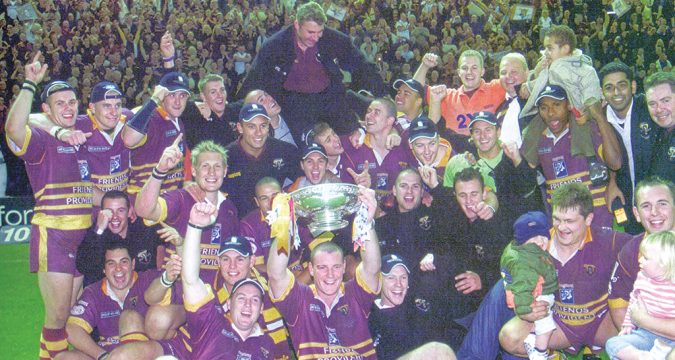
After Dewsbury beat Workington 25-15 in the series decider at the Halton (now DCBL) Stadium at Widnes, Huddersfield took to the field to face Leigh in the NFP Grand Final, the winners of which would win promotion to Super League if they came up to off-field standards (Hunslet and Dewsbury had been turned down in 1999 and 2000 respectively before Widnes went up and the Giants down in 2001).
Huddersfield, with rookie Australian coach Tony Smith in his first full campaign in charge and skipper Steve McNamara pulling the strings on the pitch, were playing their 39th competitive match of the year.
They had come through eight ties to win the Buddies (National League) Cup, defeating Hull KR 32-6 in the final at Featherstone’s Lionheart Stadium, before topping the table with 26 wins and a draw (at Whitehaven) from 27 games.
Then came a 36-10 home win over Leigh in their first outing of the Australian-style play-offs to seal their showpiece spot.
The Hilton Park side, coached by Smith’s compatriot Paul Terzis, had made the quarter-finals of the Challenge Cup and finished second in the table (ten points behind Huddersfield).
And having lost to them in that qualifying semi-final, they set up the big rematch at Widnes (their 41st competitive game) by beating Batley 35-28 at home in the major semi-final.
Leigh put up a tough fight, with their pack challenging Huddersfield’s, however the midfield trio of stand-off Stanley Gene, scrum-half Chris Thorman and loose-forward McNamara and speedy wingers Hefin O’Hare and Marcus St Hilaire, who scored two tries apiece, proved the difference in a 38-16 white-rose triumph.
Huddersfield duly returned to Super League at the first attempt, with Salford relegated to join (in 2002 descending finishing order) Leigh, Rochdale, Hull KR, Featherstone, Doncaster, Batley, Whitehaven, Oldham and the aforementioned Dewsbury in the National League One line-up for 2003.
National League Two comprised, in similarly descending 2002 finishing order, Workington, Sheffield, Barrow, Keighley, Swinton, Chorley, Hunslet and Gateshead plus the readmitted new version of York and newcomers London Skolars.
That reigning champions Hull KR will visit York in the opening match of the 2026 Super League season happily illustrates the rise of both over the intervening years.
Back in 2002, Rovers hadn’t been in the top flight since 1993-94, and when three divisions were brought in for 1995-96, were in the lowest.
They won promotion in the first summer season of 1996 and in 2002, when Jon Wilkin emerged as a talented backrower and earned a move to St Helens, as well as making the Buddies Cup Final, they finished fourth, their best position in four seasons, only to fall at the first hurdle in the play-offs as Oldham won at Craven Park, after which Gary Wilkinson decided to call time on his reign in the dug-out.
Fifty miles away, York Wasps lost their sting – and how – when after eleven league games (and two in the Challenge Cup), that club announced they could not continue to operate.
Pre-season optimism, fired by the appointment of Australian Leo Epifania as coach and the addition of several new players, had been extinguished by defeats in all but two matches in the two competitions.
Desperate attempts to keep going were made, but it was decided to focus on starting a new club for the following campaign, and with former England and Great Britain prop Paul Broadbent player-coach and Brough signed from Dewsbury, York City Knights made the starting line for National League Two, finishing a creditable fourth.
First published in Rugby League World magazine, Issue 516 (January 2026)