


Following the passing of historian and journalist Cliff Spracklen, Pierre Carcau reflects on the insights from Spracklen’s Treiziste Diary columns in 2006 – a pivotal year in the modern history of French rugby league.
“THOSE who look back only see dust.”
These lyrics from a French singer — you can probably guess their geographical origin from the unmistakably optimistic tone – could become my motto and sum up my editorial line for Treiziste Diary.
Even if I am usually fond of history, what I try to offer readers of Rugby League World is a modern vision of French rugby league – a sport living in the 21st century rather than trapped in an album full of old black-and-white pictures.
But the exception proves the rule, and a recent sad event led me to reconsider my point of view.
Cliff Spracklen, a household name in both English and French rugby league, passed away in February.
I never met Mr Spracklen, but I came across his name many times, especially during the nineties when he co-founded XIII Actif, a society campaigning for the historical rehabilitation of French rugby league and for reparations related to the assets seized under the Vichy regime.
He was also a journalist and independent researcher who ran a dedicated column in Rugby League World for roughly ten years, becoming one of the most consistent English-language voices on the sport’s history and contemporary scene in France.
And unsurprisingly, the title of his monthly column was Treiziste Diary.
By chance, I recently discovered a kind of time capsule – and not from just any year. The Treiziste Diary columns he wrote in 2006, a pivotal year for French rugby league.
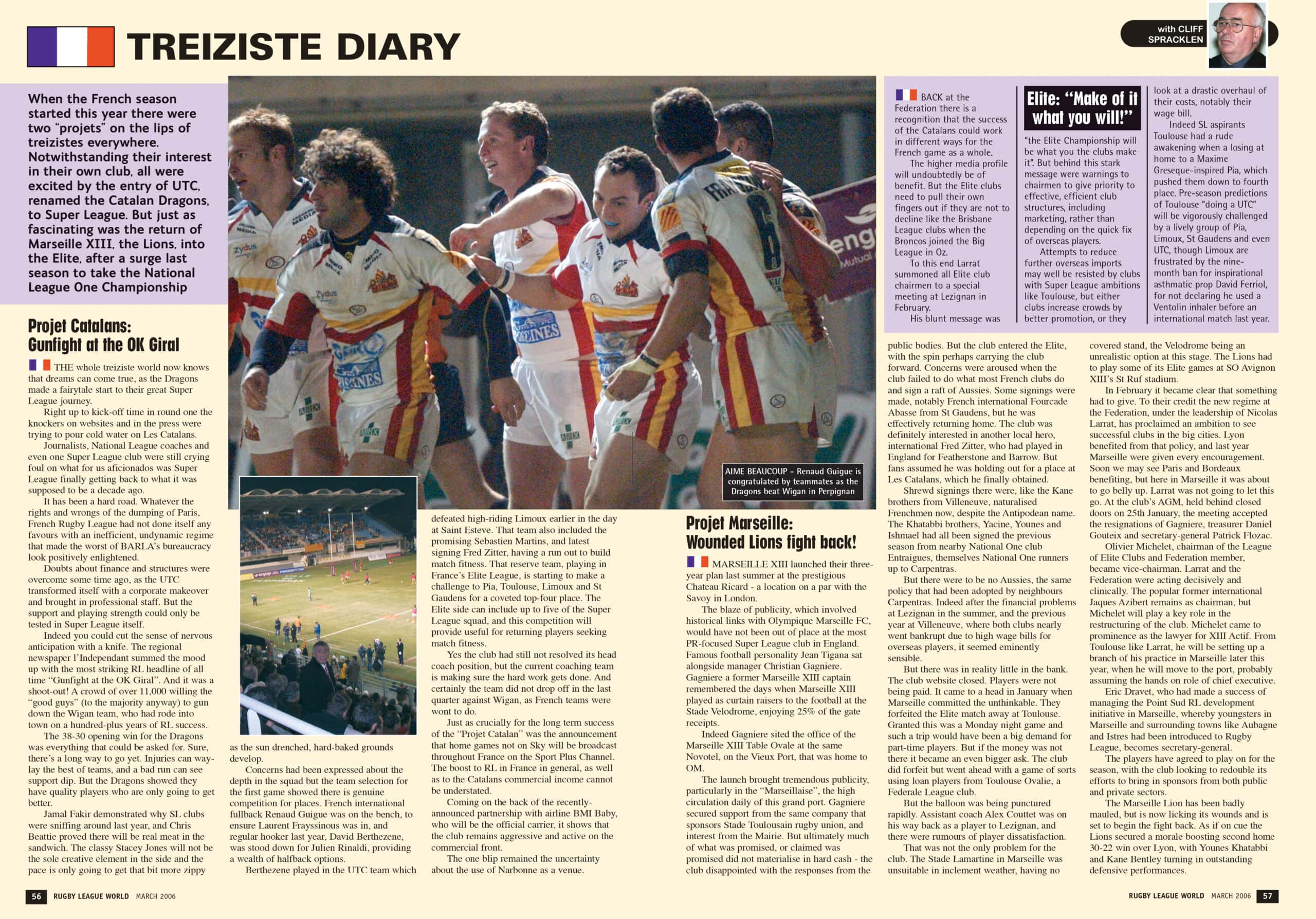
It was, of course, the year when Super League returned to France and when Catalans Dragons joined the competition. Moreover, Spracklen offered readers many landmarks and insights that help explain today’s French rugby league landscape.
This is how Cliff Spracklen described the beginning of the Catalans adventure: “The whole Treiziste world now knows that dreams can come true, as the Dragons made a fairytale start to their great Super League journey.”
He was referring to their inaugural victory over Wigan (38-30).
He was also aware of the strong opposition from some quarters towards French teams: “Journalists, National League coaches and even one Super League club were still crying foul at what, for us aficionados, was Super League finally getting back to what it was supposed to be a decade ago” (RLW 300).
Nothing has changed, has it?
But the versatility of the French public did not escape him either. In April 2006 he wrote:
“Successive defeats for the Catalans after that euphoric start against Wigan had some French fans descending quickly into depression, egged on by those this side of the Channel who were opposed to the whole Catalan project in the first place” (RLW 301).
Nowadays, and somewhat ironically, Catalans fans may experience that same seasonal depression at one point or another each year – but the reasons are no longer the same.
Winning the Challenge Cup in 2018, reaching the Super League Grand Final twice and lifting the League Leaders’ Shield once have made the Dracs’ supporters far more demanding.
For instance, the relatively slow start to the club’s season – defeats against Bradford Bulls and St Helens – brought back that familiar anxiety. But by the time of publication it had disappeared following victory over Leigh Leopards.
In 2006, Spracklen was also a privileged witness to Toulouse’s ambitions: “Clarifying rumours that Toulouse were a write-in for a second French franchise for Super League entry in 2009, federation chairman Nicolas Larrat said: ‘At the present time Toulouse is the only candidate. Toulouse has the right structures already in place and is ahead of any other club. It is now up to it to demonstrate that there is a sufficient audience in the area for the game.’” (RLW 308)
For Toulouse, the road has proved much longer and more difficult. Toulouse Olympique eventually joined Super League only in 2022, were relegated and have now returned to the competition this year.
However, their promising start to the current season – two wins and two respectable defeats in the opening four rounds – would probably have delighted Spracklen.
Spracklen also noticed something that went largely unnoticed by many: the side effects of the hype surrounding Catalans Dragons’ entry into Super League.
He pointed to one indirect victim – Villeneuve-sur-Lot, regarded at the time as “the St Helens of their day before all this Catalan stuff” (RLW 309).
He summarised what he called the “deposing” of the Leopards: “The club lost its status once UTC (the former structure of the Catalans) went professional and players moved south to the Mediterranean.”
He also recalled a game when Villeneuve travelled to Perpignan to play UTC shortly after the announcement that UTC had received preferred bidder status to join Super League ahead of Villeneuve and Toulouse.
“The snubbed Leopards, playing with a resolve that was frightening, took the Catalans to the cleaners in a second-half rout.”
If you follow French rugby league – or the discussions on social media – you may still sense that lingering resentment from some Villeneuve supporters towards Catalans Dragons.
Spracklen also addressed a subject I find particularly interesting: the attempt to create a major rugby league club in Marseille.
For him, the project appeared to be of similar significance to the Catalans venture. But in April 2006 he had no choice but to acknowledge its failure: “At the other end of the scale, Marseille, despite the intervention of the federation, were forced to throw in the towel. Despite optimism that the club could restructure and see out the season, it folded, the financial shortfall greater than originally anticipated.”
This episode occurred during a period when I was less involved with French rugby league and I had never heard of it before.
Of course, I do not question Spracklen’s reporting, but it perhaps illustrates how difficult it can be for the French general public to remain fully informed about the sport.
That said, rugby league still has a presence in Marseille. The Jourdan tournament was held there last weekend by the association Point Sud.
As heirs to the Marseille XIII project, they run not only a rugby league school but also an ambitious social and cultural programme for young people living in the northern districts of France’s second-largest city.
Finally, I will forget the pessimistic lyrics of the French singer.
Exploring Cliff Spracklen’s writings from 2006 proved highly instructive, and I would like to thank him for this posthumous lesson in French rugby league.
It is deeply regrettable that he will not be here to witness the crowdfunding campaign led by Quentin Morlaas to fund a short fiction film devoted to French rugby league and its tragic history.
Perhaps, then, I should adopt a new maxim — one expressed by former British prime minister Winston Churchill in a 1944 speech to the Royal College of Physicians: “The farther back you can look, the farther forward you are likely to see.”
First published in Rugby League World magazine, Issue 519 (April 2026)