

IT’S becoming that time of year (we’ll find out more in 2027 and beyond) when it almost feels as though more games are off than are on.
That’s partly because it’s holiday time of course, while another major factor is the weather. Many pitches are simply too hard, given the prolonged heat and, for some time, a lack of rain, for play to be safely possible.
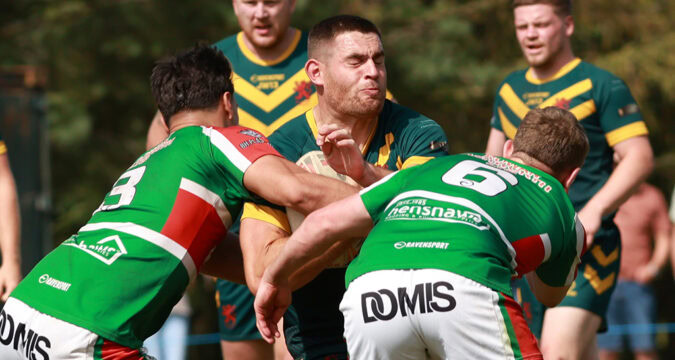
Much credit is due, therefore, to West Hull, for pulling out all the stops to ensure that Saturday’s BARLA National Cup semi-final against Featherstone Lions actually happened.
Wests paid for a tanker to visit their ground on Friday and several of the Green and Golds spent time spraying water from the machine on to the pitch.
Because of that the game went ahead and a strong West Hull side duly earned a place in the final.
I can’t blame other clubs for not being able to play. Not all pitches can be watered, for one thing, and neither do all clubs have the money available to pay for usable water (if it can be obtained) anyway.
At the same time I can see why West Hull are riding high at the top of the inaugural National League’s Premier Division, with a 100 percent winning return.
It takes good players to produce such a record, not to mention coaches of quality. I’d take it further, though – it also requires a good club, with imaginative and proactive administrators. Without such folk in place, on-field success can be fitful at best. Last Friday’s episode tells us a great deal about why West Hull have been so successful for so very long.
They will now meet the winners of the other semi-final in the decider, on Saturday, October 31.
That will be either Ince Rose Bridge or Leigh Miners Rangers (both, like Wests, grand outfits) and I wouldn’t imagine those two clubs will have trouble playing each other after Saturday’s postponement, given how close they are geographically.
What about the 1973 Cup, though?
This competition, which involves teams who lost in the first round of the BARLA National Cup, seems to have stumbled somewhat in its first incarnation, the latest instance being that Cumbrian side Distington conceded Saturday’s semi-final at Fryston Warriors.
I suppose that will mean that Fryston will be in the decider and the Warriors won’t have to travel far – just down the road, in fact, to the OneBore Stadium, Castleford, as part of an enticing double-header with the BARLA National Cup final. It should be quite an occasion.
That’s what the Scottish Grand Final should have been. The game was to have been played last Sunday at Hawick RUFC and was due to have involved Border Barbarians and Edinburgh Eagles.
Unfortunately the match was, in the words of Scotland RL’s operations and league director Barry McGuffog, cancelled.
The reason given was that the Barbarians, who had stepped in at short notice to replace Tayside Silverbacks – who had withdrawn – were themselves hit by player problems.
It seems that too many of their squad, like Tayside, had rugby union commitments that, at short notice, they couldn’t get out of.
There would probably have been issues, too, regarding the fitness of the pitch at Hawick, given the weather.
The match might have failed to go ahead anyway, which leads me to an as-yet unanswered question. Was the Scottish Grand Final actually cancelled (which in my book means it will not now take place at all) or postponed (which means that a future date will be set)?
At the time of writing, I don’t know, although I do anticipate cancellation. We’ll see.
Happily the Irish Grand Final and the Welsh Cup finals went ahead as planned, as did the Irish Women’s Grand Final.
On the wider issue, though, it’s happened too often over the years, mainly in England I think, that important Rugby League games (ie. Grand Finals), haven’t been played because too many players for comfort seem to show more loyalty to their rugby union clubs (even in the very early stages of the 15-a-side season) than to their League outfits.
That’s not good, is it? Perhaps a solution might be for our Grand Finals to be played earlier if at all possible, simply to avoid unnecessary clashes.
Meanwhile the Rugby Football League are, of course, well aware of the issues BARLA has faced for quite some time over their National Cup – there have been plenty of ‘blobs’ in this season’s early rounds – and, to their credit, the RFL left slots in its inaugural National Community Rugby League programme for ties to take place.
Not that it has always been thus. The RFL (or at least organisations operating under what I viewed as its ‘wing’) seemed to do their best, all too often, to undermine the National Cup.
Given that knockout fare no longer seems to quite get players’ pulses racing – in any sport, so far as I can see – it may be (in fact it might already be the case) that the days of cup competitions, at all levels including professional, are numbered. If that’s so I find it very sad.
Still on Scotland, and the Bravehearts will entertain the Irish Wolfhounds in a likely-looking international on Saturday, in Edinburgh.
Ireland have already named their squad but, as League Express went to press, I was still awaiting details of the Scotland selections.
Whoever is picked for Scotland (I believe they will be from ‘domestic’ clubs) will certainly wear their shirts with pride, and a rousing game is in prospect.
There should, too, be plenty of passion shown in the forthcoming German Exiles versus German ‘Domestic’ game, which will be played at Featherstone Rovers with the Kaiser Cup at stake, as last year.
I don’t yet have the exact date of the game, or the squads, but I hope to have full details in time for next week’s issue, together with information regarding the two amateur clubs who will play an open-age game as a precursor, and the Under Ten sides who will also be in action.
I’m also awaiting details of last week’s Blackpool Bash, as mentioned in last Monday’s issue. Fingers crossed I’ll be sent that by the RFL over the next few days.
Meanwhile, it’s good to see that officials of the now-defunct National Conference League are issuing commemorative plaques to the clubs in membership last season, and have already visited Kells and Pilkington Recs.
They’ll be busy getting round all 48, that’s for sure, but I’m certain they’ll be well received and will share some happy tales and anecdotes.
Finally, my esteemed colleague Paddy McAteer, who is very close to the grassroots scene in the Barrow and Furness areas, was moved by Graham Shaw’s funeral last week.
Graham Shaw epitomised much that is best about Rugby League, indeed all sports, and he will be badly missed.