
Our journey around the villages, towns, cities and regions that have rugby league running through their veins returns to the maritime city on the north bank of the mighty River Humber.
OLD foes Wigan and St Helens can lay claim to being sport’s true derby rivals.
It’s said the much-used term for neighbourly contests originates from rugby league and the respective locations of that pair at the top and bottom of the Knowsley Estate of the Stanley family, the Earls of Derby.
However, head 110 miles across England and the all-Hull showdown of FC and KR is right up there in terms of fervour.
So it seems a little strange to think that FC once wore the red and white colours now so strongly associated with KR, who once played at the ground which became synonymous with FC before their move to what is now known as the MKM Stadium.
Having put the spotlight on KR’s manor east Hull four issues ago (number 510, July 2025), let’s go west and consider the maritime city’s other side and its three best-known rugby league venues.
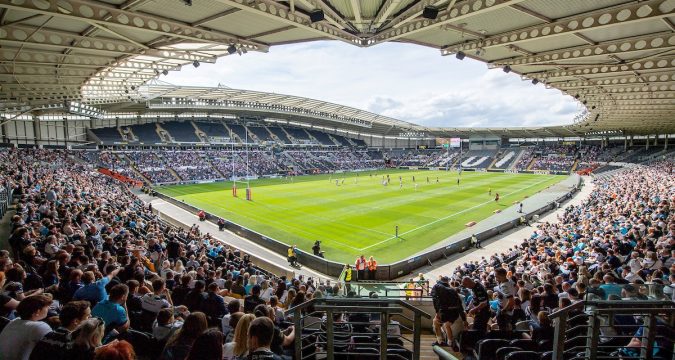
Now gone are The Boulevard, former home of FC, and Boothferry Park, the old headquarters of football’s Hull City, with the two clubs, having occasionally shared each other’s facilities down the years, moving in together at the end of 2002 on the opening of the £44m, 25,500 all-seater KC Stadium (KCOM from April 2016 to June 2021, when building supplies firm MKM gained the naming rights).
That ended more than 100 years of FC playing at The Boulevard, which was just more than a mile to the south of the MKM and from where the club won six league titles between the 1919-20 and 1982-83 seasons, when KR were also one the game’s strongest sides.
FC were formed in 1865 by a group of public schoolboys – perhaps ironic given in that in future years plenty of support was drawn from the many dockers and trawler workers involved in Hull’s once-flourishing fishing industry, the centre of which was not far from the ground.
Originally wearing red and white hoops before the adoption of black shirts, then white, then blue and white, then from 1909, the now-trademark irregular black and white hoops, like so many clubs of that period, FC originally led something of a nomadic existence.
At one stage they played out of Selby, 40 miles from Hull, and later had a spell on the east side of the city, before selling up and switching to The Boulevard in 1895, when they became founder members of the Northern Union.
The multi-purpose sports venue had for the previous three seasons been used by KR, in existence since 1883 and who in the face of FC’s ability and willingness to pay a higher rent, headed east and turned professional in 1897, spending two years in the ‘junior’ ranks before their 1899 move to the Yorkshire Senior Competition initiated the Hull derby.
By then FC had bought The Boulevard, off Airlie Street (hence the Airlie Birds nickname) and started developing it, including the construction of the Threepenny Stand, which became the go-to place for many of the club’s most vociferous followers.
Both end terraces were curved, with the ground also staging, at various times, greyhound racing and speedway as well as, in Hull City’s earliest years after their formation in 1904 and again immediately after the Second World War, football.
The latter spell was due to bomb damage at Anlaby Road, where City had played since 1906 and which was adjacent to The Circle cricket ground, which staged more than 100 Yorkshire matches of various types and was demolished to make way for the current stadium.
Rather than pay to restore Anlaby Road to the necessary standard, City put their resources into a long-held plan to build a bigger ground, Boothferry Park, which opened in 1946.
While it never reached the 80,000 capacity once envisaged, a record attendance of 55,019 was set for an FA Cup quarter-final against Manchester United in February 1949.
The Boulevard was hardly small – a best gate of 28,798 squeezed in for a Challenge Cup last-eight tie against Leeds in March 1936 and the ground was considered well-equipped enough to host eight internationals, including an Ashes Test in 1921 and ties in four different World Cups (the current stadium had an Ashes test in 2003 and was used in both the 2013 and 2022 World Cups).
But the ability of Boothferry Park to accommodate more, especially when tightened guidelines led to ground capacities falling in general, meant it was used for occasional rugby league matches.
The first of those was on Good Friday 1953, when in a neighbourly gesture, City loaned their home free of charge to a the hard-up KR for a derby clash, won by a Johnny Whiteley-inspired FC in front of 27,670.
England and Great Britain backrow Whiteley was later to coach both Hull clubs, while another of the city’s rugby league legends, Wales and Lions winger Clive Sullivan, played for both.
Boothferry Park was also the venue for two all-Hull finals in 1984-85, FC’s Yorkshire Cup triumph and KR’s John Player Special Trophy success, both seen by more than 25,000.
As mentioned, this was a special period for rugby league in one of the game’s most celebrated hotbeds.
After KR beat FC to lift the Challenge Cup at Wembley in 1979-80 (with 95,000 present), Arthur Bunting’s Black and Whites won the Challenge Cup in 1981-82, and the following season’s league title, finishing four points in front of second-placed KR, who were champions in both 1983-84 and 1984-85.
Under Bunting, a former KR scrum-half and coach, FC also won the Second Division title in 1978-79, with a maximum 26 victories – KR were the First Division top dogs – the BBC2 Floodlit Trophy at the expense of KR at The Boulevard in 1979-80 and also by beating KR, this time at Headingley, for sthe John Player Trophy in 1981-82, while the previously-chronicled Yorkshire Cup Final derby triumph at Boothferry Park was the club’s third in succession in that competition (and fifth overall).
When FC won their first two titles, in 1919-20 and 1920-21 and both under Sid Melville, the latter came via a Championship Final victory over KR at Headingley.
And the club were also twice champions under renowned coach Roy Francis – in 1955-56 and 1957-58.
While there have been three Challenge Cup Final wins in the summer era, including the consecutive successes of Lee Radford’s sides of 2016 and 2017, the closest FC have come to another title was in 2006, when Peter Sharp’s charges lost to St Helens in the Super League Grand Final.
First published in Rugby League World magazine, Issue 514 (November 2025)