

WHEN I started planning out the latest issue of Rugby League World I expected this column would be based on the Challenge Cup Finals in some way – be it the action on the pitch, or the chatter off it around the inevitable negativity of the attendance in the stadium.
When it was announced shortly after the final hooter that just 56,383 had made the trip, making it the second lowest crowd in 80 years (not including the two Covid-hit seasons), I imagined myself reiterating the points I made on this page four issues ago.
I said then that more of an event needs to be made of the game to make supporters feel it’s the must-see match of the rugby league year, and therefore attract a big crowd. I also said that simply taking the game away from Wembley to a smaller ground more suited to our attendances wouldn’t fix the problem. For many, Wembley is still a major draw of the Challenge Cup, and if you take that away, you take with it some of the mystique of the game.
I was going to say we need to find a way to make the game fit the venue, and not find a venue that fits the game.
I was also going to mention that there is simply too much expected of rugby league fans nowadays.
When looking at this year’s attendance figure, you also have to take into account that of the two finalists, Hull KR supporters have already forked out for a trip to Vegas this year, while many Wigan fans already had trips booked to Paris the following week. Add to this the costs of making two trips to the south of France for league games, Magic Weekend costs and the Grand Final, and it’s highly unlikely any fan will be able to afford to go to all the major events in one rugby league season.
What I didn’t expect to be writing this column on, is something that, weeks on, still doesn’t feel quite real.
That is, of course, the loss of a true rugby league man in John Kear.
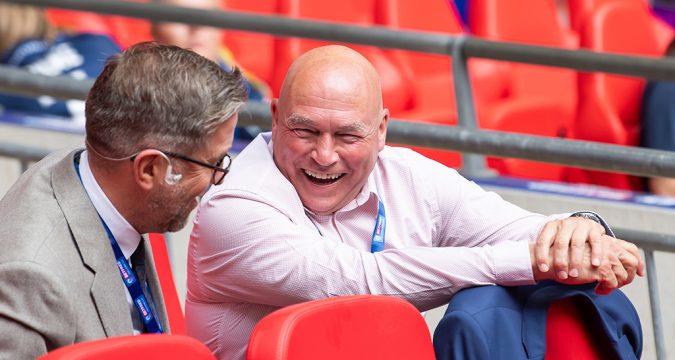
Waking up on that Monday morning and scrolling through social media on my phone I was instantly met with John’s usual happy smiley face, and it instantly brought a similar smile to my face, because that’s just the effect the friendly and affable man tended to have on most people. But then I read the caption that went with the picture and instantly felt numb.
John Kear, easily one of the nicest, most likeable and most successful men in our game, was gone. I couldn’t believe what I was seeing, but there it was in black and white, over and over again.
I hadn’t seen him at Wembley on the Saturday, but I had watched some of the highlights back, and there he was, as informative, charismatic and knowledgable as ever, and now he was gone.
The suddenness of it all was what hit the hardest.
There is not much more I can say about John that has not already been said in the hundreds of tributes that flooded in after his death was announced.
Everyone has said what a gentleman he was, how he had the ability to make players and fans alike think everything and anything was possible. We’ve heard how he was one of the best man managers there was when it came to any player he worked with.
When he talked, be it in the changing room to his squad of players, or on TV or radio as a pundit or commentator, people listened and valued his opinion. They may not have always agreed, but thought enough of him enough to respect his views.
Rugby league was at the heart of everything he did and he was a great advocate for making it the best it could be. He always spoke with passion and was always at the end of the phone if you wanted to speak to him about anything in the game.
His standing within the game was evident as clubs across the game either witnessed impeccably-observed minute silences or emotion-fuelled minute applauses.
I was at Odsal the weekend after his death and paying tribute to him was very emotional as I felt I knew him on two different levels.
Speaking as a Bradford fan, what John did for the club was immeasurable. He came in during our very darkest of days and stabilised the club in a way probably only he could have done. And the results spoke for themselves.
Promotion from League One at the first time of asking in his first year, a sixth-round Challenge Cup victory over Leeds Rhinos in his second and eventually a return to the Championship play-offs. When he left in early 2022, there was no ill-feeling, simply a debt of thanks for steadying the ship and getting the club back on the right path. In fact, much of the work John put in over his time at the club, paved the way for the Bulls’ return to Super League ahead of this season.
But it was through this role within the media I had the pleasure of getting to know John.
I can always remember the first time I had to interview him – he’d just joined Wakefield and I’d been in the job for less than a year. I’m not going to lie, the thought of conducting that interview was quite daunting.
He was such an established and highly thought-of coach, and someone I really admired within the game, and I was a wet-behind-the-ears journalist fairly fresh out of uni. I was still finding my feet and was having to go and ask someone who seemingly knew it all, about rugby league.
But I needn’t have worried, as soon as I introduced myself he treated me like and old friend, made me feel at ease straight away, and by the time that first interview had finished it felt like we’d known each other for years.
In the intervening 20 years I met John many more times, be it through interviews, his trips into the League Express office to record our podcast, or even bumping into him outside Old Trafford on Grand Final day. And it was always the same – I was greeted with that beaming smile of his, a hug, a friendly peck on the cheek, and a general chat about life and the game.
It’s makes me so sad knowing that that is never going to happen again.
First published in Rugby League World magazine, Issue 522 (July 2026)