
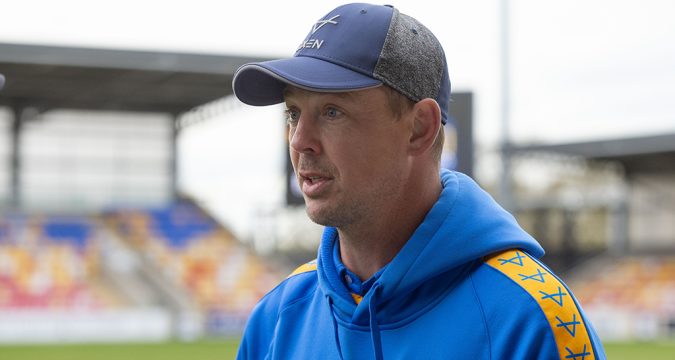
Richard Horne has spent nearly a decade quietly transforming Doncaster into Championship contenders. With ambitious owners and Super League firmly in their sights, he believes the Dons are ready for the next step.
THERE was a time when Richard Horne had barely known life outside the city of Kingston upon Hull – at least in a rugby league sense.
From running around as a junior at Myton Warriors, to making his Hull FC debut as a 16-year-old in the first of 367 appearances as a one-club man between 1999 and 2014, followed by becoming assistant coach to Lee Radford after hanging up his boots, the versatile back was about the closest thing to the definition of a mainstay you could get.
Sure, there were 12 international caps for Great Britain and playing in the 2000 Rugby League World Cup for Scotland – his grandparents being from the Isle of Man made Horne eligible for any of the Home Nations – too, but crack him open and he’d likely have ‘Hull’ running all the way through the middle. In black and white, of course.
Yet in June 2017, he decided to swap Humberside for South Yorkshire when he accepted the chance to succeed Gary Thornton as head coach at Hull FC’s dual-registration partner, Doncaster, in League One.
Nearly a decade later, Horne is still at the helm, with the Dons fighting it out among the Championship play-off contenders and ambitious to join the rarefied air of Super League sooner rather than later.
“They were looking for a coach, and I was their link to the dual-reg, sending the players,” Horne told Rugby League World. “So we just came up with the idea that it would probably work well if I coached them.
“For me, I just thought it was really good for my development as a coach, especially as a young coach, where I get to implement things that I want to implement… so I jumped at the opportunity.
“I never thought it’d be nine years and I’m still here. It’s been great – it’s been crazy and a bit of a roller-coaster, but coaching is.”
Horne’s longevity at Doncaster is unprecedented and he is now the club’s longest-serving head coach, although it has been a story of steady progress rather than overnight success during his time at the helm.
After missing out on the play-off semi-finals during his first season in charge, the Dons then suffered a string of agonising near misses at promotion either side of the Covid-19 pandemic – a semi-final defeat to Workington Town, Newcastle Thunder avenging a loss in the semis in the preliminary final, and back-to-back promotion-final defeats to Workington and Swinton Lions before an 18-6 win over North Wales Crusaders in the 2023 final took them back to the Championship after eight seasons away.
Horne admits he has not got everything right during the past nine years, but is grateful for the support of Dons chairman Gavin Baldwin and CEO Carl Hall, the New Zealander who has played a significant role in the club’s history both on and off the field.
One area they have all worked hard on is steadily improving the squad so it is capable of challenging for promotion and then becoming a competitive side in the Championship, something which has played out so far this season in the merged second-tier competition, where they are firmly on course for a play-off place.
Super League and NRL experience from the likes of Bureta Faraimo, Luke Briscoe and Suaia Matagi, the presence of Papua New Guinea internationals Watson Boas and Edene Gebbie, as well as the leadership of skipper Cory Aston after he made the switch from South Yorkshire rivals Sheffield Eagles ahead of this season, have all helped establish the Dons as a force to be reckoned with.
Even so, the course of being a head coach never runs smoothly, particularly at part-time level, where the players are juggling day jobs and family life with their playing commitments.
That was something Horne had to get used to quickly after previously spending his entire professional career in a full-time environment, particularly when it came to last-minute changes to midweek training sessions.
“You spend a couple of days thinking about what you want to do and planning your session around it, and you turn up and five lads have got caught at work or stuck in traffic in key areas that you wanted to work on,” Horne said.
“You’re literally rolling that up in a ball, sitting down with your assistant, going, ‘Right, let’s change this plan and write a new one,’ and adapt the session accordingly.
“It’s a lot of managing as well because they’ve got jobs, they’ve got families, and you try and get the right balance of still giving them time to spend with their families because you don’t want them just to be engulfed in work and rugby.
“It’s just trying to get that right balance for them so it gets the best out of them.”
Even without those challenges, Doncaster had long been one of the more onerous coaching gigs in the professional game, where glory proved fleeting and financial instability was seemingly always lurking around the corner.
Indeed, arguably the most notable thing about the club at one time was its appearance in the 1980 documentary Another Bloody Sunday, in which a Yorkshire Television crew shone a light on the harsh realities of life at the bottom of the professional rugby league ladder as the Dons attempted to avoid going the season without winning a game.
This, too, is a city which had its own established sporting traditions for decades before the rugby league team arrived in 1951.
Doncaster Rovers FC, who have experienced their own boom-and-bust spells as well, dominate the landscape. So too does horse racing, with Town Moor Racecourse being home to the oldest of English flat racing’s Classics, the St Leger.
Now under the Club Doncaster umbrella following a takeover by Rovers chairman Terry Bramall, however, a quiet rugby league revolution is taking place on the southern outskirts of the sport’s Yorkshire heartland.
That financial stability has allowed the Dons to invest in marketing like never before, with billboards featuring members of the squad – something previously only reserved for those involved in the round-ball code – now visible around the city and players regularly going into schools in the area as part of their community programme.
Crowds have steadily increased too, from 300-400 when Horne first took charge to now numbering anywhere between 800 and 2,000, depending on the opposition. Small in the grand scheme of things, maybe, but significant for a club like the Dons.
Sharing the £20million Club Doncaster Sports Village with Rovers, as well as utilising training facilities which have recently benefited from a £1million investment, means they have facilities which are the envy of many of their Championship rivals, helping when it comes to recruiting players as well.
Bramall is ambitious to get the club into Super League and, as recently as last month, met with the RFL to discuss how Doncaster can improve from the 7.85 which saw them placed 23rd out of 33 on last October’s IMG gradings.
“Our owners are speaking to us and the RFL, and Terry is like, ‘I want Super League – how do I get it?'” Horne said.
“He’s ready to press the button on his side. He’s financially in a really good place, the club has got the facilities… they keep saying about crowds, but it’s like any club… it’s not until you get into Super League where you go, ‘Let’s see what the crowds are going to be now.’
“That’s the attraction to bring in the crowds – the quality of teams. You’ve just got to look at Salford, they’re still getting 2,000 on the back of being in Super League. So you build your fanbase around being in and around the elite teams.
“[The RFL] keep saying, ‘You need to meet this requirement and that requirement’ – we’re ready to go, we just need to go out and buy a team, and our owner is willing to do that.”
Returning to the top flight after a 31-year absence, when they were briefly top of the early 1994-95 standings before being relegated amid a financial collapse, might come later rather than sooner for the Dons, even with Bramall’s determination.
If they do manage to bring South Yorkshire representation back to Super League for the first time since their nearest neighbours, Sheffield, were merged with Huddersfield Giants in 1999, though, Horne hopes he is still there to be part of it.
“That’s the exciting thing – they’re happy just to sit in the Championship and spend a couple of years here and see what’s going on and how it’s happening there,” Horne said.
“They’re trying to push every opportunity to say, ‘Look, we’re ready to go,’ and it’d be really nice to see that through from when I joined, and Carl and Gavin and everybody who’s backed me and supported me and helped me with my coaching development.
“It’s like anything, you never get everything right. But even when I’ve got it wrong, they haven’t come and given me the third degree and put the foot down on me, they’ve just said, ‘Look, you need to get that right,’ and worked with me rather than against me.
“It’s been really good, and I’ve only got really good things to say about the club and how they’ve treated me.”
First published in Rugby League World magazine, Issue 523 (August 2026)