

THERE are some things you just would not, once, have envisaged making up.
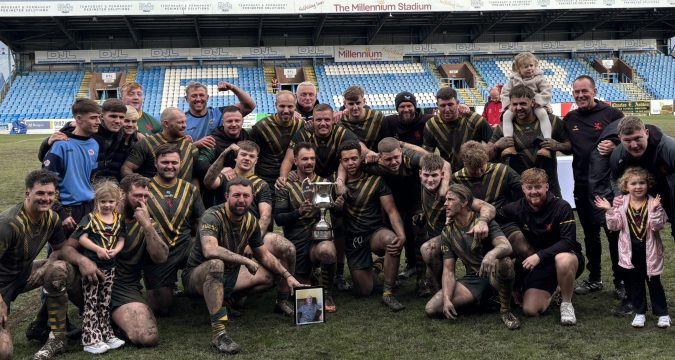
I had no notion, when covering the 2025 National Conference League Grand Final between West Hull and Siddal (Wests won 8-0) that host club Featherstone Rovers would not be playing in 2026.
Or that I was witnessing the curtain-call on 40 decades of important Rugby League history.
But I was, on both counts. No one had any idea at the time (or had any reason to) but incredibly, less than four months down the line, the NCL is no more, having chosen to dissolve itself.
The background and build-up to that decision, which was made last Monday (January 19). has been well-documented in League Express over the last few months.
And I’ve no doubt that the various participants (the NCL management, led by Mike Denning, who became chair at the beginning of the 2025 season, and the RFL, propelled on this matter by Martin Coyd OBE, who is an executive director of the British game’s governing body in addition to being chair of the Community Board) will have different stances on various actions taken during what has been a raucous rollercoaster ride.
It seems to be a fact, though, that after its four-division structure was effectively dismantled and appropriated by the RFL (the top two divisions will operate, from March, as the National Premier League and National Division One, and sides in the bottom two sections will now play in newly-formed regional conferences) the NCL’s management group felt they had no option other than to wind up a competition most, if not all, amateur clubs aspired to being part of.
It’s perhaps telling that Denning indicated to League Express that the NCL’s funds will not go to the RFL, but will be allocated to the charity Rugby League Cares.
That alone might be seen as evidence of the rift between two organisations that seemed, to me anyway as an observer, to be very close, to the point where the NCL ultimately jettisoned BARLA, which initially had been a joint partner.
Things have moved on since those days in a reminder of how turbulent life in Rugby League is, certainly off the field.
We’re now not too far off the stage at which all competitions will be under the control of the RFL.
At that point the proof of the pudding will become clearer for all to see – as someone said, recently, the creation of the new pyramid structure under the National Community Rugby League initiative is a sea change that’s very much of the RFL’s own making.
As Hunslet (the club I’ve supported for, well, a while) stressed only last week in revealing that all proceeds from their Betfred Challenge Cup tie at Stanningley would be retained by the host club after the RFL’s stunning about-turn on the matter: “It’s vitally important that the professional game supports community clubs wherever possible as they are the key pathway for players coming into the sport. Quite simply, we would not have Rugby League without them.”
That’s very true. We’ll find out, shortly, whether the RFL’s drive to replace structures which have been in place for many years with the NCRL initiative will be a success or otherwise.
I fervently hope it will be a success, not only for the sake of the amateur game but because, as Hunslet chief executive Neil Hampshire implied, without a healthy grassroots, the professional game will struggle.
Put simply, we’re now approaching a crossroads. This year will, I reckon, come to be seen as either that of a brave new dawn, or the one in which British Rugby League embarked on a terminal illness. Time will tell.
I was, incidentally, at Stanningley on Saturday, and although scoreboards don’t actually lie, they don’t always tell the whole truth, and this was a classic example.
Hunslet emerged as 44-0 winners but their players certainly knew that they’d been a game. The hosts tackled wholeheartedly, and applied some serious pressure, from beginning to end.
What is definitely the case is that Stanningley did themselves proud, both on and off the field, in a way typical of clubs long-imbued with the wonderful ethos of the National Conference League, an ethos I hope will be continued by the RFL.
Stanningley’s burgers and chips, by the way, are highly recommended and of terrific value. A visit to the Arthur Miller Stadium this year should be a ‘must’ for any sports enthusiast living nearby while there are many other former NCL clubs around the land who offer very similar entertainment and facilities.
Much less happily, I received a pithy email from a bloke who is upset that the RFL are now running what has been, for more than half a century, the BARLA National Cup.
On the face of it, this is the latest in a growing number of instances where people at the grassroots are being presented with a ‘done and dusted’ scenario.
The RFL are, “due to alignment of fixture dates”, giving teams in Lancashire and Yorkshire the option of entering either the National Cup or (according to geographical location) the North West League or Yorkshire League Cups – but not both.
My correspondent said: “What a load of **** – making clubs choose again about a long standing National Cup. When did BARLA pull out?”
He told me later, regarding my request to reveal his identity: “I don’t want repercussions. I just wanted some coverage and support for the game in general.
“The RFL have brutally demolished the NCL, with no remorse, so where does that leave the lower clubs?”
After pondering the financial background to the NCRL saga, which I’ll leave on the back burner for now, he added: “The professional game is in a poor state, the community game is worse. (Whoever) is pulling the strings doesn’t care for clubs (or) the game because they’re killing it.
“And now they’re making us choose between which cups to enter – theirs or the BARLA Cup, which has been going for more than 50 years!”
So that’s yet another missive that has dropped my way from someone who doesn’t want naming because of, he says, potential repercussions for their club. That’s not good, is it?
Meanwhile, the RFL’s Player Dispensation Policy, which was issued to amateur clubs a little over a week ago, is surely to be welcomed, as it will help to enable youngsters with physical or mental impairments to play Rugby League.
Meanwhile I’m certain Rugby League folk far and wide won’t hesitate to get behind young Welsh player Ethan Griffiths.
It was only shortly before Christmas that Ethan, who has played for Bridgend Blue Bulls for three years, made his debut – in the second row – for West Wales against East Wales.
Only a few short weeks later, the 14-year-old has been diagnosed with cancer.
Ethan is meeting the diagnosis head-on, which is no surprise to everyone who knows him.
A Just Giving page has been launched, and his parents stated: “As many of you know, Ethan is a talented, charismatic, and deeply-loved friend to so many.
“Recently, our world was turned upside down when Ethan received the devastating news that he has cancer.
“It has been a whirlwind of events for the family over the last few weeks. Ethan has already started his long road of treatment, showing the strength and spirit we all know him for.
“We want to support the Griffiths family as much as possible during this incredibly difficult time. Our goal is to ease the financial pressure of medical-related costs, travel, and time away from work, so they can concentrate 100 percent on what matters most, getting Ethan better.
“Any contribution, no matter how small, will make a massive difference. If you aren’t able to donate, please consider sharing this page to help us spread the word.
“Thank you for your love, prayers, and support for Ethan.”
Click here for the Just Giving page.