

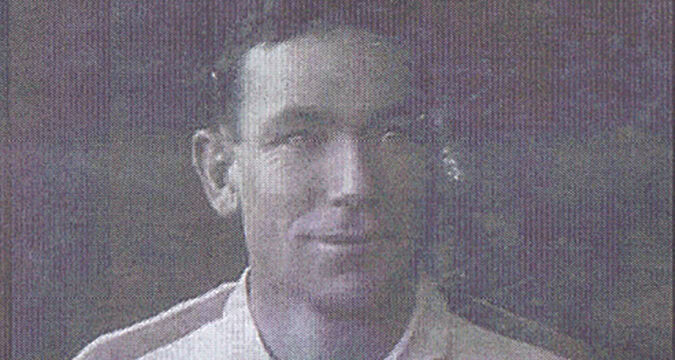
A century after Wigan’s 1925-26 Championship triumph, we look back at the remarkable career of South African powerhouse George ‘Tank’ van Rooyen, whose extraordinary feats of strength made him one of rugby league’s most colourful characters.
CARRYING a bag of cement under each arm, clearing the Central Park pitch of snow with only a wooden plank and heaving a stranded horse out of a manhole.
Those were just three of the feats attributed to strongman second-row Gert Wilhelm ‘George’ van Rooyen, better known to those Wigan supporters who stood on the terracing from which he reputedly extracted a damaged crush barrier using only a shoulder as ‘Tank’ and described by a team-mate as “more than human”.
Back in the 1920s, Wigan were fond of signing not just players from Wales, but also another bastion of rugby union – South Africa.
The team who won the league title a hundred years ago in 1925-26, beating Warrington 22-10 at the Knowsley Road home of St Helens, included a trio in flying winger Adriaan Jacobus ‘Attie’ van Heerden, scrum-half David Booysen and cult hero van Rooyen.
And to borrow a phrase from Ewan Phillips’ entertaining 2010 book The Wigan Warriors Miscellany, if ‘AJ’ van Heerden was the rapier and Booysen the conductor, Tank, who stretched the tape to 6ft 2in and weighed 17st, was the bludgeon.
While Booysen was brought over from rugby union team Paarl in the Western Cape province in October 1924, van Rooyen and van Heerden had arrived at Central Park eleven months earlier, both as South Africa internationals who had toured Australasia in 1921.
AJ, a dashing, motorbike-riding poster boy of a player who had competed in the 400m hurdles at the 1920 Olympics in Antwerp, Belgium, switched from Johannesburg-based Transvaal.
Tank had also been at Transvaal, but had spent the previous 14 months with Hull KR, whom he helped reach, but didn’t feature in, the 1922-23 Championship Final, in which Huddersfield were seen off 15-5 at Headingley, Leeds.
Both played key roles in a big 1923-24 campaign for Wigan, who won the Challenge Cup and the Lancashire League section of a one-division table which they topped, but lost to runners-up and Yorkshire League kings Batley in the Championship Final.
The Challenge Cup Final against Oldham attracted a then-showpiece record crowd of 41,831 to the Athletic Grounds at Rochdale, where mounted police had to be deployed in a bid to prevent spectators spilling onto the pitch.
And it was reported that in scoring his side’s second try in a 24-4 triumph, AJ not only outran the Oldham defenders, but also rounded a horse before touching down.
Wigan might also have had Welsh stars such as full-back Jim Sullivan and winger Johnny Ring in their ranks, but three weeks later in the Championship Final at The Cliff, the base of Salford club Broughton Rangers, they went down 13-7 to Batley before a more modest 13,729.
It was a different story two years later, when Wigan again finished in pole position and were Lancashire League champions and ended up playing the runners-up, this time Warrington, in the title decider.
Coached, or perhaps more accurately trained, by Tommy McCarty, a renowned wrestler who had fought in the First World War and was seven years into the 20 for which he held the Central Park reins, the Cherry and Whites lined up: Sullivan (the captain), Ring, Tommy Howley, Tommy Parker, van Heerden, George Owens, Booysen, Wilf Hodder, Jack Bennett, Tom Beetham, van Rooyen, Frank Stephens and Jack Price.
The Championship Final took place during the General Strike, one of the effects of which was disruption of public transport.
Even so, 20,000 turned out at Knowsley Road, where Warrington took an early lead through a Ned Catterall penalty-goal.
Tries (then worth three points) from Howley, Ring and van Heerden, the last of those converted by Sullivan, meant Wigan were 11-2 up at the break, and that became 14-2 when Howley, another Welshman, claimed his second try on 52 minutes.
Warrington responded with an Alf Peacock try goaled by Catterall, so Wigan still had a job to do, and came under intense pressure.
However, Parker intercepted a pass and freed Howley, who sent Ring in for Sullivan to convert, and a hat-trick try by Ring, the former Aberavon ace who, like ex-Pontypool prop Hodder, was a dual-code Wales international, meant Fred Ryder’s late score for Warrington was of consolation value only.
Wigan had won their third title, after those of 1908-09 and 1921-22, and van Rooyen had cemented his place in the history books of a club for whom he played 178 times (and once for the Other Nationalities team, in their 23-17 win over England at Headingley in 1924) before joining Widnes in the close-season of 1929.
Tank was 36, but played until 1933, turning out 74 times for the Chemics (he had represented Hull KR in 35 matches) and featuring in the 10-3 Wembley win over St Helens in 1929-30 which brought the Challenge Cup to Naughton Park for the first time.
According to local legend, he also swam across the River Mersey between Widnes and Runcorn, the town in which he died at the age of 49 in 1942.
Sullivan called his team-mate “the most fabulous character I have known in rugby league”, adding: “He was a great giant of a man, solid granite and the strongest I’ve ever seen apart from the old music-hall acts. There were times when I thought he was more than human.”
First published in Rugby League World magazine, Issue 525 (October 2026)