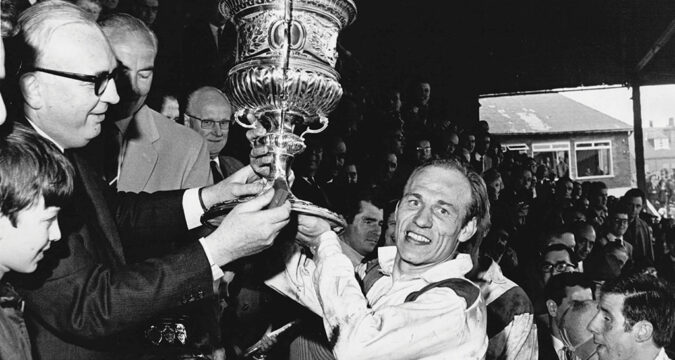
The last time Wakefield Trinity ruled rugby league, humanity was making its first journey around the Moon. Michael O’Hare looks back at the club’s golden generation of 1968.
IN 1968, humans circumnavigated the Moon for the first time.
When the crew of Apollo 8 drifted beyond the lunar horizon and lost radio contact with Mission Control, they became the first people ever who were unable to see the planet on which they had been born. For 42 minutes they were out of contact with the rest of the world, but their reward was to be able to see what is somewhat incorrectly known as the dark side of the Moon. It was a major world event, but in Wakefield they barely noticed. They had bigger fish to fry. Because in 1968 Wakefield Trinity became rugby league champions.
Earlier this year, humans circumnavigated the Moon again, the first time since the Apollo missions. The crew of Artemis II were the first to see the dark side of the Moon for almost five decades. And guess what? Wakefield Trinity became rugby league champions again, for the first time since Apollo 8.
The crew of Apollo 8, Frank Bormann, Jim Lovell and William Anders, had their very literal day in the sun that year. But in Wakefield they had their own high-flying heroes. Winger Gert Coetzer had signed from South African rugby union five years before and went on to score 122 tries for Trinity. Stand-off Harold Poynton was locally born and played 319 times for his hometown team. And there was the incomparable Neil Fox at centre. He went on to become the highest points-scorer in the sport’s history and the 10th member of the Rugby League Hall of Fame. All would play their part in the 17-10 Championship Final win over Hull Kingston Rovers at Headingley on 4th May, 1968.
Trinity had been one of rugby league’s most successful clubs throughout the 1960s, and although their tenure at the top was coming to an end with their Headingley swansong, they could look back on their trophy haul from previous years with some satisfaction. Under the guidance of coach Ken Traill, a former Great Britain international, and a succession of inspiring captains including Fox, Poynton and World Cup winner Derek ‘Rocky’ Turner, Trinity began the decade with three Challenge Cup wins, the first in 1960 by a then record score of 38-5 over Hull FC. Victories over Huddersfield in 1962 and Wigan the following year, despite being underdogs, saw Trinity installed as one of the sport’s leading lights. So famous was the club in that era that it was chosen as the setting for the rugby league-oriented, Oscar-nominated film This Sporting Life starring Richard Harris.
However, notwithstanding Yorkshire Cup and Yorkshire League titles throughout the sixties, the Championship eluded them until 1967 when, after a 7-7 draw at Headingley, Trinity triumphed in the replay at Station Road, beating St Helens 21-9.
However, their era of success was drawing to a close. One final victory awaited. The following year Wakefield breezed through the top-16 play-off which had replaced the traditional top-four play-off back in the 1964-65 season. Having finished second in the final table, seven points behind Leeds, Trinity saw off Huddersfield, Castleford and Wigan on their run to the final. Because Wigan had been surprise victors over Leeds in the quarter-finals, Trinity were set to face Hull KR in the final, Rovers having finished just behind Wakefield in the table on points difference. The match was finely balanced.
Up against a team containing the likes of mercurial half-back Roger Millward, fearsome enforcer Frank Foster and livewire hooker Peter “Flash” Flanagan, all Great Britain internationals, Trinity came out with guns blazing and dominated the first quarter. However, fierce tackling by Rovers meant Wakefield could not translate their dominance into points until 20 minutes in, when scrum-half Ray Owen took a pass from Bob Haigh and touched down. Neil Fox converted, but minutes later Rovers were level. Millward landed a penalty and Paul Longstaff followed immediately with an unconverted try, and the teams went in at half-time all square at 5-5.
Foster began to dominate the game, constantly creating openings with his powerful runs and slipped passes. Things were looking ominous for Trinity. But finally, Rovers’ tenacious defence broke with David Jeanes flinging himself over from short range for a converted try. Rovers now realised they had to be expansive. Millward’s drop-goal closed the gap, but their adventurous play opened up the opportunity for a counterattack which Coetzer, with an opportunistic intercept, exploited. He fed Neil Fox who, with that score and a Poynton drop goal, secured victory despite John Moore’s last-minute consolation try for Hull KR. Trinity full-back Gary Cooper won the Man of the Match Harry Sunderland Trophy for his solid defence and attacking support play.
It was Wakefield’s last hurrah of a dominant era, although it will always be overshadowed by what happened at Wembley the following week. Against Leeds in what became dubbed the ‘Watersplash Final’ because of the sodden pitch, Neil’s brother Don’s agonising, last-minute missed kick denied Trinity the trophy, made him one of rugby league’s most unfortunate figures in perpetuity, and relegated their fine display of the previous weekend to something of a footnote in the history of the 1967-68 season. That does the fine Trinity team of the 1960s a grave injustice.
Nonetheless, in the city, that team of ’68 is still revered. When Wakefield’s Belle Vue stadium was recently being renovated, the club named their new main stand after Neil Fox. Meanwhile, mention the name ‘Oupa’ to fans of a certain vintage and they’ll know you are talking about Gert Coetzer. Oupa means old man in Afrikaans, a reference to Coetzer’s mature appearance. And, perhaps most significant of all, in 2007 Harold Poynton had a beer from Fernandes brewery named after him. What higher praise could there be?
And the good news for Wakefield 58 years later? Humans will be returning to the Moon very soon. Probably as early as next year. The odds on a Wakefield triumph will be shorter this time, but, if you believe in omens, it might be worth stumping up. Reach for the stars and all that…
First published in Rugby League World magazine, Issue 526 (November 2026)