
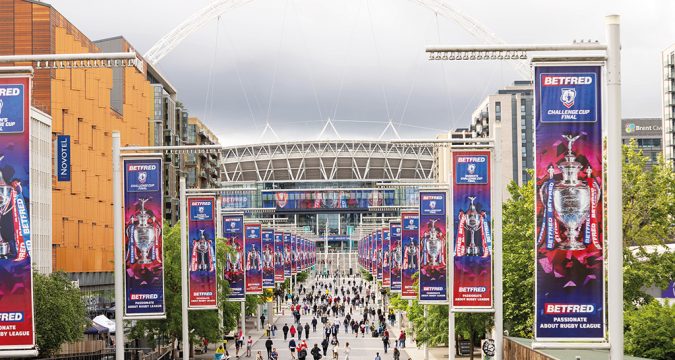
MIKE WELLS puts forward a radical proposal for reorganising and reviving the magic of the Challenge Cup.
THE roar of the crowd, the iconic atmosphere, the prestige of the Challenge Cup Final at Wembley – for many, it’s the pinnacle of Rugby League.
Yet the journey there increasingly feels more like a whisper than a crescendo, plagued by dwindling crowds and a sense of déjà vu.
Evidence of low crowds compared to like-for-like Super League fixtures is abundant; these matches are often treated as mere footnotes.
Limping along
“The Cup is dying” is a phrase thrown around, and who can blame them? From the outside, it appears a downgrade from the weekly hustle of the regular season. Familiarity breeds contempt, particularly when Cup ties mirror regular league fixtures, leaving the run-up to the Final to limp on as a whimper, rather than building into a momentous march.
So how about we make it “unfamiliar”.
Eight years ago, I wrote in to the League Express with radical suggestion to upgrade the Challenge Cup. Eight years on, part one of my suggestion played out this season, and part two is partially being discussed as a possibility.
My suggestion? That no Challenge Cup fixture should be the same as a Super League fixture.
This eliminates direct comparisons and immediate criticism, whilst providing a unique and attractive alternative. The Cup’s structure remains true to the original, but its appeal changes.
Part one of my original suggestion played out this season: Super League clubs were seeded separately and played away from home against other qualifiers in an earlier round. This created a buzz around new fixture variety, less familiar venues, and incomparable match-ups that avoided accusations of less appeal from the off. The Challenge Cup this year had a tremendous start.
Then, the same old, same old after. Aside from a fluke draw of a first Hull cup derby in nearly 40 years, the rest of the fixtures produced poor attendances, especially in comparison to their regular Super League equivalents.
Other than the derby, no fixture broke the 12k mark until the Final. And historically, this is consistently the case. Attendances at very few fixtures reach the five-figure mark.
Not good enough
The data paints a stark picture. For context, previous Challenge Cup Round of 16 fixtures often struggled to hit 30,000-35,000 in total attendance, with 2022 and 2018 not even breaking 30,000.
This translated to a dismal average of roughly 4,000 per game for eight fixtures featuring Super League teams, which is simply not good enough.
Although the equivalent round in 2025 saw a much-improved aggregate attendance of approximately 45,000, this was an anomaly amidst a sea of otherwise mediocre efforts, and not a particularly impressive one at that.
The quarter-finals in 2025 were obviously unique, with a rare Hull cup derby. Around 40k over four fixtures sounds healthy, but taking the derby out leaves you with less than 7k average for the remainder.
Historically the quarter finals total around 25k over four games. But 2019 didn’t even break 20k aggregate, and the highest attendance for that round featured two Championship teams playing each other.
These are concerning figures for these two rounds, suggesting a competition that, outside of a rare derby, often fails to ignite public interest. Yet, an unprecedented opportunity to inject much-needed vitality into the Challenge Cup is emerging.
Magic opportunity
As Super League seeks to streamline its own schedule, the much-loved Magic Weekend is on the cusp of being removed from its traditional slot. This presents not an ending, but a new beginning – a chance to repurpose a hugely successful concept and inject genuine “Magic” into the heart of the Cup.
Moving Magic to the Challenge Cup would kill two birds with one stone. It would allow Super League to have a completely fair 26 game round-robin league AND it would help bring a much-needed boost of interest to the Challenge Cup. 55-68,000 Super League fans attend the Magic Weekend every year for its carnival-like atmosphere, to mix with fans of other clubs and to watch games they wouldn’t usually attend. It’s a great weekend enjoyed by all who attend and crowd numbers grow every year. 55-68,000 fans for a Magic Weekend is around double the usual Round of 16 fixtures generate, meaning an increase to the Cup aggregate attendance if this concept is used.
While Magic Weekend has mostly hosted six games (three per day in a 12-team league), it did host seven league fixtures for six years during the expanded 14-team competition, with one day featuring four. It wouldn’t be a stretch to expand both days to host four games each, achieving the eight-game weekend necessary for the Round of 16.
The main criticism behind moving Magic Weekend to the Cup is the preparation time needed to sell tickets. The fixtures are usually known well in advance, meaning fans can prepare for a trip.
On top of that, there’s no guarantee all Super League teams will make it. However, given enough run-up time between the previous round and the Round of 16, there would be plenty of time to prepare. If the early round was hosted in early February, as it was this year, and Magic Weekend moving back to its more traditional May Bank Holiday slot; that leaves fans with plenty of time to prepare for the trip.
With the earlier round now also being seeded, all Super League clubs are in with a very strong chance of qualifying still, not to mention the added intrigue amongst fans of Championship clubs lucky enough to make a rare appearance on a grander stage as the 15th and 16th clubs involved (and possibly more should an upset occur).
Logistical advantages
There’s no real reason why a Challenge Cup Magic Weekend, with arguably more at stake, wouldn’t attract the usual 55-68,000 attendees that the Super League version does – an attendance figure that dwarves the usual aggregate for that round, potentially even surpassing it in a single day.
Beyond the attractive prospect of larger crowds, consider its media coverage and sponsorship potential. Currently, only two games are usually shown live at this stage. A Magic Weekend, with its established set-up at one ground, offers the potential to broadcast all eight fixtures with minimal logistical effort.
In the era of streaming, where content is king, hosting all games in one venue provides an easy and convenient avenue to drive online traffic. This presents a truly compelling package for potential broadcasters, with rights due for sale soon.
I’m so certain that the concept would work that I’d even extend it to the quarter finals. Imagine four teams, one day, one venue, with blanket coverage in an attractive city. An attendance above 25k beats the vast majority of previous quarter-final aggregate attendances over the last few decades with the prospect of attracting a new audience in a new area.
This isn’t just about boosting numbers; it’s about genuine expansion. By taking these major Cup rounds to major cities with limited current Rugby League presence, we can introduce the excitement of top-tier Rugby League to entirely new demographics. This would be a powerful vehicle to spread the game, cultivating fresh fanbases and ultimately strengthening the sport’s national footprint.
Think about it – this makes the Challenge Cup a truly unique spectacle, distinct from the Super League. No repeat fixtures in the same venue. All Super League teams would play at neutral grounds, different from their regular-season visits.
Every game from the Round of 16 onwards would be neutral, ensuring an even fairer competition (further complementing the elimination of loop fixtures from the Super League).
All games could be broadcast, enabling video-referee inclusion. This means increased exposure and sponsorship potential.
New fans and new life
The draw for the next round could even be held live with all fans present, providing an additional incentive to remain. Fans could plan better, knowing exactly when and where fixtures would be. The Challenge Cup would become a dynamic roadshow, marketing to neutral audiences in target expansion areas.
If you returned to the double-header semi-finals you could even market all four venues from the off. Challenge Cup 2026: Cardiff, Newcastle, Sheffield, Wembley. Just an example, but a powerful marketing message that shows the competition is held in prestigious venues in major cities across the country.
Why wouldn’t local tourist boards in Edinburgh, Manchester, Liverpool or even Coventry or Birmingham see potential in investing and a significant boost to their local economy?
Qualifier in February. Round of 16 in May. Quarter finals in June. Semi-finals in July. Final back to an August bank holiday. Plenty of time to organise. Plenty of time to build. Plenty of time to enjoy a truly unique event each round rather than the current mundane afterthought it currently is.
The Challenge Cup deserves to reclaim its magic.
By embracing innovation and leveraging the proven success of the Magic Weekend concept, Rugby League has an unprecedented opportunity to transform a dwindling competition into a truly unmissable spectacle, drawing new fans and breathing fresh life into one of our sport’s most cherished traditions.