Our journey around the villages, towns, cities and regions that have rugby league running through their veins heads across the Irish Sea.
GEORGE BEST, Alex Higgins, Carl Frampton, Mary Peters …
Belfast has a proud sporting heritage, and whether football, snooker, boxing or athletics, has produced some genuine superstars.
The city is the base for the Irish Football Association, which was founded in 1880, with the Irish League, of which seven of the eight founder members were Belfast-based, established ten years later.
By then, organised cricket was taking place, and the Stormont ground, in the shadow of the spectacular Northern Ireland Assembly building, is one of the venues used by the Ireland national team.
From Corrigan Park, Antrim compete in Gaelic games (football and hurling), while the city is also home to Ulster, who playing at Ravenhill and with fellow Irish provinces Connacht (based in Galway), Leinster (Dublin) and Munster (Cork and Limerick), compete alongside rugby union teams from Italy, Scotland, South Africa and Wales in the United Championship.
The former North of Ireland rugby club (now part of the Belfast Harlequins multi-sports set-up, more of which later) were founded in 1868.
And other city sides Queen’s University, who started out the year after, Malone, formed in 1892, Cooke (1910), Instonians (1919) and Grosvenor (1953) still exist.
But enough of the rival code – what about rugby league?
While senior 13-a-side matches in Belfast have been few and far between, a trio have been hosted.
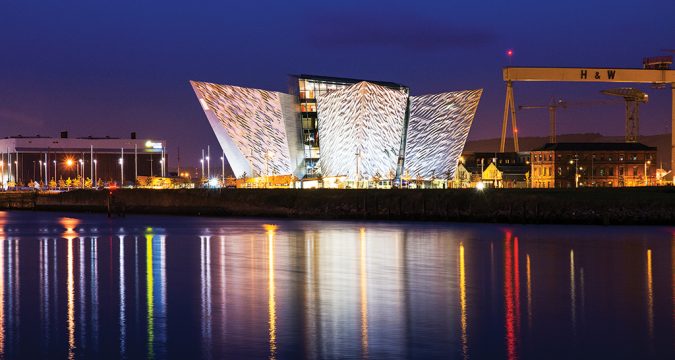
And having taken in Scotland and Wales, it seems only right that this column calls at Northern Ireland’s capital and principal port, once renowned for both shipbuilding (including the ill-fated Titanic, at the time of her launch in 1911, the largest ship afloat) and the production of linen, and scarred by The Troubles, which impacted on virtually every area of life in the province, including sport.
As with Scotland and Wales, Ireland, which was partitioned in 1921 with the six north-eastern counties becoming Northern Ireland and remaining in the United Kingdom, has been a potential target area for rugby league expansion almost as long as the code has existed.
On Saturday, 12th May, 1934, Wigan beat Warrington 32-19 in an exhibition match at the Shelbourne Park greyhound stadium in Dublin, the capital city of what was then the Irish Free State (now the Republic of Ireland).
Twenty years later, Warrington were invited by interested parties to return to Dublin, and this time were accompanied by Halifax, the pair having recently faced each other in both the famous 1954 Challenge Cup final replay at Bradford, where an official attendance of 102,569 packed into Odsal to see Wire win 8-4 (after a 4-4 draw at Wembley), and that season’s Championship Final at Maine Road, the former home of Manchester City Football Club, won 8-7 by the men from Wilderspool.
The Dublin game was to take place on Friday, 28th May, 1954 at Dalymount Park, still the home of well-known League of Ireland football club Bohemians and used by the Republic of Ireland national team until 1990.
And it was decided that the previous evening, the English sides should break new ground and spread the rugby league word by playing a match in Northern Ireland, with Belfast’s Windsor Park the stage.
Now known as the Clearer Twist National Stadium, and redeveloped between 2014 and 2016, the 18,500 all-seater venue, once capable of holding 60,000, is the base of the Irish Football Association, the Northern Ireland national team and Linfield, the province’s most successful football club in terms of trophies won.
Formed in 1886 as the works team of the Ulster Spinning Company’s Linfield Mill, one of so many in the city producing linen, The Blues were founder members and the first winners of the Irish League in 1890-91 and last season claimed their 57th title. They have played at Windsor Park since it was opened in 1905.
Linfield were also the reigning champions (their 21st such success) when Warrington and Halifax played at Windsor Park on Thursday, May 27, 1954, 22 days after the Challenge Cup final replay and 19 after the Championship Final.
The Thrum Hallers did the double, winning 34-15 in Belfast before a 23-11 victory in Dublin.
Later in 1954, it was reported that Australian rugby league chiefs had agreed a recommendation that future Kangaroos touring teams should include Ireland on their itinerary, but the proposal was not followed up.
A little bit of Belfast did come to Warrington, however, when in 1955, the club signed Ireland rugby union secondrow Robin Thompson, who was fresh from captaining the Lions in South Africa having previously played for the aforementioned Queen’s University and Instonians.
International rugby league finally made it to Belfast in 2000, when Windsor Park, which had been upgraded over the previous two decades with two new stands constructed, was among the venues used for that year’s World Cup.
Ireland defeated Samoa 30-16 in front of 3,207 on their way to topping Group D to reach the quarter-finals, where they lost 26-16 to England.
And during the 2012 European Cup, Ireland were defeated 56-4 by eventual tournament winners England Knights at Deramore Park, the home of Belfast Harlequins, who as well as rugby union, have hockey and squash teams.
First published in Rugby League World magazine, Issue 513 (October 2025)