
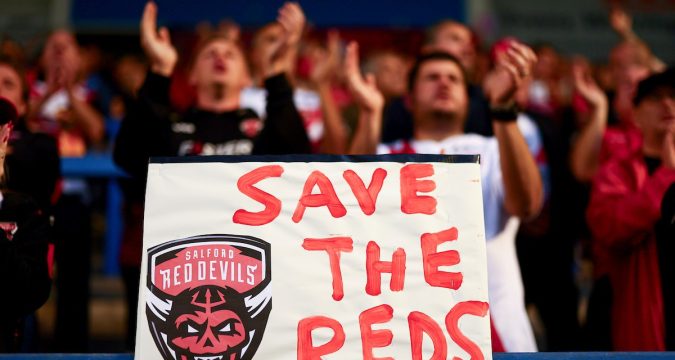
SALFORD, in their old form at least, are no more.
Formed as Cavendish Football Club in 1873, known as Salford since 1879, christened (and much later made official) in the 1930s as the Red Devils.
The winners of six league championships, including three in that pre-World War Two heyday under coach Lance Todd and legendary back Gus Risman when they also won the Challenge Cup.
Amid the glory, there have been many dark days too – more than their fair share.
Indeed, they were wound up previously, just months after their first league title in 1914.
While attempts to form a phoenix club and continue this lineage have begun following their liquidation on Wednesday, the story of how such a great club ended up in such a great mess should not – must not – be forgotten.
Living beyond their means
For a long time the club had – certainly by its own standards – stability under the leadership of Dr John Wilkinson, the longest-running chairman in rugby league history having been at the helm from 1982 to 2013.
He helped establish Salford as a Super League side, albeit with some yo-yoing and mostly confined to its bottom end.
But with the club making a regular loss and debts growing, Wilkinson handed over to a richer doctor – Marwan Koukash.
The West Bank-born businessman gave Salford a greater profile with his eccentric personality, but he grew frustrated by his stalling efforts to drive the club forward and handed control to a community trust in 2017.
Koukash said on his departure that he wanted the club to become self-sufficient – but this was a forlorn hope.
Few Super League clubs are, certainly not with attendances around the 3,000 mark. Without a ‘sugar daddy’, Salford were up against it.
They enjoyed good times on the field under coaches Ian Watson and Paul Rowley – the former leading them to the Grand Final of 2019 and Challenge Cup final of 2020, the latter getting them into the play-offs twice in three years.
But to be competitive at the top end requires spending, and Salford were living beyond their means in search of sporting dreams.
Holding out for a hero
That became clear in April 2023 when the Red Devils launched a community share scheme, encouraging supporters to invest.
Managing director Paul King said at the time that it would enable the club “to maintain a competitive playing squad and gives us a real chance to win the biggest prizes in the game”.
Instead, the £360,000 raised barely papered over the cracks. Salford lost £350,000 in 2021, £580,000 in 2022 and just shy of £400,000 in 2023 – a better performance than many rivals, in fact, but in their situation a great concern.
In 2024, the severity of the situation became apparent. The club made a loss of nearly £1.4m, and the request of a significant advance of central funding from the RFL set alarm bells ringing.
Nonetheless, Salford prepared for last season largely as normal, even when special measures including a sustainability cap were imposed and the club were told to sell players.
They were pinning all their hopes on a takeover that would save the club – and while they did indeed find new owners, things would only get worse.
A slow death
A deal was secured with a consortium at the beginning of February, days before the start of the season. Within two weeks, the takeover had been approved (many would say rushed through without the required due diligence) by the RFL, after a team mostly made up of reserve players suffered a Super League-record 82-0 defeat to St Helens in round one.
RFL chief executive Tony Sutton later said: “There is no doubt that the process highlighted issues in the RFL processes for approving such club-based transactions. However, it is worth noting that the only alternative to approving this takeover was the very probable and immediate demise of the club.”
Initially the only publicly named figure was Dario Berta, a Swiss businessman. Once sealed, the involvement of Kurt Graver, as director, plus Saia Kailahi and Curtiz Brown from Jacobsen Management Group, was also revealed.
The latter pair would go on to have the most hands-on involvement, and take the brunt of supporter fury for the events that unfolded over the following ten months.
It didn’t take long for things to fall apart, with player and staff wages for February were paid almost a week late. Regulations were blamed for significant funding not arriving from overseas, the start of a regular theme of excuse-making which simply did not wash.
Not only were existing debts not cleared as promised, but with the club unable to cover operating costs, they were plunging further into the financial mire with every month.
Marc Sneyd was the first star player to depart in March. A trickle of exits in the following months became a flood by August, at which stage only a handful of first-teamers were left.
One match against Wakefield Trinity had to be cancelled, and they only fulfilled the rest of the season thanks to a haul of loan players. Inevitably, they finished bottom, with just three wins all year.
Scrutiny had long since turned on the ownership’s real intentions. The priority, it appeared, had been the Salford Community Stadium, key to securing the club’s future but which the council were unwilling to sell to them.
So on Salford limped, haemorrhaging money, staff and – for the supporters – hope. It was a slow death, with only one conceivable outcome.
A winding-up petition was first brought by HMRC in May (the same month Chris Irwin left as chief executive and King returned to the club) over unpaid tax. They received no fewer than four adjournments, as future funds were repeatedly promised by the owners and repeatedly went undelivered.
Finally, on December 3, the game was up.