

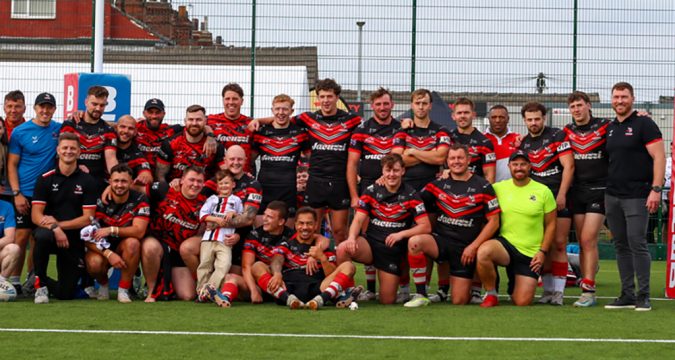
Goole Vikings have quickly established themselves as a competitive outfit in League One from a standing start, and are now looking ahead to bigger things next year.
STARTING a new business is a challenge, but to do it in rugby league in the current climate could be seen as madness.
But Goole Vikings have come to the end of their first professional season with ten wins under their belt, and are now excited about the challenge presented to them by the merger of the Championship and League One, which will help them put the town on the map even more.
James Clark, the former Hull FC chief executive, has been there from the start. “It’s been the ultimate challenge to start from nothing, which is what excited me about the project in the first place – and we’ve loved every minute of it so far. A few sleepless nights, admittedly! Starting a new business in any walk of life is a challenge, I think the stat is something like 80 percent fail inside the first year – most people told us to try and do that in rugby league is just madness. But that is when it is most rewarding in seeing those decisions turn into a functioning professional sports club in under a year.”
Goole have had to manage on just £14,000 of central funding in year one, and say they ran at the second lowest budget in the professional game.
Not only that, but having only got the nod in September, they had to build a team to compete when the majority of clubs had already completed their recruitment. Scott Taylor was appointed as coach and they got to work.
“We’re really pleased with what we achieved. Bear in mind this time last year we didn’t exist, we had no coaches and no players contracted. Scott and myself worked round the clock really to build a squad that we felt could compete – but we had days and weeks, not months. To pull together a squad that delivered ten wins – something that only Toronto achieved in modern times as a new professional club, and they did it with millions behind them – speaks volumes of what the team achieved.
“We had a really clear focus on what we wanted. I’ve always believed in giving young players a chance, but we knew we had to mix it with some proven experience and leadership at this level to look after the and help set the standards. We wanted to show that it’s not always about money – and that if we can place the right values on our people, give them the support and encouragement to learn and develop and create a really strong culture across the club, then we can be competitive.
“We wanted to bring people into the club who had a point to prove and were fully invested in being part of an exciting project to build a club from scratch. It was about the right people with the right attitude, and you saw that on the field.
“I hope that has laid the foundations for the future, but it certainly hasn’t been easy. There are no shortcuts and next year will be even harder, make no mistake about that.”
Goole also beat eventual League One champions North Wales Crusaders in the 1895 Cup and then went on to win eight league games to finish 7th. They had to contend with a long period away from home, playing ten games on the road before finishing with five games in six at their Victoria Pleasure Grounds home, with a £7m development project still ongoing.
Former Hull FC and Hull KR prop Taylor, who played four times for England, is in his first coaching role at the age of 34 and has become a key asset.
Clark added: “I have obviously known Scott a long time and he was our first option to come in as coach, as I genuinely believe he has all the attributes to have a great career in the role. He’s backed himself to jump in the deep end and he’ll admit he has learned a lot about himself and others this season, but it’s a great apprenticeship. A couple more years at this level and he’ll move on to bigger and better things I’m sure of that. This level gives him a chance to learn, grow and probably make a few mistakes along the way without that added pressure.
“I love that he is fully invested, he doesn’t know any other way. He is loyal and we support each other through the good times and the tough times, and he really believes in what we’re trying to do. I think having the calibre of people involved that we have, including Scott, has given the club credibility – and players want to be part of that.”
The Vikings got off to a dream start in their very first game as a professional outfit, defeating London Broncos 17-10 in the Challenge Cup. Founded in 2018 as a community club, Goole does have history in the pro game, joining the Northern Union in 1898 before disbanding in 1902 after failing to gain election to the new Second Division.
Some eyebrows were raised when Goole got the nod over potential expansion hotspots in Anglian Vipers and Bedford Tigers, but Clark says they present an opportunity to bridge gaps between existing rugby league clubs.
“This is a town that’s never had professional sport before, and we are central to a rugby league stronghold. We’re strategically well placed between Hull, Leeds, Castleford, York and Doncaster, yet with the chance to forge our own identity. Over 300,000 people live within 20km of our ground, with no other club to turn to. Compare that to somewhere like Salford or Huddersfield, for example, you’re looking at eight or nine clubs on their doorstep across various sports.
“One aspect of our strategy was to set out to become everyone’s second favourite team – we’ve had Wigan fans, Leigh fans, Bradford fans, we’ve had football fans from various clubs. There are plenty of fans in the region who love rugby league and are curious about what’s happening in Goole. If we can be their ‘second club’ while still building our own unique following from our local community, then that’s a win for everyone and great for the game.
“The town is on the up, there is exciting investment beginning to flow through which has helped fund the ground development, and some big businesses setting up base here. There is a strong appetite for sport, we’ve just got to awaken people to the opportunity.”
First published in Rugby League World magazine, Issue 513 (October 2025)