

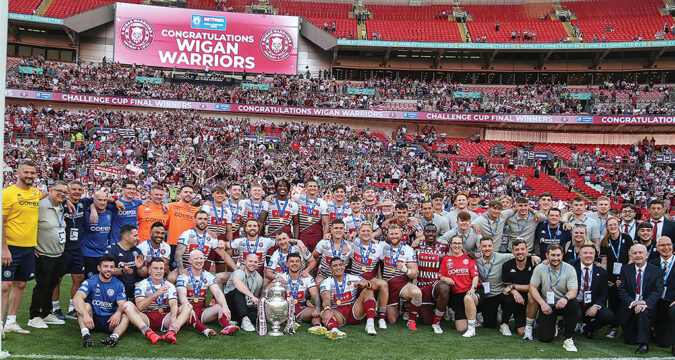
As Wigan celebrate under the arch again, is Wembley essential to the Challenge Cup’s relevance or is it time to leave?
IN THREE years’ time, rugby league will mark a century since the Challenge Cup Final was first played at Wembley Stadium.
Whether it will still be there or not by that point, however, is very much a matter of debate.
Things were, of course, somewhat different back in 1929. Rugby league was still a winter enterprise, there was no women’s final, and no one had even considered the six-tackle rule.
Wigan were still victorious though, beating Dewsbury 13-2. Some things, it seems, never change.
But this year, the talking point was not so much that it was a Wigan clean sweep in the men’s and women’s finals as well as the Steven Mullaney Memorial Game – St Peter’s overcoming cross-town rivals The Deanery 38-0 – but how many people were there to see it.
Excluding the Covid-19 pandemic years of 2020 and 2021, the 56,383 crowd was the second-lowest attendance at Wembley since the Challenge Cup final returned to the redeveloped national stadium in 2007.
Still more than the 41,500 who made the trip to London 98 years ago, mind, but not what would have been expected given the final featured the country’s two leading men’s teams who battled it out for Super League Grand Final supremacy last October.
There are a couple of ways of looking at it. One is that the venerable old competition’s showpiece still managed to draw 12,466 more fans than the Women’s FA Cup final, played at the same venue the following day between Manchester City and Brighton & Hove Albion.
The other is that while the dust was settling at Wembley on Saturday night, over 60,000 were across the capital packing out the London Stadium the following night to watch Soccer Aid, which – without wanting to sound too old man yelling at clouds – is an event where Firstname Bunchofnumbers influencers and C-list celebrities have somehow convinced the public to sponsor them for the arduous task of living out their dreams of being professional footballers.
Even the RFL and RL Commercial seemed embarrassed, with the attendance figure only coming to light after being included at the bottom of the match report on their website after not announcing it during the men’s final, as is tradition.
Yet whether you take the stadium two-thirds full or one-third-empty viewpoint, the facts are undeniable. Crowds for the Challenge Cup Final have been declining since it came back from being on the road in Edinburgh, Cardiff, and Twickenham for seven seasons.
Indeed, the once-unthinkable idea – more unthinkable, even, than the idea of the 13-a-side code being played at the English, Scottish, and Welsh homes of rugby union would have been in 1929 – of relocating what was once a jewel in rugby league’s crown away from Wembley when the current hosting contract expires after next year’s finals has gained traction.
To such an extent, in fact, that it was mentioned as something which should be given consideration in the Club-led Strategic Review released earlier this year as part of proposals to revitalise the Challenge Cup as a whole.
You will, however, find at least 56,383 people who thought travelling down to Wembley to watch the sport’s oldest competition reach its conclusion this year was worth making the effort for even in these financially-trying times.
So too, the players who were involved in the final. Players such as Harry Smith, now a three-time Challenge Cup winner after helping Wigan to a 40-10 win over Hull KR in a repeat of last year’s Super League Grand Final.
The first of those came in 2022 when a scheduling conflict forced the final to relocate to Tottenham Hotspur Stadium, with half-back Smith setting up Liam Marshall’s match-winning, 77th-minute try in a 16-14 win over Huddersfield Giants.
Playing in a Wembley final just hits differently, though.
“It’s incredible,” Smith said. “You don’t realise how big it is.
“Coming as a kid and watching certain games, you obviously think it’s big, but then when you’re down there [on the pitch], it’s incredible how big it is.
“The nostalgia and stuff like that they all say about Wembley, you can definitely feel it when you play.”
If winning at the national stadium means more, then it stands to reason the pain of defeat is even greater too.
You don’t have to look far for evidence of that, from Don Fox collapsing onto the sodden turf in frustration at his missed last-minute conversion in Wakefield’s agonising loss to Leeds in 1967, to Warrington’s Marc Sneyd bluntly admitting he’d rather have not been awarded a third Lance Todd Trophy for player of the match following last year’s narrow defeat against Hull KR.
The Robins have now been on the end of that twice in the past four years themselves, going down to Lachlan Lam’s golden-point drop-goal in 2023 as Leigh Leopards celebrated their first Wembley triumph for over half a century and this year’s defeat sandwiching them claiming the iconic trophy for the first time in 45 years as the first part of their 2025 treble-winning campaign.
At least head coach Willie Peters, who has overseen the Robins’ rise since taking charge ahead of the 2023 season, has been able to taste glory on one of rugby league’s grandest stages before he returns to the NRL to take charge of the expansion Papua New Guinea Chiefs at the end of this year.
The desire among Hull KR’s players to send him out with another cup success was clear though, as was wanting to give those fans who made the near-on 190-mile, four-hour journey from East Hull by bus, train and car to cheer their side on.
“They stayed singing loud until the end and that’s our fans – they’re loyal,” Robins captain Elliot Minchella said.
“I’m disappointed that they’ve got to experience this feeling like us players.
“It’s not how we’d imagined it would have gone and we’ve had a great journey [with Peters] so far, but we’re not done just yet.
“We’re obviously disappointed because we wanted to send him out a Challenge Cup winner, and we’ve not done that.”
Arguably, that fact the Challenge Cup Final is no longer the grand denouement of the rugby league season is a significant reason behind why attendances have fallen over the past 20 years. After all, even rugby league’s heartlands emerging from the economic and social chaos of the miners’ strikes did not stop nearly 98,000 flocking to north London for the 1985 epic between Wigan and Hull FC.
Indeed, the Grand Final has long since replaced the cup final as rugby league’s big day out at the end of the season.
Add in Super League tagging one game a season onto the NRL’s Las Vegas showcase and Magic Weekend – this year heading for impressive crowds over both days at Hill Dickinson Stadium in Liverpool – and it’s not difficult to see why the Challenge Cup Final has lost some of its allure.
Perhaps part of the problem is the cup itself always seemed like something of an afterthought when the switch to summer was made in 1996. It was left in its traditional place in the calendar while the rest of the sport moved on, and now finds itself back there after moving it to later in the season did little to give it more prominence.
Not that it was something which seemed to perturb then-RFL chief executive Maurice Lindsay, who prophetically admitted to The Independent’s Dave Hadfield in January of that year the Challenge Cup may no longer assume the same level of importance in the future.
“Nostalgia is lovely,” Lindsay said in the same interview. “But if you wallow in it, it can lead you to make mistakes.”
A mistake in the eyes of many would be taking the final away from Wembley Stadium though, where once a year rugby league is afforded a place on the national stage in front of a free-to-air audience on the BBC – something which is still not to be sniffed at even in the age of streaming.
Just look at other sports to see what happens when you make such decisions. Rugby union’s top cup competition is now little more than a development tournament on the back of the final having long since been moved from Twickenham. And does Trent Bridge – fine venue though it is – really have the same pull as Lord’s for county cricket’s One-Day Cup final?
That even resonates on the other side of the world as well, where there has long been a tradition of Australian rugby league fans getting up in the middle of the night to watch the broadcast of the Challenge Cup Final.
There will be many for whom the game was their gateway to British rugby league, not unlike those of us who grew up outside of rugby league’s heartlands and whose window to the sport was Challenge Cup matches on Grandstand.
Would the final not being at Wembley have given it that same lustre? Arguably not – and that is something which is not lost on Wigan’s Australian full-back Jai Field, also a three-time winner after playing in all of their most recent cup triumphs.
“There’s so much history here with this club and the Challenge Cup at Wembley,” Field said.
“To be able to win it twice [at Wembley] is definitely great.
“In Australia, it’s [the league] or nothing, so you get two bites at the apple here. It’s definitely very pleasing.”
Either way, those in charge of the sport will have a decision to make over the final’s future sooner rather than later.
Yet those who actually play the game are clear in what they think.
“Whatever the decision is, I’ll go with it,” Smith said, adding: “[But] Wembley is amazing.”
First published in Rugby League World magazine, Issue 522 (July 2026)