

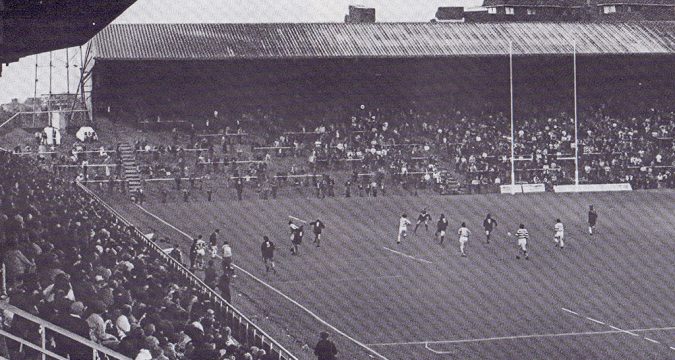
Our journey around the villages, towns, cities and regions that have rugby league running through their veins makes its final stop on the banks of the River Thames.
FROM Barnet to Brentford, Charlton to Crystal Palace National Sports Centre and The Stoop to their current base at Wimbledon, London Broncos have played at their fair share of venues under their various names.
But for sports ground connoisseurs, the first was very probably the finest.
Formed in 1980 as Fulham, the rugby league offshoot of the famous football club spent their first four seasons on the banks of the River Thames at Craven Cottage.
And that made them the first of the code’s clubs to play regularly at an arena which bore the stamp of the man who shaped Britain’s early sports stadia, including the 15-a-side bastions of Cardiff Arms Park, Lansdowne Road and Twickenham.
When Archibald Leitch died aged 73 in 1939, relatively few knew his name – but many thousands were familiar with his work.
For the Scottish architect is credited with having an often substantial hand in designing more than 40 grounds over the first 30 years of the 20th century, with much of his work remaining intact until the Taylor Report which followed the Hillsborough disaster of 1989 started a wave of revamped and new stadia.
As well as the trio of eleven-a-side temples Ibrox, Celtic Park and Hampden in his home city of Glasgow, the list includes Old Trafford, Anfield, Goodison, Highbury, Villa Park and the Bradford pair of Valley Parade and Park Avenue.
Those West Riding venues staged rugby league matches from the sport’s formation in 1895 until, respectively, 1903 and 1907, when first inaugural champions Manningham, then the original Bradford, who took the title in 1904 and won the Challenge Cup in 1906, switched to football as Bradford City and Bradford Park Avenue and engaged Leitch as they upgraded their headquarters.
One of his most celebrated constructions was the double-sided main stand at Park Avenue, which had three pedimented gables, a corner pavilion which housed the dressing rooms and was known as the Dolls’ House, 4,000 seats for football fans plus a small terraced paddock and at the back, a balcony overlooking the adjoining cricket pitch which once staged Yorkshire matches.
Having lost Football League status in 1970 (it had been gained in 1908), the original Bradford PA abandoned their home in 1973 and after a season playing at Valley Parade, folded in 1974. The stand, which also featured the designer’s trademark criss-cross steelwork, was demolished six years later.
Having started his career designing factories, Leitch’s first foray into sports stadia came with Kilmarnock in 1899, interestingly at Rugby Park, the name reflecting the fact that like Bradford’s twosome, the Scottish football team had oval-ball origins.
That led to Rangers, the club he supported, commissioning him to redevelop Ibrox, at the time the largest ground ever constructed (by 1902, it held 80,000).
There was a major setback when, during a Scotland v England international, a section of new timber terracing over an iron frame gave way, with 25 lives lost.
While an inquiry found inferior materials were to blame, Leitch came up with a new design of terracing on solid earth banks, with crush barriers incorporated.
Among the first venues to benefit were west London’s Craven Cottage and Stamford Bridge, home of newly-formed football club Chelsea, in 1905.
Stamford Bridge staged the second Test of the first rugby league tour, by New Zealand, in February 1908 (Great Britain were beaten 18-6) while Craven Cottage hosted the Australians in October 1911 (England were defeated 11-6).
Called after the royal hunting lodge which existed on the site between 1780, when the surrounding area was mostly woods, and 1888, when it was destroyed by fire, Fulham Football Club, founded in 1879, moved to their ground in 1896.
Safety concerns amid growing attendances led to Leitch being hired to provide a home suitable for the Football League, to which the ambitious club were to be elected in 1907, when their place in the Southern League was taken by the new Bradford Park Avenue, who despite the travelling involved, saw that competition as a stepping stone to higher levels.
Craven Cottage, currently hosting Premier League action with an all-seater capacity just short of 30,000, has changed markedly over the years.
But one constant is the Leitch-designed and Grade II-listed Johnny Haynes or Stevenage Road Stand, with its ornate red-brick exterior facade, single central gable and adjacent Park Avenue-like pavilion, or in this case, cottage.
When rugby league returned to the stadium in 1980, it had two end terraces as well as a paddock in front of the Stevenage Road Stand, and a capacity of 40,000 (the ground had in 1938 hosted its record attendance of 49,335 for the second-tier clash with Millwall).
Fulham saw the setting up of a 13-a-side team, proposed by Warrington director Harold Genders and taken on by football club chairman Ernie Clay, a businessman from Yorkshire, as a revenue stream.
There had not been any professional club rugby league in the capital since the 1930s, when first Acton & Willesden then Streatham & Mitcham disappeared, and no new team since Blackpool in 1954.
Under coach Reg Bowden, Fulham started strongly, beating relegated Wigan 24-5 before 9,552 at Craven Cottage in their opening game, attracting 15,013 for their Challenge Cup first-round meeting with Wakefield and winning promotion to the top flight.
However relegation followed the season after, and when the same thing happened after Bowden had led the club back to the First Division in 1983, the football club pulled the plug on the rugby league team.
Kept going by diehards, Fulham played at Crystal Palace National Sports Centre in 1984-85, then spent five seasons at the Polytechnic Sports Ground in Chiswick before returning to the Crystal Palace athletics venue and becoming London Crusaders.
The Broncos name was first adopted in 1994, and two years later, the club were founder members of Super League, sharing The Valley with Charlton Athletic Football Club.
First published in Rugby League World magazine, Issue 516 (January 2026)