Rugby League Yearbook co-editor TIM BUTCHER reflects on another eventful 12 months for our great game, on the 30th anniversary of its publication.
NOT much stays still in Rugby League. It’s an ever-changing landscape. Thirty years has passed since the first Rugby League Yearbook was produced and we now have to try and cover a fast-expanding landscape.
A perusal of the International scoreboard in this year’s book will illustrate the extent of Rugby League. The old canard that Rugby League is a ‘northern game’ can easily be rubbished.
The yearbook covers the international games, men’s and women’s, wheelchair and women’s Super Leagues and of course the domestic leagues, with a mind-boggling statistical section compiled with unyielding accuracy by co-editor Daniel Spencer, who also designs the book.
It’s been another absorbing 12 months on the home front. There can’t be many supporters who haven’t enjoyed both elation and despondency during the year.
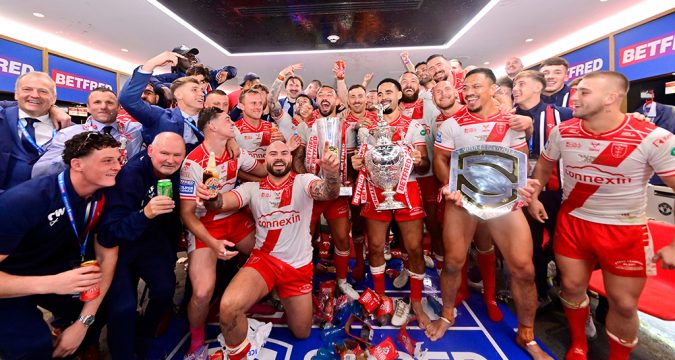
Hull KR fans certainly won’t be forgetting 2025 for a long time. An all-conquering campaign came not long after some lean times – a Challenge Cup win for the first time in 45 years, a first League Leaders’ Trophy and then a first Championship title since 1985.
In winning the Grand Final, Hull KR became only the fifth club in 30 years to get their name on the Super League trophy. Coach Willie Peters was an obvious choice to feature as one of the yearbook’s five personalities of the year.
Hull KR’s current standing is remarkable and there has been some canny decision making along the way. But it was the inspired appointment of former Gateshead and Wigan scrum-half Peters as head coach at the end of the 2022 season made the glorious year of 2025 possible.
Wigan fans had to experience a season without any trophies, although it would have been nice to see them defend the World Club Challenge. But the thing that got in the way was Las Vegas, where the Warriors and Bevan French in particular mesmerised a huge audience. And at the end of the season they were only one game away from successfully defending their title.
Expectations are high at clubs that are used to winning trophies. St Helens are another and club stalwart Paul Wellens was relieved of his head-coaching position at the end of the season – a semi-final wasn’t good enough. But Saints did produce the most memorable winning try in the Eliminator at Leeds.
With ten minutes to go, Leeds were on their way to a semi-final against Hull KR, leading 14-6. After Jon Bennison’s seemingly last-gasp try (or no try) and conversion, a penalty, 16 passes, 30 seconds – 28 of them after the final hooter had sounded – six attempted tackles on Harry Robertson on the right, an audacious no-look long back flick pass by Tristan Sailor, a sensational gather and offload by Matt Whitley, his second key involvement, to create an overlap left and, with quick hands, Lomax, James Bell and Jack Welsby sent Shane Wright, who had started the move, over for the winning score. Thanks to Phil Caplan for that description in League Express. It takes your breath away just reading about it.
Leeds fans’ spirits must have been shattered, but they can’t have been that good when winger Maika Sivo was ruled out for the entire season in a pre-season game against Wigan. The omens weren’t good for the Rhinos but, by the end of the campaign they were contenders. Jake Connor had claims to be the most improved player in the game, which sounds a bit strange for a 31-year-old veteran of 12 seasons in Super League. He’s always been a brilliant player but the way he knuckled down at Headingley finally saw him fulfil his potential.
Connor was rewarded at the end of the season with the Steve Prescott Man of Steel Award and he is a Personality of the Year. Always an instinctive talent, Connor’s box of tricks, either with hand or foot, came into play to the benefit of the Rhinos fans, who saw their side finish in fourth spot, their highest placing since the Grand Final winning year of 2017. Coach Brad Arthur has got to take some credit for getting the best out of him.
By the season run-in, Leigh were at the top of their game, finishing third in the table and the Leopards have now established themselves among the big clubs.
The Super League season started with a bang in February with a best-ever opening-night attendance (Leigh beating Wigan 1-0 in the lowest scoring game in the history of Super League), continued in Las Vegas with record-breaking Sky Sports viewing figures, set more attendance records for the so-titled Rivals Round over the Easter weekend – and concluded with a Grand Final that attracted the highest crowd for eight years and the second-best viewing figures ever.
Leigh were miles too good for Wakefield in the Eliminator but what a season it was for promoted Trinity. They had been all-conquering in the Championship the year before but no-one was really certain if their squad was good enough for Super League. A fine season that included wins over Wigan, Leeds and Hull KR proved they were and Trinity were rewarded with bumper attendances and a great atmosphere at the revamped Belle Vue.
Of course, not everything has been positive for everybody. Sport is all about winning and losing. Hull FC were there or thereabouts for most of the year and, though they suffered more than their fair share of injuries to key players, they didn’t fall off a cliff as in previous seasons.
Warrington’s season ebbed and flowed. Their signing of Salford evacuee Marc Sneyd should have made them a challenger. Sneyd’s third Lance Todd Trophy performance in June had them within three minutes of winning the Challenge Cup.
Catalans’ fortunes went southwards for most of the year, with Joel Tomkins taking the coaching reins when long-serving Steve McNamara was sacked. The Dragons eventually finished the season with four wins from the last five rounds.
Huddersfield didn’t win a league game until round ten and had more than their share of injuries, while the proposed new stadium and possible temporary move to Halifax was a big diversion.
Castleford opened their season with a bang and could have beaten eventual Champions Hull KR but for a late missed penalty goal and a Mikey Lewis field goal. They got rid of their coach in July, as Danny McGuire was not even given a chance to complete one season. The Tigers saved their best for late on with a memorable win over Wakefield and got within two points at St Helens.
Which leaves Salford, their high coming in February when their future looked secure after the RFL gave the takeover of the club the green light. By the time it became obvious that their new owners were far from saviours, it was too late to let them drop out of the competition. With most star players moving on amidst the financial uncertainty, coach Paul Rowley and his staff managed to turn out a team in every round bar one – they even won three league games. St Helens-bound Rowley is one of our five personalities.
Paul McShane is too, as the unique winner of the Championship Player of the Year award, five years after being name Man of Steel as a Castleford player. The hooker was the driving force behind York’s brilliant season.
The Knights were elevated into the expanded 14-team Super League for 2026 along with Toulouse Olympique, who edged them in the Grand Final. Bradford, having achieved tenth spot in the IMG rankings, will join them in the expanded 14-team Super League next year.
London Broncos didn’t make the cut despite an eleventh-hour takeover by former Kangaroo great Darren Lockyer and his business partner Grant Wechsel, the appointment of former South Sydney and current PNG coach Jason Demetriou as coach and the signing of some NRL stars and Kumuls internationals. They’ll be the team to beat in the newly merged 20 or 21-team Championship.
What else changed? Live TV coverage of every Super League game enabling the Captain’s Challenge and video-referees at every game. They produced less excitement and much frustration.
Nigel Wood was back at the helm of the game after the ousting of the previous board of directors. And there was a potential takeover of the British game by the Australian NRL.
So it was quite a year that ended with the first Ashes Series since 2003.
But sadly, what didn’t change was that the Kangaroos retained the Ashes.