

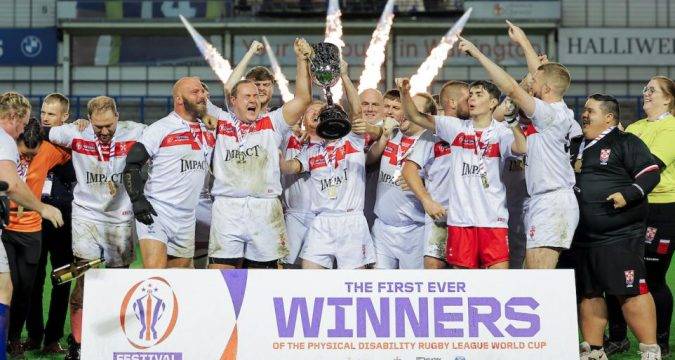
THE announcement of the England Community Lions squad for the Physical Disability Rugby League World Cup in Australia towards the end of this year followed hot on the heels of the Disability Rugby League launch.
And that launch, which was held at the MKM Stadium on the day of the Betfred Super League fixture between Hull FC and Leeds Rhinos, followed, similarly, the Rugby Football League’s ‘More than a Sport’ report.
That report touched on a number of developments which were also mentioned at the launch and in the squad release, which was timely, not least for the RFL’s explanation of the rationale behind the Medequip Cup.
In ‘More than a Sport’, it was stressed that “PDRL has seen a complete recovery in participation, driven in part by the introduction of the Medequip Cup — a representative, origin-style competition for classified athletes.
“Sixty players took part across Lancashire and Yorkshire, competing at major venues including Headingley and Robin Park.
“Player feedback has been overwhelmingly positive, with many describing it as their most enjoyable experience in the sport.”
That was very good to hear, as was further information in the report, which revealed: “Domestic competition also strengthened, with more fixtures completed and improved adherence to participation rules.
“The creation of the first PDRL Player Advisory Group has enhanced communication and player voice, supporting ongoing development. Overall, the number of active participants increased by seven percent, and fixture completion rose from 60 percent to 90 percent.
“Learning Disability Rugby League has similarly rebounded, achieving record registrations in 2025 following the introduction of clearer eligibility parameters.
“The programme benefited from increased opportunities to play at major events, including Magic Weekend and the Challenge Cup semi-finals double-header.
“It also received national recognition, winning the Care Innovator Award at the Great British Care Awards.”
The report continued: “Participant feedback highlights the programme’s impact: improved confidence, increased physical activity, stronger social connections and greater independence.
“Further enhancements are planned for 2026 while the Tryz programme, delivered in partnership with Access Sport, has continued to progress.
“The programme has been introduced to more traditional areas of Rugby League as an alternative and meaningful engagement opportunity for junior participants living with disability.
“We have seen 117 juniors engage in the programme, giving them an introduction to the sport, with a view that as they progress, they can engage in impairment-specific offers such as those discussed above.”
This is all, clearly, excellent, highlighting the ability of Rugby League to enhance the lives of all involved in it.
The PDRL and Wheelchair World Cups towards the end of 2026 are proof positive of that.
Yet again, though, I have to lament having had to ‘dig out’ results and fixtures for the Cumbria Men’s Regional League, as nothing at all was sent to me by the RFL.
I regret having to say this but Cumbria has, following the advent of the National Community Rugby League initiative, been transformed from a well-publicised competition into something of a well-kept secret. Sorry, but our marras in the north-west deserve much better.
I expect that there will be folk at the RFL who will be most upset that I’ve publicised these failures.
However, I would be failing in my duty to the Rugby League public if I didn’t flag up such glaring omissions, especially as the RFL drove through its plans despite serious misgivings expressed by folk in the county, many with decades of experience.
On something of a brighter note, the ‘More than a Sport’ report mentioned a “two-player tackle pilot at Oulton”, which is referred to elsewhere in this issue regarding ongoing work in the Lions Development Programme.
The RFL hadn’t, at the time of going to press, fully replied to me as to what exactly the pilot was but, from a bit of digging, I’ve established that it was an ‘RFL Rule Pilot Festival’ focused on community Rugby League, held at Oulton Raiders last October, involving more than 160 players from Castleford Tigers, Featherstone Rovers, Leeds Rhinos, London Broncos (who, I seem to remember, performed very well at the event) and Wakefield Trinity, who provided two teams.
The information I have is that “the festival was part of the RFL’s broader efforts to develop and test new rules at the community and youth levels to increase appeal and accessibility”.
And that’s all I have – I assume that the festival involved limiting the number of players in a tackle to no more than two, which could be easier said than done to police.
Meanwhile the York and District League’s Under 16 team are currently in Spain, embarking on a three-match tour.
Details are, at this stage, sketchy, although I understand that most of the players have been drawn from Heworth and York Acorn.
I hope to be able to report more fully to readers in next week’s issue.
And, finally, congratulations to Trevor Hunt on being inducted into the Rugby Football League’s Roll of Honour.
Trevor, who was feted at the RFL’s President’s Ball at the Queens Hotel, Leeds, on Saturday, has experienced a real roller-coaster ride in recent months, not least because the RFL itself undermined the National Conference League (a competition I regularly described as the amateur game’s flagship league) which he had served tirelessly for more than four decades.
Ironic doesn’t begin to describe the RFL’s decision to honour Trevor, whose board dissolved the NCL last January, in the wake of the sport’s governing body’s actions, after having threatened legal action.
Unless things have changed since then, chairman Mike Denning and his colleagues – including Trevor – made it very clear that there was no way that the RFL would get its hands on NCL funds.