

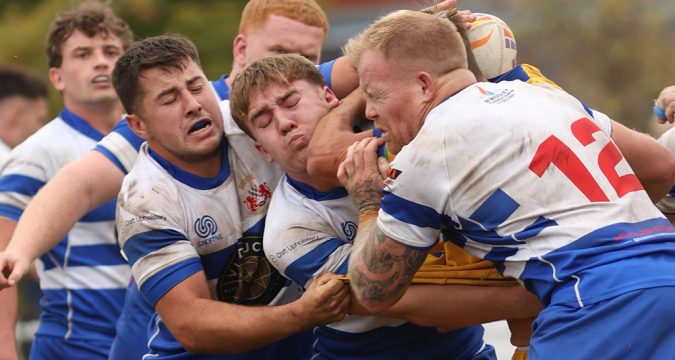
THE National Community Rugby League initiative is rumbling on, as regular readers of League Express will be fully aware – not least because the Rugby Football League are providing updates on at least a weekly basis.
I’m satisfying myself, currently, on simply publicising in our pages information supplied by the RFL and, occasionally, from such as the British Amateur Rugby League Association.
This is for two or three main reasons.
Firstly, I broadly agree with the thrust of the proposals put forward by the RFL (although not, I have to say, necessarily with the timing – it might have been more prudent to set a date of March 2027 for any new structures to kick-start, rather than next spring, which can mean certain clubs or even leagues planning for one scenario are now faced with something rather different and imminent).
However, we are where we are. I can appreciate the need to avoid ‘drift’, and the RFL are now busy arranging and conducting webinars at which league structures will be debated.
Those debates may well be heated. I’ve not reported, in recent weeks, anything from the dissenters, but casual readers should be aware that there are certainly voices opposed to the proposals, in fact I could probably fill much of an issue of League Express with their thoughts. Perhaps, at a later stage, the time might be right to publicise some or all of those views.
For now, what I can say is that volunteers are fretting, as some seem to be required to apply for their own positions, while I understand that in certain parts of the country, appointments have already been made by the RFL, and long-serving and very capable stalwarts could be jettisoned.
Time will tell on that one – as it will regarding clubs, at all age groups, potentially finding themselves at inappropriate levels, either for themselves or perhaps for teams who are left behind.
It is certainly the case that some leagues and clubs don’t feel that they have been properly consulted, although I have to say that the RFL will contest such allegations. Perhaps a little ‘tidying up’, aimed at clarifying to whom emails are actually directed, will improve that particular situation.
An acknowledgment (perhaps already made) that different regions have differing requirements will help, even if that’s at odds with the stated aim of unanimity across the land.
While I can declare, meanwhile, that there are a number of dissenting voices, and in varying degrees, it’s also a fact of life in the newspaper industry, no matter what the subject, that there can exist a ‘silent majority’, that is to say, people who say nothing because they have no issue with whatever is being proposed.
Another category is the one that ‘keeps its head down’, a phrase which can cover a wide range of folk, including those who either just want a quiet life or, in more sinister arenas than Rugby League, are simply frightened.
The relevance of any or all of these factors could emerge over the next few weeks, methinks.
A number of other matters have, or are, perhaps coming to a head. I mentioned, two or three weeks ago, my sadness that the BARLA County Championships are no more.
BARLA chair Sue Taylor has stated, in today’s issue, that there are no plans to resurrect them.
That, to me, is a great shame and (as we’re talking about structures a great deal, in fact that’s what much of the National Community Rugby League initiative is about) denies amateur players a vital stepping stone towards the international arena.
For the life of me I’m struggling to understand why games between Cumbria, Lancashire and Yorkshire (alongside, perhaps, such as Southern Regions and even Wales, Scotland and Ireland) cannot be revived.
It’s the kind of selection system that’s certainly worked for the England Universities team, and I see no reason why it couldn’t work equally well for England Community Lions.
District leagues have also been mentioned in dispatches. For some reason, they seem to be anathema to a number of characters in the corridors of power at the Rugby Football League, and one or two conversations and encounters still stick in my mind after many years.
I’ve long held the view that district leagues attract, in some instances, venom because they can, at their best, be a vehicle where clubs in the same locality actively support and advise each other (what might happen on the field of play is, rightly – this is Rugby League – another matter).
Could a perceived lack of power over those clubs be a factor behind district leagues being constantly and repeatedly undermined by outside forces?
Such topics could well crop up when the Leeds and District League holds their next annual reunion, which will take place at the Irish Centre on York Road on Friday, November 21 (although most of the veterans who attend will, I imagine, be more happy to recall deeds, or misdeeds, which happened on the pitch many years ago).
Anyway, it’s only a fiver to get in, and for that you also get pie and peas and a raffle ticket.
My advice to readers is to contact either Glenn Davies (07801 063797) or Sam Horner (07780 676132) and get yourself down, even if the city of Leeds isn’t your own locality.
And, finally, hearty congratulations to the England Wheelchair team.
News came through, just as I was about to file copy, that the side have won the Ashes in Australia 2-0, a late Joe Coyd try breaking a 42-42 deadlock against the Wheelaroos in the Second Test on the Gold Coast.
Yet more fantastic news from coach Tom Coyd’s charges, who really do set the standard for all English and British Rugby League teams to follow. What a side, and what heady days.