

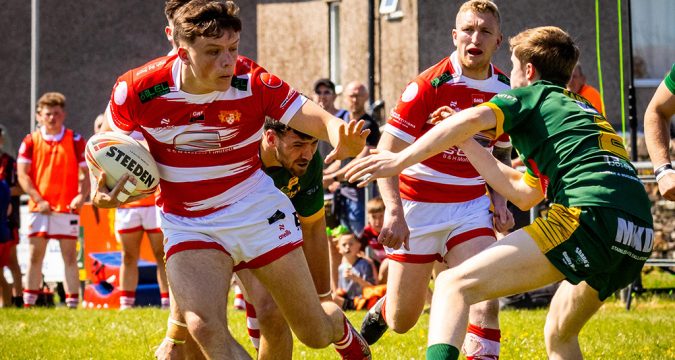
I HAVE to admit that I was taken by surprise a little by the fairly hard-hitting response of the National Conference League’s management group, headed by chair Mike Denning, to the Rugby Football League’s proposals for regionalised fare below its top couple of divisions.
The NCL has, in my experience, generally worked pretty much in tandem with the RFL, but not this time. Far from it, as summed up perhaps by Denning’s parting shot, which was “we want the RFL to not try and act in haste and create chaos that could take us all back years.”
This evening (Monday, November 10) the Conference’s management will discuss the situation with member clubs in what I think could be one of the most important meetings held in our sport, and certainly in the NCL, for years.
I used to write, regularly, about what was the ongoing ‘civil war’ between the RFL and BARLA. It seemed to me that the NCL tended to take the RFL’s side in those perennial spats; if the RFL isn’t careful, though, they could be involved in a similar conflict with the NCL, which would be immensely damaging to the entire sport in this country.
It will be interesting to see how the RFL responds. My advice, for what it’s worth (and which I’ve stated several times in this column) is that the planned launch of the National Community Rugby League initiative should be put back a year, to 2027, which would give everyone involved the opportunity to fully debate the many issues.
I was unable, meanwhile, to reflect in last week’s issue on the BARLA National Cup Final, purely because the match was played on the Sunday. It was a game between two fine clubs – Brighouse Rangers and Orrell St James – although, currently, Orrell are the stronger on the field of play, as the 56-0 result confirms.
However, there had been no score at all midway through the first half by which stage Rangers, who operated last season in the Yorkshire Men’s League’s First Division, had gone closest to registering the first try of the contest.
The Saints, who have now completed 2025 with a 100 per cent winning record, then cut loose but I’ve long felt (including from my own playing experience) that if a side can match so-called superior opposition for, say, ten minutes, then why not for 80. The answer to that poser could, of course, be fitness, and Brighouse’s coach Adam Hirst told me late last week that plans are in place to appoint a coach who will be primarily responsible for that important aspect.
He and Orrell boss Sean McHugh were, incidentally, both keen to praise BARLA for their handling of the event. Those commendations were certainly warranted on yet another grand occasion at the grassroots.
Something else worth mentioning, I think, is the 2025 Euro Men’s competitions, which concluded at the beginning of this month.
We tend to focus, internationally, on the very top level (ie Australia and those, like England, who strive to match the Kangaroos) but the Euros serves as a reminder that there’s much to enjoy elsewhere and this year’s three-group structure – the brainchild of ERL manager David Butler, I imagine – with three teams in each section has worked very well, and offers scope for future development, I’m sure.
It reminds me, in a way, of three decades ago, when I reported exclusively on the professional arena. However, Steve Brady, who was then the editor of the Rugby Leaguer, asked me if I’d care to cover the amateur game as well.
I said ‘yes’ and it was timely. I was very hacked off back then with the professional game, given the launch of Super League and the move to summer and, at the same time, I ‘rediscovered’ amateur Rugby League and, in particular, the extremely vibrant National Conference League, which was – and is – of a very high standard on the pitch itself, while club and league administrators tend to be folk who bring important professional skills to the sport they love, which is a heady combination to be sure.
The Euros might be like that. I advise readers to check out the articles elsewhere in this issue and, in future, track the progress of the countries involved. It could be rewarding!
Ongoing, incidentally, are details of which amateur teams will enter next year’s Betfred Challenge Cup. I understand that Orrell St James and Brighouse Rangers will be involved; fingers crossed that I’ll be able to name the others in next week’s issue.
Similarly, I hope to be in a position to list dates and venues for the England Universities regional programme (which feeds into the England team) next week. On a sad note, however, it was disappointing to learn that Terry Barker, who has done so much sterling work as secretary of the Barrow League for many years, is stepping down, other than in terms of dealing with match officials. What a loss – we cannot afford to lose men of his calibre.