
THIS is our annual series that looks back at the year just gone and selects the most significant and memorable moments, whether they are triumphs or tragedies, great matches or momentous incidents, domestic or international events.
Let us know whether you agree with our selections.
Our countdown of the top 50 moments of the year began here.
10 Rugby League makes its debut at Hill Dickinson Stadium
IT’S always exciting to see our game played at a brand-new venue.
But the excitement goes to another level when it is an Ashes Test and the stadium is brand new.
Both these factors were present on 1st November, when England faced Australia at Everton’s sparkling Hill Dickinson Stadium.
Everton had played their first Premier League game at their new home on the Liverpool waterfront only a few weeks earlier and the club had received far more applications for season tickets than they could supply for the 52,769-capacity ground.
Such was the popularity of the venue that it was announced on 14 April that the match had already sold out, more than six months ahead.
That news demonstrated that the decision to play the second Test there was already an outstanding success long before it took place, with the game set to generate more sales revenue than any previous Rugby League international in the UK.
The contest was played in a great atmosphere, with England clearly stimulated by the crowd support.
The half-time score was locked at 4-4, with both sides having scored two penalty-goals, but Australia pulled ahead early in the second half with tries to Cameron Munster and Hudson Young and England couldn’t respond.
But RFL officials did respond to the event by deciding to take the 2026 Magic Weekend to Everton on the first weekend in July.
9 A record Ashes crowd at Wembley
THERE was some controversy about taking the first Ashes Test to Wembley, with some people suggesting that the national stadium was too big for the crowd that was likely to attend the game.
However, the attendance of 60,812 was the highest-ever for an Ashes game in England, despite the fact that the stadium was only two-thirds full.
The only Wembley attendances for international games that had exceeded that figure were for World Cup finals – in 1992 (73,631) and 1995 (66,540) – and the semi-final against New Zealand in 2013 (67,545).
With a significant proportion of those attending having home addresses in the south-east of England, there will almost certainly be a debate about whether more international matches should be taken to Wembley.
And, with the contract to play the Challenge Cup final at Wembley entering into its final two years, there could even be a debate about whether that match might find a future home away from Wembley.
8 Wigan beat Warrington in Las Vegas
THE first-ever Super League game played in North America took place in Las Vegas on 1st March at the Allegiant Stadium, which is normally the home of Las Vegas Raiders.
Wigan and Warrington were invited to join four NRL clubs, as well as the Australian and English Women’s sides, in the second season of Rugby League in the entertainment capital of the world.
And the historic occasion was totally dominated by Wigan, who led 42-0 after an hour before the Wolves replied with four late tries to take the final score to 48-24.
The star of the show on the biggest stage was Wigan stand-off Bevan French, who scored one try and had a hand in several others.
Thousands of Wigan and Warrington fans made the journey to Las Vegas, boosting the attendance to 45,209, which was a significant increase on a year earlier, when 40,746 had been present for the inaugural two NRL matches.
The occasion went well enough to ensure that European Super League sides would be invited to future events in Las Vegas, with Hull KR and Leeds Rhinos scheduled to play there this year.
And the other result of the event was the contact between Wigan and Warrington owners Mike Danson and Simon Moran respectively and the leaders of the NRL, which gave rise to constant speculation about the NRL taking a stake in the European Super League.
7 Hull KR sell out WCC tickets in record time
2025 will go down in history as having been Hull KR’s year, given their treble success, and one other aspect of the momentum the club has built up was the news that all the tickets for their World Club Challenge match against Brisbane Broncos at the MKM Stadium on 19th February were sold out in a little more than 24 hours after going on sale in mid-November, after the two clubs had confirmed their commitment to the fixture.
The Robins revealed that they had sold all 24,600 tickets available to make it the fastest-selling World Club Challenge ever.
It means the MKM Stadium will record its biggest club Rugby League attendance, with the previous record standing at 23,004 for a Hull derby in 2007.
Hull KR chief executive Paul Lakin said: “We are delighted to achieve a sell-out of the MKM Stadium in record time.
“It’s our 31st consecutive (home) sell-out, with all league and play-off games selling out since late 2023 – a truly phenomenal achievement and testament to so much work behind the scenes, and our loyal fanbase.
“We can’t wait to show the world what we, and the city of Hull, are all about. It promises to be a magnificent occasion for all and we’d like to thank everyone for their support.”
6 Bradford Bulls score gradings success
BRADFORD Bulls ended their eleven-year exile from Super League after being placed in the top twelve of this year’s club gradings, which were published on 16th October.
The Bulls came tenth in the grading table, meaning they will be in Super League this season for the first time since 2014, replacing Salford Red Devils who, as expected, missed the cut after a year of crisis.
Bradford climbed an impressive six places from 16th, improving their score from 12.15 to 14.81.
A club policy of focussing on gaining points, particularly with regard to the facilities and finance categories, helped them secure a place in the top flight.
They increased their finance score by 1.5 points, and their facilities score by 1.1181 points.
A decrease in the fandom category was cancelled out by an improved performance score.
The Bulls’ success in securing a Super League place through IMG’s grading system, as opposed to having to apply for one of the two additional places that later went to Toulouse and York, carried the bonus that they will receive a full distribution of around £1,250,000 coming from Super League’s broadcast deal with Sky Sports, as opposed to York and Toulouse, who will each only receive half that figure.
5 The saga of Salford
SALFORD RLFC may no longer be able to use their Red Devils moniker, but for much of 2025 it had looked as though there may not be a team at all going into 2026.
The club had suffered well-publicised financial problems the previous year and during the close-season, asked for and were granted an advance of £500,000 from RL Commercial.
However, on 7th February they announced they had been taken over by a consortium led by businessman Dario Berta, CEO of Matanel, an investment bank specialising in real estate investment.
The new owners claimed to have cleared all the club’s debts and said they would deliver additional significant investment for the future growth of the club, with a process already underway to recruit a new internal management structure led by recruitment industry experts, Kinsey Sears.
Berta commented: “I’d like to express my gratitude to Paul King and the existing team within the CBS who have led the club in recent years from celebrating its 150th anniversary, a Betfred Super League Grand Final and Challenge Cup final, as well as navigating the club through tricky periods such as Covid.
“This is the start of a very bright and successful future for Salford Red Devils. I’m very proud to be involved, and with Chris (Irwin) at the helm, I feel like we have the perfect opportunity to build something special.
“Our focus and dedication now is to work together with stakeholders and fans to build sustainable success on and off the pitch for the long term.”
The RFL issued a statement on 20th February saying that it had “approved the change of control and all owners and directors tests while also lifting the sustainability cap that has applied to Salford Red Devils since they were given an advance on their central distribution in December”. The governing body added: “The club’s new ownership group have met the conditions that were necessary.”
Unfortunately that was far from true and after a series of winding-up orders were brought against the Salford City Reds (2013) Ltd, the company finally went into liquidation on 3rd December.
Shortly before Christmas the RFL announced that it would grant a new membership to the consortium led by former player Mason Caton-Brown to resurrect Salford in the 2026 Championship competition.
4 Arise Sir Billy
FOR many years, Rugby League officials and supporters were frustrated by the lack of knighthoods awarded to former Rugby League players when they were much more readily awarded to famous sportsmen in other sports.
But in June that wrong was finally put right when Wigan legend Billy Boston received a knighthood from King Charles at Buckingham Palace, making him Rugby League’s first knight since the Northern Union’s formation in 1895.
Sir Billy, 90, was awarded his knighthood early – before the King’s birthday honours list was officially announced – because of concerns about his health, given that he has been suffering from dementia.
The reaction to Sir Billy’s knighthood was wholly positive, with Prime Minister Sir Keir Starmer admitting that: “It is an historic wrong that a sport which is the backbone of so many communities has waited so long to receive this honour.
“Boston is a legend of the game who overcame prejudice to represent Great Britain and opened the door to a more diverse game.”
Sir Billy’s wife, Lady Joan, said his family “are so proud of him” and “excited that everything he’s done for the sport and for our community is being recognised”.
The Cardiff-born player was one of the greatest stars of Rugby League and a trailblazer for black sports stars when he played for Wigan and Great Britain in the 1950s and 1960s.
He is the only surviving member of the 1954 Great Britain touring party.
3 Super League decides to increase in size to 14 clubs
IN late July at a meeting of Super League clubs, a majority voted in favour of expanding the competition to 14 sides for the 2026 season.
The only club to oppose the decision was Wigan Warriors, although both Hull clubs believed that the change should only take effect in 2027. Nonetheless, the votes of the other nine clubs carried the day.
And the clubs decided that while club gradings would decide twelve of the teams to make up Super League in 2026, the two additional slots would be determined separately by an independent panel that would be chaired by Lord Jonathan Caine, who had recently been elected to the RFL board.
A reversion to 14 teams for the first time since 2014 is the biggest decision made in the sport since Nigel Wood, now chair of RL Commercial and an executive director of the RFL, began a strategic review at the behest of the clubs in March.
It was a controversial decision to change the league structure with just a couple of months of the season remaining and to change how Super League status is determined – with two methods side-by-side, with twelve clubs to earn their place through their grading score and two further clubs to be added, “provided the panel judges there are two applications of sufficient merit against the set criteria”, according to a Super League statement.
The two additional clubs were of course Toulouse Olympique and York Knights, who on 17th October were both revealed to be the clubs chosen by the panel.
2 New owners at London Broncos
At the end of the 2024 season, the then London Broncos owner David Hughes announced that he was going to stop funding the club and he was looking for a buyer.
His decision was thought to be mainly as a result of the Broncos having been demoted from Super League at the end of the season, not because they finished bottom of the league but because they had a lower gradings score than their rivals, with Wakefield Trinity taking their place in Super League in 2025.
Leeds Rhinos chief executive Gary Hetherington took up the challenge to find new owners for the capital city club, buying Hughes’ shareholding and then scouring the globe for new investors who could acquire the club and deliver a strong future for it.
He achieved his aim when Australian icon Darren Lockyer and his business partner Grant Wechsel were revealed as the new club owners later in the year, with a promise to invest in the business and in the wider game in the southeast of England.
That they were serious about those aims was shown in November when it was revealed that the club had taken over the former London Irish training ground at Sunbury, which will also serve as their administrative base.
The Hazelwood training centre has five full-size rugby pitches in an affluent part of Surrey, with the Broncos intending to house their players in the immediate area.
The Broncos will now become the Hazelwood Centre’s primary tenants. It lies about 30 minutes southwest of the Cherry Red Records Stadium.
The Broncos previously trained at Rosslyn Park rugby union club’s Priory Lane base at Roehampton, west London.
1 Hull KR winning the treble
The year 2025 will be primarily remembered for one historic reason.
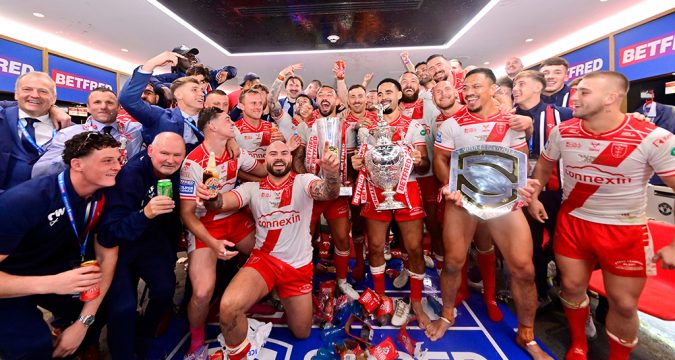
Hull Kingston Rovers, who had battle for so many years without winning a major trophy at the highest level, gave their supporters a season they will never forget by winning every trophy that was available to them, supplanting Wigan Warriors, who had done the same thing in 2024.
It meant that Rovers became only the fifth club to win the treble in the Super League era, following in the footsteps of Bradford Bulls (2003), St Helens (2006), Leeds Rhinos (2015) and Wigan Warriors (2024).
They began their trophy success by coming from behind late on to win the Challenge Cup 8-6, thanks to a late Tom Davies try, converted nervelessly by Mikey Lewis, to defeat Warrington Wolves at Wembley on 7th June in front of 63,278 spectators.
They secured the League Leaders’ Shield with a 28-20 victory in Round 27, again against Warrington Wolves, this time at Sewell Group Craven Park.
And they completed the treble with a convincing 24-6 Grand Final victory against Wigan Warriors at Old Trafford on 11th October in front of 68,853 spectators.
It was a fitting climax to a season in which the Robins had succeeded in selling out every home game during the Super League season.
And they will now go forward to face Brisbane Broncos in the World Club Challenge at Hull FC’s MKM Stadium on 19th February this year.