There’s a feeling of familiarity as our time machine sets the controls for 1985.
SPECULATION over a breakaway competition, fears about clubs disappearing, debate over the value of imported players, discussion over the selection of a Leeds venue for a Test match and talk of York and the top flight…
With rumours of Super League expanding further into Europe amid an NRL takeover, Cornwall folding in-season to leave an already-limited League One a team down, an incoming increase in the overseas quota, AMT Headingley to stage an Ashes clash after the first two are played at far-larger venues and the minster city Knights pushing for promotion, all the above have been a feature of rugby league in 2025.
But go back 40 years and take a look at what was happening in the game, and it’s clear many of those same issues were provoking plenty of deliberation.
The 1985-86 season was the last time a York side were in to top division, then the Slalom Lager Championship (although that company were set to pull their backing after six years and be replaced by Stones Bitter).
The original version of the club had been among the four promoted from the Second Division the previous campaign (Swinton, Salford and Dewsbury were the others to come up and replace relegated Barrow, Leigh, Hunslet and Workington, with Warrington and Castleford having also featured in the lower reaches of the top section).
York, still playing at Wigginton Road, within walking distance of the city centre, were coached by former Great Britain secondrow Phil Lowe, whose old club Hull KR had won the league for the second season running in 1984-85.
They possessed a rising star in stand-off Graham Steadman, signed from his local rugby union club Knottingley in 1982.
Through 20 tries, 116 goals and six field-goals, he had scored 318 points, then a club record for a season, in all matches in the promotion campaign.
Other York mainstays included fullback Trevor Midgley, winger or centre Wayne Morrell, prop and skipper Steve Crooks and loose-forward Gary Price, while in the wake of promotion, centres Matt Carter (from Parramatta) and Sean Willey (Manly-Warringah) and forwards Mike Marketo (Balmain) and Peter Martin (North Sydney) joined the flood of Australians into the UK game.
There were undoubted assets, such as Hull KR backrow Gavin Miller, the 1985-86 Man of Steel, and Chris Anderson, the Kangaroos winger who as player-coach, led Halifax to the league title, but also a worry that clubs were overreaching financially.
York had their moments, such as winning at Leeds and doing the double against Bradford, but struggled to compete on a regular basis, and having sold Steadman to Featherstone for £50,000 in the February, were relegated following 21 defeats in 30 league games, with Swinton and Dewsbury also lasting just the one season at the higher level.
After suffering the ignominy of relegation in 1979-80, Wigan were re-emerging as a force, and flexing their muscles budget-wise.
Twice during the season, they smashed the world record transfer deal to bring in backs, first by splashing out £85,000 plus two players (Phil Ford and Steve Donlan) on Bradford ace Ellery Hanley, then by paying £100,000 to Widnes for Joe Lydon.
While Widnes coach Eric Hughes quit because he was not consulted about the Lydon sale, Doug Laughton returning to the helm, Wigan finished second in the league to Halifax, having won the Lancashire Cup and John Player Special Trophy (Castleford edged out Hull KR to lift the Challenge Cup after losing to them in the final of the Yorkshire Cup).
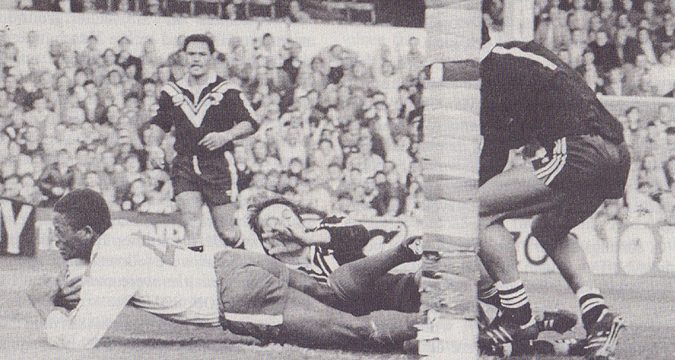
Meanwhile Hanley and Lydon were both involved in Great Britain’s Test series against New Zealand which started and ended in Leeds and was drawn.
There was plenty of drama as the tourists snatched a 24-22 victory in the first match at Headingley through the conversion by Olsen Filipaina of a try by Hull FC’s James Leuluai.
Maurice Bamford’s Lions hit back by marching to a 25-8 win at Wigan’s Central Park, with another Hull star, Garry Schofield, crossing four times.
Then a third Hull player, Lee Crooks, held his nerve to land a last-minute touchline penalty-goal to clinch a 6-6 draw at Elland Road.
It was the first time the Leeds United football ground had staged a rugby league Test, and the choice raised a few eyebrows.
However the 22,209 gate was the biggest of the tour and took the combined total for the trio of Tests to 50,306, the average of 16,769 being nearly double of that for the Kiwis’ previous visit in 1980, when the matches were played at Wigan, Bradford’s Odsal and Headingley.
The threats of a ‘Super League’ breakaway followed a meeting of ten clubs – Bradford, Halifax, Hull, Hull KR, Leeds, St Helens, Salford, Warrington, Widnes and Wigan – who wanted more direct influence and control of the game and a bigger share of the financial rewards.
Leigh and Oldham later joined the group, but the RFL Council allayed fears by agreeing to discuss the issues raised, including a reduction of the top flight from 16 to 14 clubs, at their annual meeting (the change was introduced for 1987-88).
The 1984-85 campaign had involved two divisions of 16 and 20 respectively, but in 1985-86, the second tier had 18 after the suspension of bottom-two pair Southend and Bridgend late in the pre-season – and after the fixtures had been published.
Southend, originally Maidstone-based Kent Invicta and admitted to the league two years earlier, were considered not to have prepared a team, while the Welsh club, formerly Cardiff and on the scene since 1981, were ruled put for not being able to secure a ground.
A Stockport club applied to enter a team playing out of the town’s football ground in the 1986-87 second tier, but after a study of their proposed structure and finances, failed to get the green light.
First published in Rugby League World magazine, Issue 514 (November 2025)