Our time machine travels back to the 1960s when rugby league discovered some future stars of the game on the running track rather than the rugby pitch.
PACE has always been a passport to points in rugby league, making any kind of speed merchant of interest to clubs.
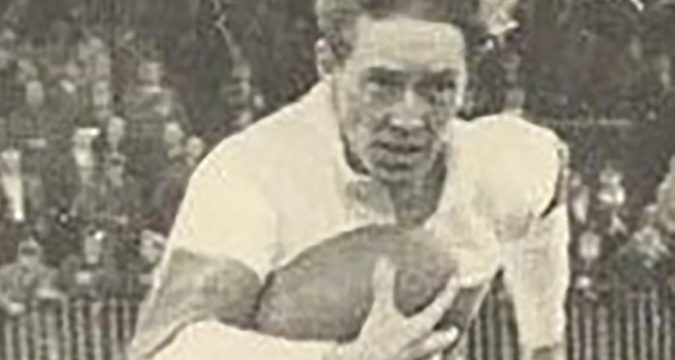
Back in April 1964, the Welsh sprint sensation Berwyn Jones (above) hit the headlines when he gave up the chance of representing Great Britain at that year’s Tokyo Olympic Games to take up the 13-a-side game.
At a time when athletics, like rugby union, was an amateur pursuit, the 24-year-old from The Valleys had racked up eye-catching victories on the track in 1963.
He won the AAA 100yd title, then matched the British 100m best time of 10.3 seconds before playing his part in equalling the world record of 40 seconds for the 4 x 100yd relay in a thrilling showdown with the USA, whose quartet included Bob Hayes, who was to take Olympic 100m gold in October of the following year.
By then, Jones was showing his growing talent as a winger on the 13-a-side pitches of northern England, having been tempted to swap the White City for Wakefield Trinity by a reputed fee of £6,000.
In that era, it was not permissible to be a professional in one sport and an amateur in another, so his athletics days – and Olympic dreams – were over, with the South Wales Echo proclaiming ‘Berwyn Bombshell’ and Athletics Weekly observing: “Berwyn’s loss will hit our hopes in Tokyo. We cannot afford to lose such a great fighter.”
Despite having played only a handful of rugby union matches for hometown team Rhymney, he was a big success in league – he scored tries for Trinity (47 in 189 outings up to 1967) and (more briefly) Bradford Northern and St Helens and made three appearances for Great Britain.
The year before Jones joined Wakefield, Barrow had brought in another renowned speed merchant but inexperienced oval-ball man in Mike Murray.
He also became a highly-effective winger, and was able to combine rugby with competitive running.
That’s because he was a successful professional athlete – and Murray, Barrow-born born in May 1940, three months after Jones had come into the world, achieved an impressive double of playing in a Challenge Cup final at Wembley and winning the well-known Powderhall Sprint at the stadium of that name in Edinburgh.
While the Scottish venue has now gone, closing in 1995 with the site now a housing estate, what is officially known as the New Year Sprint, and run over 110m, continues, with this year, the 156th version, run at Grangemouth Stadium, 27 miles west of Edinburgh, in February.
It provides a reminder of the old days of professional running and what was once a lucrative business, particularly in Cumbria, the north-east of England and Scotland, when the prize money for an event, sometimes worth more than half the average annual salary, attracted entrants and the chance to bet on the outcome helped pull in the punters.
Unlike athletics but like horse racing and golf, professional foot races use a handicapping system, in this case based on previous performances and meaning the highest-rated run a longer distance.
Having competed in the Powderhall event since 1961, Murray came through two qualifying rounds to win the 1966 final and £500 (£12,000 today).
He entered ten more times (making it 16 in all), and among a number of high-profile events, in 1972 and at the age of 32, was second in a 220yd event at the World Professional Sprint Championships, which ironically took place on the Belle Vue pitch at Wakefield previously trod by Jones.
Murray’s defeat was to American Tommie Smith, the 200m champion at the 1968 Olympics in Mexico City, who during that medal ceremony, attracted international attention when he and teammate John Carlos gave the Black Power salute. It became a defining moment in the Unites States’ civil rights movement.
Interestingly both Smith and Carlos, who took Olympic bronze, moved into gridiron, with Cincinnati Bengals and Canadian team Montreal Alouettes respectively.
Murray, whose last Powderhall attempt was in 1981, when he was 40 and the event was held at Edinburgh’s Meadowbank Stadium, turned out 168 times, and scored 65 tries, for Barrow between March 1963 (when he was 22) and November 1969 (age 29), so repaying the gamble the Craven Park club took in signing him despite his lack of a grounding in the game.
The tallies might well have been higher had he not spent certain periods preparing for professional races.
But he did appear in Barrow’s biggest match of the time he was at the club, the 1966-67 Challenge Cup final meeting with Featherstone Rovers in front of 76,290 at Wembley, when player-coach Jim Challinor was also able to call on another pacy winger in Great Britain international Bill Burgess.
Centre Challinor was also a Lions representative, and the Craven Park side also boasted a former England rugby union stand-off in Tom Brophy and useful pack players in Ivor Kelland, Ray Hopwood and Henry Delooze, and headed to London as favourites.
However Laurie Gant’s Rovers edged a tight contest 17-12, scoring three tries (through secondrow Arnie Morgan, winger Vaughan Thomas and loose-forward Tommy Smales) to Barrow’s two by Brophy and loose-forward Mike Watson.
Murray also played two matches for Lancashire before hanging up his boots, but keeping his spikes operational for a while longer.
Leigh also had a professional runner in their ranks in winger Rod Tickle, who notched 114 tries in 284 games between 1962 and 1973 and was second in the Powderhall Sprint of 1967.
Meanwhile Barrow also ran the rule over the 1970 Powderhall Sprint winner George McNeill, who had previously played professional football, also as a winger, for Hibernian, Greenock Morton and Stirling Albion in his native Scotland.
Then aged 24, he turned out as a winger in the 13-11 home win over Warrington in September 1971, but declined the club’s offer of further trial appearances.
First published in Rugby League World magazine, Issue 512 (September 2025)