
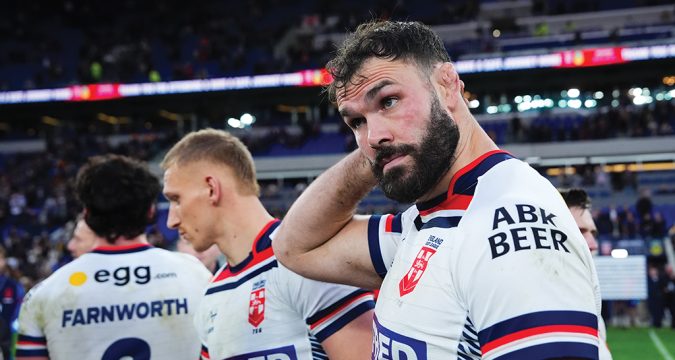
It’s the hope that kills you every time, but deep down we always knew what was coming. Michael O’Hare searches for the positives amongst the wreckage of another Ashes whitewash for England.
IT DIDN’T help that the bloke behind me at Headingley kept referring to the England coach as Shane Warne. But whatever… Shane Warne, Shaun Wane. Similar name, similar outcome: Ashes misery.
Sitting in seat 82A on Wembley Stadium’s second tier 10 minutes before kick-off in the first Ashes series since whenever, my biggest – nay, my only – fear was that 25 minutes later England would be 24-0 down with another 225 minutes of NRL-dominated hegemony to endure. Thankfully, it wasn’t as bad as that, but it was tough viewing nonetheless.
England toiled. Shaun Wane scowled. Doubtless we’ll be told that lessons will be learnt. But it wasn’t a learning process, more one of confirmation. Confirmation of what we knew perfectly well beforehand. That Australia are better, and their strength in depth is such that even if we found 13 players to match them, the collective muscle memory of playing week-in, week-out in the NRL will inevitably win through.
I was put in mind of a story a colleague from Rostov University told me. Some prankster turned up in Rostov with two pigs. On one he’d painted a number 1, on the other a number 3, and he set them loose in the city. Cue public concern and calls to the police. Officers quickly rounded up pigs 1 and 3 and then spent the rest of the week desperately searching for pig number 2, before arresting the perpetrator for wasting their time. Like the Russian police, England tried their damnedest to achieve the right outcome. But like the police, they were never going to succeed because they couldn’t. Their goal was unattainable.
Yes, both coach and team could be accused of lacking imagination – even without taking the quality of the opposition into account. But it’s not the coach, nor the players, it’s the system, the lack of money, the lack of youngsters coming through compared to Australia. A sclerosis presided over by self-interested, protectionist clubs. But it’s easier to blame the coach than fix that. If Shaun Wane goes, will the next candidate to preside over inevitable failure please step forward?
But what of the series as a whole, scorelines notwithstanding? Wembley was subdued, not because of lack of anticipation, but more because of the nervous energy flitting from field to grandstand. Everybody cared as much as I cared.
Onwards to Everton. The Hill-Dickinson is smart but soulless, as modern stadiums tend to be. But don’t tell me it isn’t better than standing in the rain as rivulets of urine and beer cascade down the terraces. On the other hand, stadium management appears intent on dispensing with anybody on minimum wage. “Beer machines” replaced bar staff, dispensing pints to punters (and only those with credit cards).
And then there was Headingley giving us misplaced hope as half-time arrived, the same as at Everton. Wishful thinking; I’m as guilty as anyone. But deep down? Well, deep down we knew there was only one outcome whatever gruff exterior Shaun Wane projected. The first halves at Everton and Headingley, for all their brief joie de vivre, were in truth papering over ever-growing cracks.
So was there gain amid the pain? Or the “torture” as the England coach described it. The answer is a solid yes, not least the demand for international rugby league, and the heartening figure that 40percent of ticket sales for Wembley came from the south-east helping to establish a record Ashes crowd, plus two other sold-out matches and fabulous viewing figures on the Beeb. It showed the nation we are still alive and kicking. A greater disappointment than losing three matches would be if the Ashes were mothballed for 22 more years, either deliberately or through apathy.
And we learnt a few things along the way that might stand us in good stead if they remain unrepeated. We now know that when encamped on the opposition’s line, England won’t score a try and Australia will. And that Mikey Lewis, for all his mercurial unpredictability, cannot play fullback. Meanwhile England probably made as many breaks at Wembley and Headingley as the Australians did, but whereas there would be a swarm of green and gold jerseys offering multiple options, too often the isolated English runner was left resorting to a Hail Mary pass.
Any other positives? Well I guess we should be thankful no Aussie larrikin committed a wanton act involving a doughnut and a pint of Bundaberg Rum at 3am in one of our popular city centre establishments, forcing an apology from the Australian management and a promise from the perpetrator to attend behavioural management therapy.
Yet amid the hand-wringing, we should salute the opposition. It’s for more qualified observers than myself to dissect the qualities of this exceptional Australian team. Reece Walsh (full of bristling braggadocio), Harry Grant (peculiarly debonaire) and Cameron Munster (a man with no fear.) made me feel privileged to have seen them live. We should applaud them and set about figuring out (and don’t expect enlightenment from me) how to match them.
It all means that the yawning chasm of unavoidable cliché is as wide as it’s been since the Invincibles tour of 1982. Is there a solution? Other than Peter V’landys and the NRL taking control of the game in this country – and he was somewhat coy when questioned by the BBC – where do we go from here? Regular international competition against the best would be a start. Reviving the Tri or Four Nations would be ideal, but almost certainly unfeasible considering the success of the Pacific Championships. So, whatever the logistical challenge, maybe England should demand (beg?) to enter that competition. And even if that came to fruition, there’s still the behemoth that is State of Origin churning out ready-made international players year-in year-out.
Just in case the impossible occurred, I wrote an alternative version of this article which began: “Thank you Headingley, for saving us from the ignominy of whitewash…” My wife read it over my shoulder and said… well, actually she said nothing. But her expression was of equal measures pitying and vaguely contemptuous.
As I said at the beginning, we all knew what was going to happen. And it did. Fifty-five years of hurt goes on.
First published in Rugby League World magazine, Issue 515 (December 2025)