

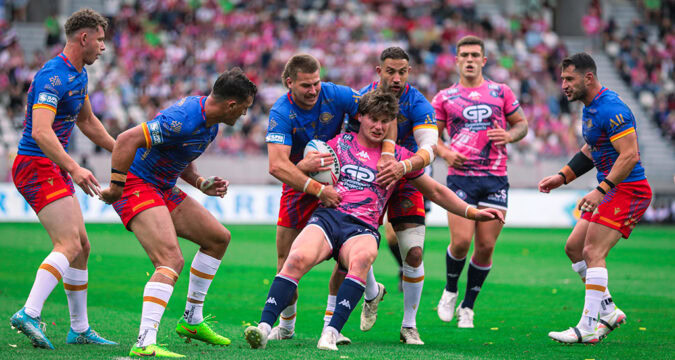
Catalans Dragons brought Super League back to Paris and delivered a successful event both on and off the field. So why did France’s national media barely notice?
“FOR SOME reason”. A very common expression in the Anglophone countries.
One that can sometimes amuse us, French people. Recently, comedian Gad Elmaleh turned a routine interview on The Tonight Show into a viral moment by fixating on this vague justification. As a perpetual learner of your language, let me borrow this expression to describe a phenomenon linked with French rugby league.
So, for some reason, the Catalans Dragons v Wigan game in Paris didn’t receive any national media coverage on match day. And, for some reason, neither did the Super XIII Grand Final.
Unfortunately, this was predictable for the FFR XIII competition; the regional label stuck to rugby à XIII is self-evident and serves as an excuse for self-appointed Parisian authorities not to cover it. But it was far more surprising regarding the Catalans Dragons and their well-oiled communication machine.
In the columns of L’Indépendant, in May 2026, Bernard Guasch had clearly identified the targets of the game held on Saturday, 6th June, at Stade Jean-Bouin: “This match must strike a chord with the public and ensure the voice of rugby league is heard, so that Parisian journalists realise this sport is truly here.”
Yes, the Parisian journalists were the target!
It may seem counterintuitive, but getting their interest is definitely the first step to take before reaching the French public, and not vice versa. As the attendance of 12,500 clearly demonstrated, numbers alone are not enough to change the status of rugby league.
Yet, I can guarantee you that the Catalans Dragons’ communication plan to conquer the capital was perfect … on paper at least.
The choice of venue was not due to chance: the Stade Jean-Bouin. Home of Stade Français, a mythical rugby union club located in the 16th arrondissement, Paris’ answer to London’s Kensington – an enclave of wealth and history far removed from the sport’s traditional working-class roots! To complete the strategic demonstration, it sits close to the Parc des Princes (home of PSG) and Roland Garros, where Parisian journalists help the public cultivate their seasonal resigned lamentation over eliminated French tennis players.
Since the official announcement of the Paris 2026 match, the Dragons played all the Parisian ‘codes’: a massive digital campaign, attractive travel offers and a symbolic conclusion — the night before the match, sailing on the Seine. Inviting journalists and partners onto a private boat was more than hospitality; it was a rite of passage. It showed the Dragons had cracked the code of the city’s establishment, moving beyond the role of a visiting club to become players in the Parisian aristocracy of sport.
And yet, on the day of the game, there was not a single column about this historic event in the national press. I was so stunned that I checked twice. L’Équipe published an article in July 2025 (almost one year prior) and a brief interview in March. Le Figaro had only a preview written by Arnaud Coudry back in March 2026. There was nothing on Saturday, 6th June, itself.
When I contacted Le Figaro’s rugby union journalist, he explained: “In fact, I was in touch with the Dragons to attend, but the timing couldn’t have been worse — it clashed with the final day of the Top 14 that I cover. It was discussed at the newsroom, but it was just bad timing.”
Belated coverage appeared the next day in both newspapers, but the silence on match day remained deafening. For some reason, roughly five or six major national newspapers, regardless of political orientation, forgot a simple journalistic rule: sometimes, reporting means covering what happens in your own city. Even symbolically, Le Parisien failed.
Catalans Dragons had a terrific plan, but their plan didn’t survive first contact with the inertia of the ‘enemy’.
This is a warning for bigger organisations like the Super League or the NRL: if they ever want to expand to Continental Europe, France will be the key. And they will have to deal with the stubborn inertia of a Parisian media landscape. They must either bypass it entirely (with 100 percent digital communication, like the Dragons did) or forge deals with major media groups. By remaining silent on the day of the match, these dailies opted for commercial safety rather than upholding the deontological imperative to reflect the true diversity of France’s sporting landscape — a principle enshrined in the French charter of journalism.
But don’t get me wrong. The event was a success for the Treiziste community, despite the Dragons’ defeat against Wigan. The Super XIII Grand Final was a thrilling contest, decided by a dramatic golden-point drop goal by Theo Fages (Pia defeating Carcassonne 31-30). It was the best possible showcase of the French domestic championship.
Yet, this event missed a crucial opportunity to mention the existing clubs in Greater Paris. As I have highlighted in previous editions of Treiziste Diary, Paris is not a desert: Charenton, Châtillon and Nanterre, to name just a few, have been active for decades. Strangely, the FFR XIII itself presented this event as the ‘return’ of rugby league to Paris. League Express, in its report, was more cautious, presenting it simply as the return of the Super League to Paris 30 years later.
As a matter of fact, Parisian clubs were not mentioned at all. During the Carcassonne-Pia game, caller Pierre Vergès recalled the special link between the capital and rugby à XIII; a city where it all started with the very first game played at the Stade Pershing in the 1930s. Later, during Dragons v Wigan, his younger colleague Aurélien Torreilles mentioned the Greater Paris rugby league schools sitting behind the posts, cheering the Dragons.
It was a genuine opportunity lost to remind the public that rugby league has been played in Greater Paris right from the beginning, rather than simply expressing the hope, voiced by one of the callers, that clubs will “emerge in Paris after the game”.
The inertia of the Parisian media, synonymous with national media, is definitely a rock blocking French Rugby League from being recognised again as a national sport.
But let’s not trip ourselves up by allowing the narrative that rugby à XIII is merely a south-western thing to persist.
Treiziste Diary is an opinion column written in a personal capacity and is © Pierre Carcau
First published in Rugby League World magazine, Issue 522 (July 2026)