

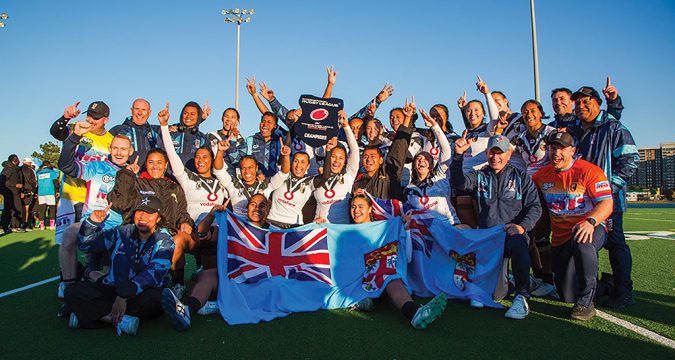
Fiji secured the last remaining spot in next year’s women’s World Cup with victory in the World Series qualifying tournament held in Canada, with captain Cass Staples leading the way, writes THOMAS LAW.
IN THE end, it wasn’t much of a contest. Bringing together four teams from four continents to battle it out for the final World Cup spot next year, the inaugural women’s World Series saw a surprise Nigerian victory over Ireland and a nilling of hosts Canada – twice previous World Cup participants – by Fiji, in just their seventh ever international fixture.
However, with the resources of the NRLW and a seemingly exponential growth in popularity of the sport in the South Pacific, Fiji were already a step above the competition in October, as demonstrated by their final 62-4 win against Nigeria.
For free-scoring winger and captain during the tournament, Cass Staples, it was the culmination of much hard work. “It’s awesome we won. It’s a goal achieved, something Fiji Rugby League has been working towards for a very long time now. To get that milestone ticked off, it’s historic. I’m blessed and humbled, it’s one of the most memorable moments of my career.”
The World Series presented a unique set of challenges for all visiting teams, Fiji included. They travelled over 30 hours just to reach Brampton, had no video material of either Canada or Nigeria, played on an artificial turf pitch with Canadian Football gridiron posts rather than the rugby league ‘H’.
The travel and time together (for many their first time away from Australia or Fiji) did however allow for the group to bond, both on and off the pitch, with trips to both Niagara Falls and a Toronto Raptors basketball game.
“It’s what makes you work hard for that person on the field, knowing their character, value, what’s important to them. We learn how we can work together better,” explained Staples.
Attention has already shifted to the 2026 World Cup, and for Shane Morris, assistant coach of the Bulikula since 2023, this is yet another milestone in his 21-year association with Fijian rugby league. Following their World Series success, he is unequivocal about their aspirations and desire to more than just make up the numbers.
“Yes, we will be the underdogs,” he said. “But with the depth of players we have and the connection within the group our goal is to be in the semi-finals.” It’s a lofty ambition, but a belief in their ability that is shared by Staples. “We’d love to take it to the finals, we 100 percent have the ability to podium.”
For Fiji, the “competition goes up another level next year,” in the words of Staples. “We take none of these teams lightly. In saying that, we’ve got incredible athletes. There’s already a lot of talk about next year’s campaign, how we can improve things, get the players best prepared. The preparation has started, there are positive signs. We’re ready for the challenge, and excited to see what the puzzle looks like.”
Fiji will also go into 2026 knowing they will be bolstered not only by the addition of Cronulla’s NRLW head coach Tony Herman (who lead the new entrants to the 2024 Grand Final) but four bona fide national talents that didn’t feature in Canada: captain Talei Holmes, halfback Losana Lutu, winger Taina Naividi, and forward Nanise Vakacavu.
“A couple needed a rest after a big year in the NRLW, a couple had surgery on injuries so they will be fit and ready to go in 2026,” said Morris.
“Our main focus is the health and family of the players, so when the World Cup starts, they’re good to go.”
It was an opportunity capitalised on by the four local talents plucked directly from Fiji’s domestic competition: Josiliva Vere Moceinacagi, Kinisalote Vusawa, Nunia Kawa, and Naomi Tegu – the latter of whom scored a try against Canada.
“She has been a part of the group for two years now and it was great to see her wear the jersey and represent her country, family, but mainly seeing her hard work pay off,” added the assistant coach.
This inclusion of domestic talent was not just a quirk of some late withdrawals, but a fundamental strategy and goal of Fijian rugby league. For Staples, born in Australia to a Fijian mother and a father of Franco-German origin, it’s simple: “You can’t be what you can’t see.” For Morris, who helped establish schoolboys programmes in Fiji two decades ago, it’s a guiding principle. “We’re growing in stature. The main goal is engaging and encouraging Fijian women to play rugby league with a vision of being a future Bulikula player.”
Morris outlined the squad’s philosophy and tactical set up at the World Series: “Our focus was for us as a team to be connected, trust in the person beside you, and be better than your opposite number. Adapt to the opposition and target key players, but our main focus was to complete our sets, control the ball, run hard with support, tackle with purpose in numbers, and just compete in every play. Play for your teammate beside you and be the best you can.”
Staples expanded on this, saying, “We didn’t look at either side, not in too much detail, it was more about us. If we performed, stuck to our own game plan, we’d be able to win. We focus on our own team, our own tournament.”
That tactical, physical, sporting display and belief is likely to persist into 2026.
Of course, the World Cup will be a step up from the World Series. But the mood is positive and optimistic in the Fijian camp. The gap between the traditional big hitters (Australia and New Zealand) and the rest of the Pacific teams is shrinking, whilst the gulf in class between the region and teams from the rest of the world grows precipitously – something for the three European, non-Pacific teams, England, France, and Wales, to consider before dismissing opposition from the region.
However they fare, they are likely to captivate Fijians and neutrals alike, as they did in Brampton. On a deceptively cold Tuesday night, a small but enthusiastic crowd of players’ families and friends, various diaspora communities, and a cheerful if inquisitive home support (including provincial ministers) could not help but be taken in by the sight, after watching Fiji thrash the hosts, of the visiting players bowed together in a circle, singing Christian hymns in unison. It’s a feature that has won Fiji’s men admirers in the sporting world in previous World Cups, and now the women will have the opportunity to do so too.
“Hymns are very cultural, it’s part of our team,” according to Staples. “Fiji is a huge faith-based country, we put God first, before footy, before anything else. We trust in our faith, it’s something the country’s really passionate about. The experience of it, getting to understand what it means, to feel what it’s like to sing is something that moves the spectator, never mind participant. It’s completely empowering, as a woman, to be able to share that connection among so many different girls.”
First published in Rugby League World magazine, Issue 515 (December 2025)