
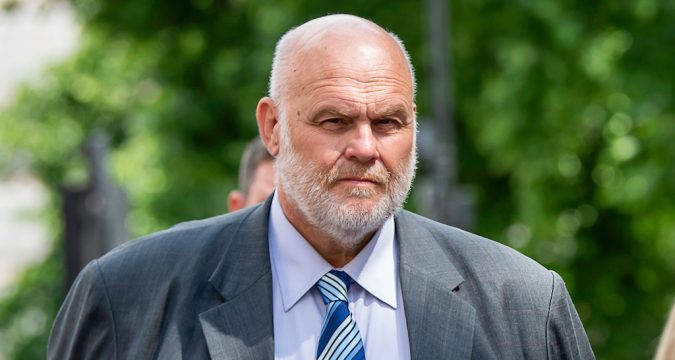
NIGEL WOOD was confirmed in July as the Chair of the Rugby Football League, more than seven years after he quit the organisation as its chief executive.
It’s a remarkable comeback, with Nigel having emulated Donald Trump in making what looked like an impossible return.
The difference is that Trump spent billions on his campaign to regain the Presidency, while Nigel, as far as I’m aware, didn’t have to spend anything.
While Trump had to appeal to millions of American voters, Nigel’s return was at the behest of the clubs, who had grown dissatisfied with the RFL’s performance under its previous chairman Simon Johnson.
With the game appearing to be sliding into a financial crisis, with Salford the most obvious symptom, the clubs wanted someone with financial skills who could reverse the trend of accumulating losses, primarily by improving the game’s commercial performance but also by making savings where possible, while also giving Super League in particular a greater sense of its own growth potential.
There have been various estimates of how much money the Super League clubs are currently losing annually, with the most reliable reports suggesting the combined figure is around £20 million for the twelve clubs.
And that’s before we consider how much the clubs outside the Super League are losing.
Clearly any organisation can only continue making losses for as long as someone is prepared to underwrite them.
As things stand, eleven of the twelve Super League clubs are in the fortunate position of having owners who are prepared to make that commitment.
But none of the owners are in the first flush of youth and they won’t be there forever.
Will there be any replacements for them when they finally decide to retire or when nature takes its course?
That is the great uncertainty and it’s why we should all hope that Nigel is able to succeed.
It’s fair to say, however, that his return to the RFL hasn’t been met with universal acclaim among rugby league supporters.
For example, on the Totalrl.com website fans forum, one member posted the following message.
“His severance package was 300k. The loss on the Odsal shenanigans to the RFL is, what, 900k.
“His vison (sic) is forever short term. His list of failures extensive. The damage caused by his actions irreperable (sic).
“So, yes, I’m happy to accept for me that it is personal *as well as* the absolute unnecessary carnage caused by the ridiculous coup that, so far, has delivered precisely nothing.
“So I can add to the list above: failure to deliver review on time, failure to take control of any of the issues affecting the game, failure to be open on any aspect of governance.”
These complaints about him are common among those who don’t like him. So let’s examine them to see whether they are justified.
In reality the severance payment to Nigel on his departure from the RFL in early 2018 was merely the contractual payment on the termination of his employment that he was entitled to, just as anyone leaving a major post would receive.
He could hardly be expected to turn down a payment that was his due for losing his position.
As for the RFL’s dealings with Odsal, the Bulls sold their long leasehold interest to the RFL in 2012 for £1.2 million, with the Bulls agreeing to pay a rent of £72,000 per annum, representing a six percent return to the governing body.
That was a perfectly respectable deal for the RFL to strike.
Or at least it would have been if the Bulls hadn’t run into financial difficulties, in the first instance because its overdraft facility was withdrawn, and in the second because it suffered relegation from Super League in 2014.
With a massive reduction in funding, its financial position became critical and it went into liquidation on 3rd January 2017, with a new company having to be formed to revive the club, but robbing the RFL of its rental income and therefore reducing the value of its leasehold interest in the site, which it would eventually sell back to the club in January 2025 for £260,000.
To believe that somehow this was all planned by Nigel Wood to somehow benefit himself is fantasy of the highest order.
Is Nigel’s vision short term?
Listen to the League Express Podcast, when he joined Jake Kearnan and I to discuss his plans for the game the day after his accession to the chairmanship, and decide for yourself.
The truth about him is that he is a financially astute, insightful lover of rugby league.
His major problem when he was the CEO of the RFL was that he paid little attention to his own public relations, which he now admits.
His critics, on the other hand, were only too vocal.
And of course we can judge his tenure by what came after it, when a succession of much more expensive individuals managed to generate less income and more financial crises for the game.
In those circumstances I’m happy to welcome him back. But there is one more thing that needs to be made clear.
Nigel is returning to the RFL as chairman, not CEO. His position will be as a non-executive and he won’t be getting paid.
The same is true of the other new non-executive directors of the RFL.
So the RFL and RL Commercial will already be saving around £200,000 per year by not having to pay the previous incumbents.
It’s not a bad start on the difficult road to financial stability.
First published in Rugby League World magazine, Issue 511 (August 2025)