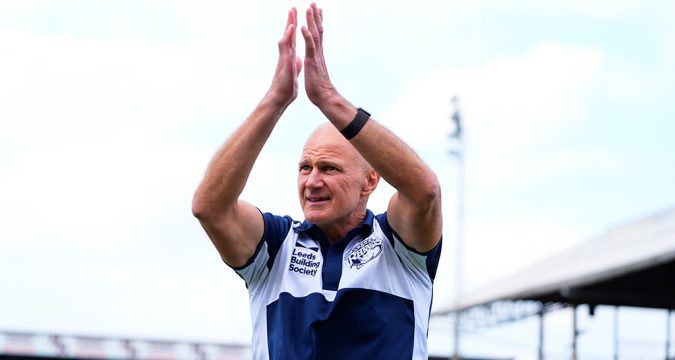
After a summer of speculation, Brad Arthur is staying at Leeds for another year. Considering his impact so far, that is only good news for the Rhinos faithful.
IN JULY 2010, LeBron James became a free agent for the first time in his NBA career, sparking a clamour as a host of rival sides chased his signature.
The media demanded to know his next move at every turn and so James took control of things himself, working with ESPN on a 75-minute TV special called ‘The Decision’, during which he revealed live on air that he would be joining Miami Heat.
While the basketball megastar partly regretted making the show in later years, despite it raising millions of dollars for charity, it provided inspiration eight summers later for French footballer Antoine Griezmann to do the same with ‘La Decisión’ on Spanish TV channel Movistar.
At the end of a half-hour documentary which showed him going about his life while deeply contemplating a transfer move to Barcelona – and having even recorded two different endings – Griezmann eventually committed to stay at Atlético Madrid.
If rugby league here had anything like the clout of basketball in the USA or football in Europe, perhaps Brad Arthur could have done something similar after all the fuss made, in admittedly far smaller circles, over whether he would remain as head coach of Leeds Rhinos.
Happily, Arthur would not want the publicity. Quite the opposite – he appeared entirely bemused as to why anybody took the slightest bit of interest in his future at all.
Questions have been asked of him every week since the early rounds of this season. ‘Would this new job opening persuade you to leave? Will your sons sign for clubs in England? When will your daughter go back to university? And does [insert result here] make you more likely to stay/go?’
Finally in mid-August, white smoke rose from AMT Headingley as the Australian penned an extension for at least another season, as part of a rolling deal.
The way he told his players says everything: “I just popped my head into the window over lunch, said I was staying and walked out. I didn’t want to make a big deal out of it.”
Make no mistake, however – Arthur’s retention is a big deal for Leeds.
When he signed a short-term deal last July he joined a club not just at risk of missing out on the play-offs for a second successive season but suffering a wider crisis of confidence, having undoubtedly lost its place at Super League’s top table.
While Arthur proved unable to lift them into the top six in the ten games he was afforded, he reckoned he could do something about the latter and agreed a new contract with sporting director Ian Blease, who appointed the coach shortly after his own arrival in a key structural change at the top of the club.
And after burning through coaches David Furner, Richard Agar (who at least claimed silverware, the Challenge Cup in 2020) and Rohan Smith, Leeds now appear a greater force than at any time since Danny McGuire and Rob Burrow lifted one final Super League title alongside Brian McDermott in 2017.
Of course, Arthur is not one to brag about his achievements. “We’re building a club to a position where the coach is important but not the be-all,” he says.
“The players are more important, the staff around the place, the identity of the club and how it wants to be seen, its standards and expectations. I just become the driver of it.
“I’m just grateful that everyone has bought into the ideas I’ve had and taken control of it.”
But ask anybody else at the Rhinos and the scale of his influence on and off the field becomes clear.
Co-captain Cameron Smith says: “The specific style he wants to play really complements our team and the roster that we’ve got. He’s really honest. He’s a great coach and he’s a had huge impact on us.”
And Blease says: “The gameplans he puts together for each team are different. He’s really clinical in his approach with the boys. He’s brought some really good standards to this club and that’s what we needed. Fans love him, players love him, staff love him.”
On the pitch, Leeds look a new team. Following the swashbuckling days under predecessor Smith, the club wanted a harder, grittier edge, and as well as recruiting big forwards like Keenan Palasia and Cooper Jenkins, Arthur worked from the start of pre-season on developing a resilient attitude and, alongside influential new assistant coach Jamie Langley, a more solid defensive structure.
After 21 rounds of the season, only Hull KR and St Helens had conceded fewer points than the Rhinos, at a notch above 12 per game. They had missed the fewest tackles (584) of any Super League side, and conceded the fewest penalties (81).
They’ve also had more of the ball than any rival this year, and are effective with it – only Hull KR made more metres while their 229 offloads were the most of any club.
The fact they had only scored 77 tries (compared to 126 for the table-topping Robins) indicates room for improvement but Arthur is most proud of the fact they have competed in every game, their biggest defeat being by 14 points at St Helens in June.
“We’ve shown we’re good enough to beat the best teams,” he says – the only side they haven’t got a win over yet is, oddly enough, struggling Catalans. “But if we want to be the best team we need to do that every week.
“We’re getting closer to it. We haven’t been inconsistent at all – at the 70-minute mark we’ve been in a position to win every game this season. At times we just find a way to put ourselves under pressure. When we get better at that, we’re going to be extremely hard to beat.”
Errors have indeed been a significant undoing, with only two sides making more than their 238 – one for every seven minutes of play.
But it’s not unfair to recognise that the individual talent in the Leeds squad, who haven’t had a top-four finish in eight years, isn’t on par with aggressive spenders Hull KR and Wigan.
This is a team playing as greater than the sum of its parts – although some of those parts have certainty been upgraded or rebooted.
Lachlan Miller has developed into a more well-rounded fullback. Ash Handley has been moved to centre with great effect. Bench prop Sam Lisone now plays for a good time, not a long time.
Meanwhile a couple of the old guard, in Ryan Hall and Kallum Watkins, are enjoying final hurrahs and proving that their returns to Headingley were far from purely sentimental.
But perhaps the greatest achievement is not only accommodating Jake Connor, a surprise off-season signing from Huddersfield Giants, but prising out some of his best-ever form by giving him the keys to the team at scrum-half.
“I love winning, but I also love seeing guys be mentioned for the England team at the end of the year, and the development of our young guys,” says Arthur.
“But the biggest thing I enjoy is the look in the boys’ eyes when they come off, whether there’s a hug or a handshake. That’s the bit, the connection, knowing they’ve had a real crack for their club, their team and for me.”
Arthur is confident they can go on a play-off charge this season. Should they fall short, they will be heavily fancied to go better in 2026 after a second pre-season under the coach and few changes of personnel anticipated.
But the Aussie is always looking beyond that – at the structures of the club, at the development of its youngsters. He sees himself merely as a steward, looking after the club and improving it for the next person to come along, whenever that may be.
He explains: “I’ve learned a lot about leadership and it’s not just about telling people what to do. It’s about giving guys control of those opportunities.
“You build better leadership if you have lots of people contributing. It’s been a really good experience for me that while we’re trying to get success and silverware, the main legacy I wanted to leave is that whenever my time is finished at this club it’s going in the right direction and it’s in a better place than when I arrived.
“At the moment I feel like we’re heading in the right direction.”
For as long as that remains the case, Leeds supporters will want him to remain at the helm – even if that means another long saga over his future next year.
First published in Rugby League World magazine, Issue 512 (September 2025)