
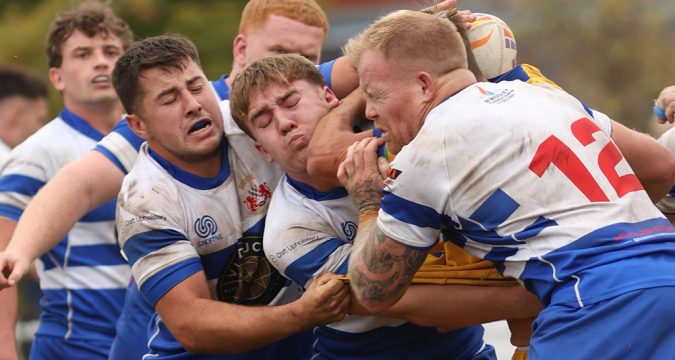
SATURDAY, March 7, 2026 will surely go down as a truly historic day in the annals of British Rugby League.
It will be that on which the National Conference League, which would have been 40 years old this year, will be replaced by competitions introduced – against strong resistance, it has to be said – by the Rugby Football League.
I’ve said quite a lot, for and against, in recent months (even years, in truth – I speculated on some of the measures which the RFL have brought in, notably more regionalisation, long before they were broached publicly by anyone at headquarters).
My broad plan, now, is to sit back and watch as events unfold – and, of course, report to our readers on them.
For now, though, just a couple of points.
The RFL countered, late last week, the previous understanding, which I touched on in last Monday’s column, that minimum standards criteria will not apply for inclusion in the National Premier Division and National Division One (sections replacing the old Premier and First Divisions of the NCL).
In fact, they will. Indeed, it goes deeper than previously, when it was accepted that not all clubs harboured ambitions to join the National Conference League.
Some, for example, didn’t want to incur the increased travel costs involved, while others had no desire to ask their players to undertake potentially lengthy journeys every fortnight for away games.
Such outfits therefore chose to remain in their relevant regional leagues.
That’s no longer such a simple option, apparently.
Under the new National Community Rugby League structure, teams who do well in any of the various regional conferences (whether Cumbria, North West, South – I believe – or Yorkshire) could find themselves making the 16 involved in Cross-Conference play-offs, the prize being inclusion in National Division One.
Those who don’t meet the minimum criteria required by the old NCL will, say the RFL, be given the help needed to reach that standard.
And those who are already at the benchmark must, it appears, go up, whether they can afford it or not, or whether or not their players agree.
I know this because I asked the RFL the question: “What will happen if a promoted club fail to meet that criteria (or, more likely, refuse to go up)?” and was given the answer: “Promotion is mandatory and cannot be declined, as set out in the competition rules.
“If a promoted club have not yet met the minimum standards, the RFL will work with them to ensure they reach compliance within agreed timeframes. The system is designed to support clubs, not exclude them, but promotion itself is not optional.”
So there you have it: “Promotion itself is not optional.”
Quite where that will leave those outfits who, for whatever reasons, never sought inclusion in the NCL despite being good enough in every way is a moot point.
They could end up skint, or losing players, or both. Another option, perhaps, is that a team who do well in their regional conference could, with a nod and a wink, field a younger side at the Cross-Conference play-offs stage, or at least not operate at full strength.
I’m starting to have visions of clubs with similar views about the desirability, for them, of the National Leagues effectively “waving each other through” on the field of play.
A potential nightmare is beckoning and the phrase used by the NCRL’s dissenters of “if it ain’t broke don’t fix it” is coming to mind.
Having said all that, I’ve been struck by, despite the high politics of recent months, how few players or coaches seem to care that much about the wrangle. They mostly just want to get on with games.
That was essentially the view of Ryan Steen, the coach of West Hull, who were the last team to win the National Conference League title.
The Green and Golds will, on Saturday, host old rivals Wath Brow Hornets at the start of what, from the players’ perspective, will be a seamless continuation of the action of recent seasons.
Those outside the top two sections of the new ‘pyramid’ may take a different view, including those with no desire to fly as close to the sun as proved so costly for Icarus. Time will tell.
Meanwhile, other competitions set to launch this weekend include the Cumbria, North West and Yorkshire Conferences, together with the North West Men’s League.
At youth and junior level, we have the Girls, Hull and North West Youth leagues, while I’m unsure about the Barrow, West Cumbria and North East leagues as I’ve had nothing from the hapless GameDay agency (which failed to provide BARLA National Youth Cup results last week – no surprise there).
Nor have the RFL answered my request for information – that has surprised me, to be blunt.
My fervent wish is that things will settle, and quickly.
On a more positive note, it was good to learn that the RFL are pushing the old BARLA National Cup. I was told, late last week, that 38 teams have entered.
And, to revisit the subject of the recently-released ‘A History of Halifax Rugby League’ by Andrew Hardcastle (who, with colleagues Chris Mitchell and Paul Field – as the Calderdale Community Trust – secured funding from the Heritage Lottery Fund back in 2023) I can confirm that copies can be purchased for £9.99 (plus £3.99 p&p) by emailing chris-mitchell@live.co.uk.
Finally, what a win on Saturday by Cardiff Blue Dragons in the Wales Wheelchair League!
The Dragons staged a real upset by beating North Wales Crusaders and will now feature in Sunday’s Grand Final against South Wales Jets.
It’s a ‘must-attend’ event and, as a further attraction, the game is being played in the beautiful Welsh spa town of Llandrindod Wells. Get there if you can!