
The NRL announced earlier on Tuesday that it has negotiated a seven-year TV contract that is worth A$5.3 billion.
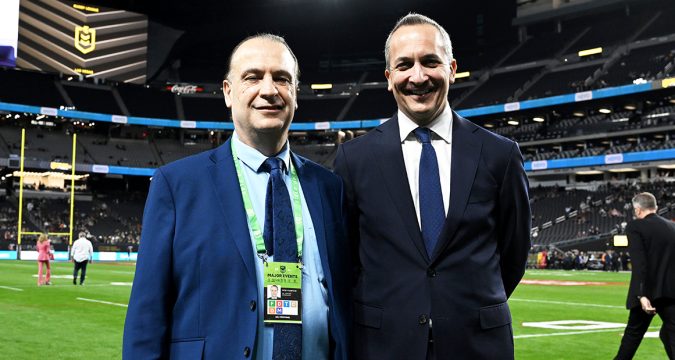
The story had been leaked to the media several days earlier, but now the NRL Chairman Peter V’landys and his CEO Andrew Abdo, sitting alongside the heads of DAZN and Channel Nine in Australia, have confirmed the details.
That is great news for Rugby League, not just in Australia and the southern hemisphere, but also for Rugby League in our part of the world.
And now that the deal has been done, attention in the northern hemisphere will now turn to a potential partnership between the NRL and the RFL that might increase the value of Rugby League in our part of the world.
There have been talks about talks going back probably around 18 months and RL Commercial CEO Rhodri Jones revealed recently that the RFL has lodged a proposal with the NRL, without revealing the details, and the RFL is now waiting for a response. Now that the NRL’s broadcast negotiations have been completed, we may at last find that the Australian body can turn its attention to its proposed stake in the game in the northern hemisphere.
Whatever format any future partnership might take it will need to benefit both the RFL and the NRL or it will be a non-starter.
So let’s look at this from both viewpoints. What do we need and what do they need from any potential agreement.
Right now we earn a derisory broadcasting income compared to the NRL’s new deal and the club owners have to dig their hands in their pockets to make up the difference.
So the RFL needs to generate future growth that will enhance the income generated by the Super League competition.
In order to do that, it must do something different. In the medium to long term it almost certainly needs to expand the competition geographically, which probably means bringing London Broncos into the competition and looking at other potential clubs that might added down the line.
The NRL is enjoying a huge run of significant success and a fundamental reason for that is surely because it is growing all its metrics.
It is attracting higher attendances, higher TV viewing figures, more participation, more social media coverage and, most importantly, the NRL competition is expanding to Perth, Papua New Guinea and probably to the New Zealand city of Christchurch in the near future, while it also initiated the bold move to start the season in Las Vegas.
That investment has clearly been repaid several times over.
In other words, success breeds success.
But the dilemma for the NRL is that it might have reached the limit of its possible financial growth in the South Pacific region.
What the NRL now needs to do is take on responsibility for the international game.
The current international governing body has very little income and therefore very little power and influence.
Without resources it can’t achieve much.
But the NRL, with its resources, could achieve far more in developing the international game.
But in order to do that it needs to strengthen some of the northern hemisphere nations, emulating the success it has already achieved in the South Pacific.
That’s why, if I were running the RFL, I would try to persuade the NRL to take responsibility for establishing a major new club in South Wales with the ultimate aim of developing a Super League club and strengthening the Welsh national side, while a return to Paris would also pay dividends for similar reasons for the French national team. Dublin is another potential venue for a nascent Super League club with a view to reinvigorating the Irish national team.
I think that would be a win for both parties.
We discuss these and other issues in this week’s edition of the League Express Podcast.