Our time machine checks out the former Wigan and Great Britain player who was a real sporting all-rounder.
FORMER rugby league players recently donned whites for a cricketing version of the Hull derby staged to raise money for charity.
It stirred thoughts of the occasional cases of gifted stars who have combined the two sports at a high level, with Courtney Winfield-Hill a recent example.
The Australian was a quickie for Queensland Fire and Brisbane Heat before moving to the UK and taking up league, a sport she had played in her youth, and representing Leeds Rhinos as a half-back in the Women’s Super League between 2018 and 2022, when she also appeared for England in the World Cup.
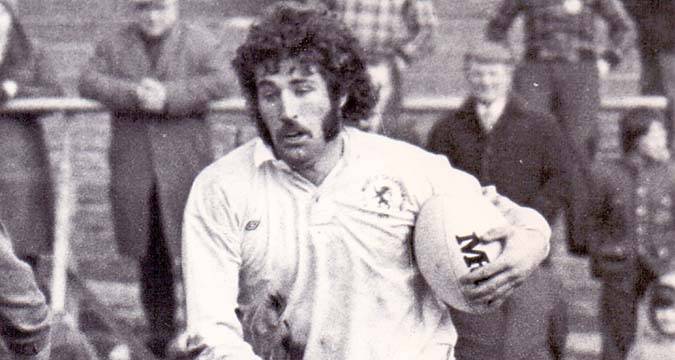
Meanwhile back in July 1973, Wigan recruited a new forward in John Gray, adding another dimension to an impressively varied sporting career.
The then 25-year-old might have been following a fairly common path from rugby union to league, turning professional after catching the eye as a hooker with Coventry – a leading club of that period – and touring the Far East with England in the 15-a-side code.
But he had also played first-class cricket for Warwickshire (in 1968 and 1969), having as a 17-year-old turned down the chance to sign for Coventry City Football Club because he wanted to remain in full-time education (he was to go on to graduate from Loughborough University and become a maths and PE teacher).
Gray proved a star turn at Wigan, winning a Great Britain call-up less than five months into his league career, heading down under on the 1974 Ashes tour and featuring in England’s first match of the 1975 World Cup.
By that time he had sealed a lucrative move to Australia, where he had two spells with North Sydney Bears either side of a stint at Manly-Warringah Sea Eagles, and was credited with helping usher in the round-the-corner goal-kicking technique and named Dally M Hooker of the Year in 1982.
Born in the village of Meriden, between Birmingham and Coventry, in October 1948, Gray excelled academically as well as proving himself a talented sporting all-rounder at school.
While he rejected Coventry City’s advances, he continued seriously with cricket, and having impressed as a left-arm medium-fast bowler with Warwickshire’s seconds, made the first team by the end of the 1968 season, taking six wickets over the course of a 175-run County Championship win over Kent, who were to finish second in the table, at Edgbaston.
His teammates included Mike Smith, the captain of England who also represented the country at rugby union, cricketing international Dennis Amiss and West Indies stars Lance Gibbs and Rohan Kanhai.
Gray also appeared in 1969, and the county were keen to keep him on board, but he later explained in an interview with League Express: “The problem was you were only playing for six months, and didn’t earn enough to last you for the whole year, so you were looking around for something else. I just didn’t see that as a career.”
Having long felt his physical size and build made him more suited to rugby than football, he played union for both Loughborough University and Coventry – whom he helped win the RFU Knockout (later John Player) Cup in April 1973, scoring a try in the 27-15 win over Bristol in the final at Twickenham – as well as Warwickshire and the Barbarians.
In 1971, he had been selected for England’s tour to Japan, Hong Kong, Singapore and Sri Lanka which formed part of the RFU’s centenary celebrations, and in April 1973, featured alongside soon-to-be Salford winger Keith Fielding for an England Sevens team.
In October of that year the pair came face-to-face in league’s Lancashire Cup Final, with Gray playing prop and kicking four goals as Wigan, coached by Graham Starkey, beat firm favourites Salford 19-9 in the final at Warrington’s old Wilderspool ground.
“We’d won the International Sevens tournament up in Scotland and I’d won the Knockout Cup with Coventry, and Wigan came in for me,” he reflected in his interview.
“They offered me £5,500 and a job (still as a teacher). My salary then was around £850, and it was just too much to turn down.”
While Wigan were entering a period of decline which culminated in relegation from the top flight in 1980, Gray flourished at Central Park, and in early 1974, he made the Great Britain squad (earning himself a £1,000 bonus through his club contract) for two internationals against France.
He came off the bench to feature in the wins in Grenoble and on his home ground, where he scored a try and landed a goal, and a call-up for that summer’s Australasian tour followed.
Gray appeared in all six Tests, playing a starring role as hooker in the 16-11 win over Australia in game two at the Sydney Cricket Ground (the Kangaroos were 2-1 series winners) before helping the Lions twice beat New Zealand.
The Aussies were clearly taking note, because in March 1975, after helping England beat France in Perpignan and Wales at The Willows, Salford, to win the European Championship, then defeat France in the opening stages of a World Cup which was spread over eight months, the 26-year-old agreed a move to North Sydney, with Eastern Suburbs also seeking his signature.
“Wigan initially put a £20,000 tag on me, which was crazy,” he recalled. ‘They eventually reduced it and North Sydney paid £12,000, which was still big money.
“The money I was offered personally was huge compared to England, and I could still work as a teacher as well as playing rugby.”
Gray was a hit with the Bears, and although they lost 21-7 to Balmain Tigers in the final, was named player of the popular midweek AMCO Cup tournament in 1976.
He had three years at Manly from 1978, when he missed out on both the Grand Final draw with Cronulla-Sutherland Sharks and subsequent replay victory through suspension, then spent a further three years back at North Sydney.
First published in Rugby League World magazine, Issue 513 (October 2025)