
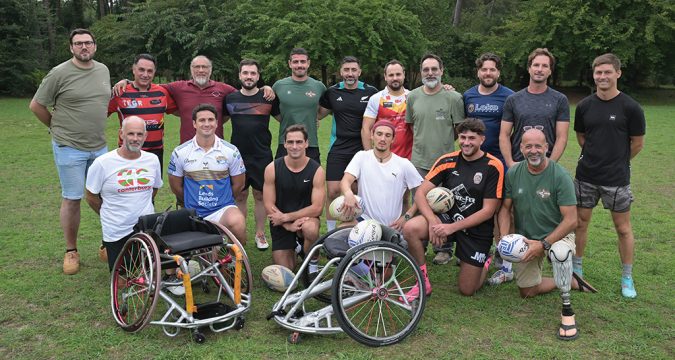
A chance meeting, and a Leeds rugby league shirt, has resulted in the rebirth of one of French rugby league’s most iconic clubs and the opportunity to reintroduce the sport in a unique region of Europe.
THE French wearing berets! The perfect cliché about my countrymen and my countrywomen, right?
In case you ask yourself, the author of these lines has never worn one. But one of my grandfathers would do it every day, and there’s a good reason for that.
My grandfather lived close to a specific area of France. Let me try to make you guess which one.
An area in the south of France, where you can find beaches, at the Spanish border. A region which has a strong cultural identity where people may be bilingual; speaking French or Spanish but also a very specific local language.
No, this area is not Catalan country for once.
This cultural region is called Pays Basque (Basque country). The place where the beret is supposed to come from.
If you look at Pays Basque today, you may fear that this part of France is reluctant to welcome rugby league. Basque country is a wealthy area where union rules and prevails over the national sport, football. At the south of the border, on the Spanish side, you find the same situation as in the Catalan country, football rules! But union managed to relocate several of their major games, in Bilbao, for instance. And not just any games: the Grand Final of their so-called European Challenge Cup. It tells a lot about the strategic importance of that transnational area.
Yet, it used to be rugby league country too, in particular with the famous Côte Basque XIII (Basque Coast team). A team created in 1934, and not attached to one city only but to several, such as Biarritz, Anglet and Bayonne. A team even coached by a Welshman, Tommy Parker (1935-1937) and which won the Coupe de France in 1936. And among its players a certain Justin Davant. Please keep in mind that family name for a little while. The club disappeared in 1958. There were a few attempts to relaunch that team in the 1970s but they all failed.
Relaunching a team in Pays Basque (like relaunching a team in Pau, in the neighbouring area) has been one of French Treizistes’ oldest aims for decades.
But it has become a reality thanks to an impromptu meeting between two men of different generations in a fitness room one day; Renaud Davant (great-grandnephew of Jusin Davant mentioned earlier) noticed a man wearing a rugby league shirt. Quite unusual in an area regarded as the lion’s den of union. The man he noticed was no less than 56-year-old Olivier Dumeaux. Although, he may need no introduction let me try to sum up his profile; Dumeaux was born in Villeneuve-sur-Lot and then played for Toulouse, was afterwards assistant coach for Cahors XIII and Villefranche de Rouergue. He also has international experience, as he was part of the coaching staff of the French and the Moroccan national teams. Not to mention his experience at refereeing (in rugby league and also at wheelchair rugby league). He is now a French teacher in Bilbao (Spain) and settled in Anglet, along with his wife.
Davant is a 33-year-old civil servant working for the city of Biarritz, with some interesting skills for growing our game; he deals not only with the growing of the Basque language but he’s also an audio-visual technician. Davant had noticed the Leeds jersey worn by Dumeaux (given to him by Justin Sangaré). A discussion started and both decided to embark on an adventure.
The beginning of an adventure which was welcomed with enthusiasm by the Treiziste community this summer.
But how is the project progressing?
Davant told me: “We got not only a pitch for our training sessions but we’ve now also got a stadium for our games, both in Anglet. This is big! It’s now our job to do everything to be taken seriously.”
Actually, they were taken very seriously by the French Rugby League Federation (FFR XIII) as they are now officially registered to play in DN3 this season in the pool West. It is the ideal championship for them as it’s contested by western and south western teams such as Nantes, XIII Gascon (based at Faugerolles), Toulouse Jules Julien, Villeneuve-de-Rivière (close to Saint-Gaudens), Pamiers, Valderiès (near Albi) and Saint-Pierre de Trévisy (at the south of Albi).
Dumeaux has set ambitious but also realistic objectives for the team: “We can count on a squad of 25-27 players for this season. Our aim is to retain a population of union players and fans for our code and be able to qualify for the knock-out phase at the end of the regular season.”
Dumeaux confessed to me also that he was in touch with Trent Robinson and Justin Sangaré. Maybe they will give him pieces of advice for the season?
I was also curious to know if they were in contact with Aingirak Euskadi (Basque country’s Eels), the rugby league wheelchair club which was created in 2011, and is also based in Anglet.
Davant replied: “When I started looking for contacts, my first move was to visit Aingirak and to offer them to create a rugby league section. Unfortunately, it was not possible so we had to create our own. But we keep in touch with them, and we’ll try to pool our requests to the city hall and to help one another. Moreover, our training grounds are nearby.”
I was also curious to know the amount of the Basque language in the project; indeed, the first publications of the club on the social networks were in French and Basque language, the latter being unique in Europe and has nothing to do even with the closest other languages, French and Spanish.
The cultural content of the project is a clearly intended decision.
Davant explained: “With this project, I wish to unite the seven Basque cultural provinces, to symbolically abolish the frontier between France and Spain. I often talk with the people living on the other side of the border; they may see coverage about our team in the future. Yes, the identical and cultural approach goes with the territory. I speak Basque and several players of the team can communicate in this language as well.”
The motivation of both Basque Treizistes is at its highest, as Dumeaux concluded: “We’ll do everything to make Basque Country a big place for rugby league.”
The return of Côte Basque XIII is some welcome positive news for French rugby league, especially after two rugby league clubs recently turned to union; Le Vertou (west) and Normandy’s Saint Pois (see RLW 471 for the creation of that club). In both cases, the clubs’ managers were approached by union, and made the decision to switch codes. The first club allegedly because of a lack of support from the FFR XIII, the second because of some kind of takeover by union people at the head of the club.
In order to avoid that situation being repeated with Côte Basque XIII, full support to this new club is necessary not only from the French Treiziste community but also from the European Rugby League Federation, given the transnational aspect of this project.
First published in Rugby League World magazine, Issue 513 (October 2025)