
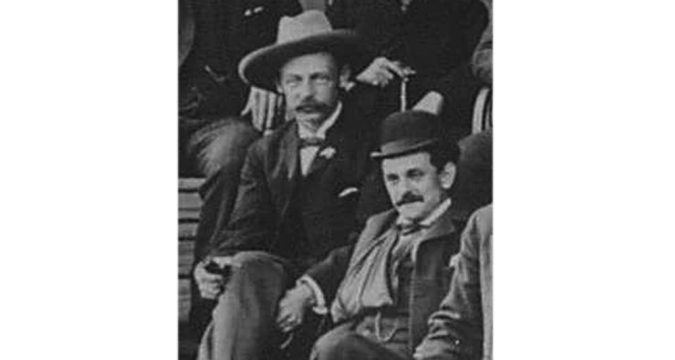
STEVE FOX celebrates the founding of the Widnes club 150 years ago.
FARNWORTH & Appleton Cricket Club (formed 1871) does not appear in any histories of that sport and with good reason.
Whereas local rivals Widnes CC were established and organised enough to employ a professional from Kent, Farnworth & Appleton often turned up for away games with several players short, such that they had to borrow fielders from the opposition and required some of their men to bat twice.
But their contribution to posterity stems from an announcement at their fourth annual dinner party in early November 1875. Prior to dancing to the lively strains of Mr Powell’s Efficient String Band (which sounds like a beat combo from the psychedelic era), Chairman Henry Lea announced to the eighty or so assembled guests that their organisation, “…had now started a football club in connexion with it, and hoped all would join.”
Farnworth & Appleton FC wasted little time in getting underway.
On 27 November 1875 they hosted their first game, on an unfenced field off Albert Road, against the visiting Crewe St George fifteen. For those that know Widnes, the location later became the site of The Premier cinema and a Wetherspoons pub now occupies the spot. The match finished in a goalless draw, one newspaper report noting that the home team faded after a strong start on account of it being their first match.
Perhaps there were no tries that day or maybe the reporter was unaware of the momentous decision earlier in the week at an assembly of leading rugby clubs and certain of the home unions. Up until then rugby results, like soccer, were determined simply by goals scored, but that meeting had ruled that the number of tries would now count as a tie-breaker in the event there were no goals or if goals were equal, though it was still the case that one goal would outweigh any number of unconverted tries. Interestingly, another proposal was narrowly outvoted which would have included “touchdowns” in the scoring system, a touchdown being the act of a defender grounding the ball in his own in-goal area.
The new Farnworth & Appleton club continued to play occasional fixtures during the winter of 1875/76, including an attempt to encourage the code in nearby Penketh, on which occasion the players carried their goalposts to the match, the home team not possessing any of their own.
But the most memorable encounter of this inaugural season was surely when the Northwich Victoria team turned up at Albert Road and were shocked to find that the home team were a rugby club whereas Vics were (as, indeed, they still are) a soccer outfit. The Cheshire men sportingly agreed to play the match under the handling code and proceeded to beat the Lancastrians at their own game, one try to nil, though it’s recorded that Farnworth & Appleton played a man short. Several weeks later the return fixture was played under association rules at Drill Field, Northwich with the Victoria men again emerging victorious.
That home/away, rugby/soccer reciprocal arrangement was carried forward to the following season but by then a pair of huge changes had taken place. Farnworth & Appleton CC, described as being in a flourishing condition at that dinner party in November 1875, had ceased to exist just four months later without playing another game. Clearly its members had decided to abandon the summer pastime to concentrate on football. And to emphasise their ambition in the winter sport, they renamed themselves the Widnes Football Club, an official title that was destined to remain until the members club became a limited company in 1993. The rest, as they say, is history.
The Pioneers
In many places, ex-Public School and Oxbridge scholars were involved in the formation of new football clubs, but such men were thin on the ground in Widnes. Elite English education still had a largely classical syllabus and an ability to read The Iliad in the original Greek was of little use when the job at hand in the local chemical factories might be creating sodium carbonate from sodium chloride.
But the sciences were taught at Edinburgh University, which had also been a hot-bed of organised football since as early as 1824. Edward M. (Teddy) Davies, a Ripon-born Scot, had studied there and may have taken part in games or, at least, would have witnessed the sport being played.
This probably explains why he was Farnworth & Appleton’s first (player) coach in a town where few would have seen football played. He worked as a chemist at the Mathieson chemical works, where his boss, and heir to the firm, was Thomas Train Mathieson – another Scot who turned out for the new club in its first season. Mathieson made headlines in 1885 when he was badly injured after jumping into a tank of noxious substances in a vain attempt to rescue one of his workers. He and Teddy Davies were later instrumental in setting up an alkali works in Saltville, Virginia, where Teddy died following a car accident in 1909.
Other members of the local business community who took to the field for the club in that inaugural season were James Beveridge – born in Fife, later a paper manufacturer in Richmond, USA and a co-founder of the famous Runcorn rugby football club – and Josiah T Wylde, a Runcornian chemical manufacturer who left an estate of £11,500 (around £1.27m at 2025 prices) when he died aged 42 in 1892.
The core of the team, however, was made up of amateur participants from the thriving local athletics scene, several of whom were well known across the north of England.
In November 1875, 19-year-old James Hough had recently been featured in a front-page article in the prestigious Athletic News newspaper and 20-year-old William Molyneux Tilley – the club’s first captain – was one of the foremost mile runners in the region. Tragically, Tilley died from tuberculosis aged just 32 so did not live to see his son, Jimmy, win a Challenge Cup winners medal with Warrington in 1907.
The Kenrick brothers, Sebastian, James and William, were also successful track runners at the time.
Finally, of course, there were the cricketers. Nat Farrant and his sibling, John, seem to have been mainstays in the Farnworth & Appleton eleven during its short existence. Despite their relative youth (22 and 19 respectively in 1875), John was captain and Nat the secretary. They were sons of a successful wholesale grocer and the family home, Appleton Villa, was just yards away from the field where their first football game was played a century and a half ago.
John became a cashier and Nat worked for many years as a chemist at a works in Hunslet.
Another cricketer, William Ireland, was a factory timekeeper who later served on the Widnes club committee. His son, George Ireland, had a brief Widnes career in the Northern Union days before becoming an RFL match official (he ran the line at Wembley in 1931) and a local amateur Rugby League administrator.
Early Years
By season 1877/78 some familiar opponents were starting to appear on the Widnes fixture list, alongside such obscure names as Dingle and Flamingoes (both Liverpool clubs).
On 19 January 1878 the Chemics, or Chemicals as they were sometimes called, made the short journey to play a first ever game against Warrington.
“This match…was contested with some fierceness,” noted a reporter, the various “difficulties” being compounded by spectators encroaching on the touchlines. One child was hit by the ball and narrowly escaped falling into the River Mersey. Widnes won comfortably against their inexperienced foes but a couple of months later received a taste of their own medicine when being outclassed by the mighty Swinton outfit.
It had been a coup for the Chemics to secure a fixture against opposition like the Lions in an era when clubs arranged their own playing schedule and tended to avoid match-ups against others who they considered to be beneath them, either in ability or social standing. Swinton were reported to have toyed with a Widnes team with plenty of pace and strength but which was woefully outmatched in terms of tactics and technique.
Two notable names featured on the Widnes teamsheet around this time.
James Concannon was an Irish-born athlete who was crowned Steeplechase winner at the first AAA National Championships in London in 1880. Such was his reputation that the all-conquering Preston North End soccer team later hired him as their fitness trainer in the run-up to the 1888 FA Cup final.
Bob Molesworth was born in Boulogne to a distinguished Rochdale family, his grandfather being a former Vicar of Rochdale and his father a famous historian. They were all descended from the first Viscount Molesworth, making them relatives of the present Sophie, Duchess of Edinburgh, wife of Prince Edward. It is likely that Bob was the first and last Widnes player to be related to royalty.
Within a further two years a man destined to be a world-famous cricketer made his Chemics debut. John Briggs was the Nottinghamshire-born son of the local cricket professional and, although he played rugby for several seasons, his own cricket career eventually took precedence on the way to him becoming the first bowler to take 100 wickets in tests and (at the time of writing) the only man in the sport’s history with both an Ashes hat-trick and an Ashes century. His life and tragic early death have been memorialised in at least two biographies.
A contemporary of Briggs who happily lived to contribute to the Widnes club and to Rugby League in general until his late seventies was JH (Jack) Smith. He was an outstanding forward throughout the 1880s before ending his playing career to focus on refereeing. Smith was already a renowned match official by the time of the 1895 split and he continued in that role for the new code, taking charge of four Challenge Cup finals, including the first in 1897. A formidable administrator, he was variously secretary, chairman and president at Widnes over the course of many decades and a three-time chairman of the Northern Rugby Football Union.
1873 and All That
Readers of a certain age (and who possess at least a rudimentary grasp of maths) might reasonably wonder why 52 years has elapsed between the Widnes club marking its 100th and 150th birthdays. The fact is that the Chemics celebrated their centenary two years early.
In 1972 chairman, Jim Davies, admitted to the local press that the club didn’t know their own formation date and that the landmark anniversary might already have been and gone. Several months later he claimed that records held at Naughton Park now confirmed that the club had been in existence since 1873, though none of this evidence made its way into the Centenary booklet issued by the club at the time, a publication which is suspiciously vague on the subject of those early years.
In all likelihood it was a fear of missing out and the absence of any concrete information that caused Widnes FC to jump the gun as they did. This and the hope that the centenary celebrations would be a useful source of revenue.
In the event, the year was a financial flop and the Widnes public in their thousands chose not to buy a Silver Centenary Medal at “only” £25 plus VAT. This despite the trading-standards-busting advice that, “…rare medals tend to appreciate considerably in value!”