

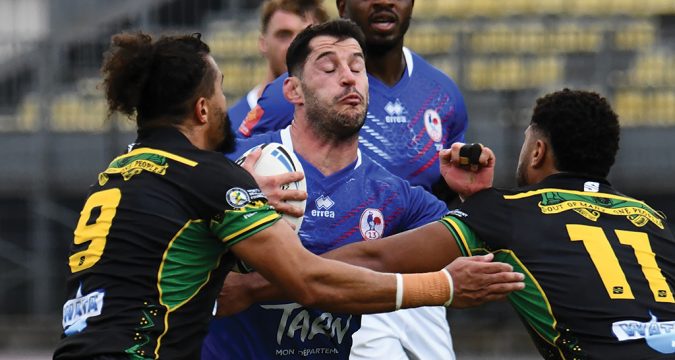
France duly qualified for the next World Cup by defeating Jamaica in Albi, but the game had an even greater significance in terms of building a new presence on television and reaching a wider audience that has become disconnected from rugby league.
PENNING a deal with the public service broadcasters. That was the objective clearly announced by the French Rugby League Federation in the media for the World Cup qualifier between France and Jamaica, which was played on October 25th in Albi, south west of France.
No disrespect to Jamaica, but no one here ever doubted the final outcome of that match, the sole international game for the France men’s team this year.
The main challenge lay elsewhere.
If you’re a frequent reader of Treiziste Diary, or just aware of our problems in France, you know that television is a touchy subject for French rugby league.
To sum up the situation, imagine if England faced the same situation as France. Imagine for example not only that the BBC wouldn’t televise rugby league games, but that they wouldn’t even mention the game or the results in any of their sports programmes either: even if they had a programme called “All the Sports”! And as an excuse, BBC officials would say, “well, actually, rugby league is only played in two northern counties, Yorkshire and Lancashire”, with a message more or less subtly conveyed via various proxies; pay for your own broadcasting! You would probably find it outrageous?
Imagine that the Speaker of the House of Commons, whose constituency is located in a rugby league heartland, would never mention rugby league in televised sessions of Parliament or even that this same Sir Lindsay Hoyle, when President Macron visited England, praised only the success of the French national football team and their two World Cups, or paid a tribute to some famous French rugby union players only, instead of giving Macron that lesson in history about French rugby league as he actually did. Wouldn’t you question the political courage of your local representatives?
Imagine a national press (yes even the Guardian) which would never publish any articles about rugby league. Wouldn’t you have some doubts about journalistic ethics?
Actually, we’ve moved on from that in France. We have no choice.
The French Federation had been bypassing this problem thanks to deal with a private channel, “Vià Occitanie”. That channel, a free-to-air channel in the south, an ISP channel elsewhere, would televise rugby league games. Until its bankruptcy in May 2025!
Therefore, the FFR XIII had to find an alternative and announced a possible deal with France Televisions; France 3 was announced. Eventually, France 3 Occitanie (the southern station covering a region of 6 million people) would be the channel to carry the return of French rugby league on public television. This is better than nothing.
Although the details of the deal were not released, it was obvious that the France v Jamaica game was some kind of trial. It was in French rugby league’s best interest to show itself in the best possible light, and that means offering French viewers a full stadium with some atmosphere.
So, for weeks, Treizistes had been taking part in this vast operation of communication; some clubs, like La Réole XIII, organised a coach journey to Albi. But also, some “Penyas” (see RLW 500 to know more about these Catalan clubs of supporters). On the social networks, many RL organisations including the most important ones (Catalans Dragons) promoted the match showing signs of goodwill. Even those voices more prone to negativity on the social networks seemed quiet.
And it paid off!
The attendance of the game, as announced by the media, was between 6,000 and 7,000, regarding various sources, much more than what was reported for the previous games of France at home in 2024 (4,907 against England in Toulouse, only 2,150 against Wales at Saint-Estève, the small city in the surroundings of Perpignan).
It was a good result, as the game was not played at Stade Mazicou, the regular stadium of the Albi Tigers, but in the ‘Stadium municipal’, the pitch of the local union club. Interestingly some union VIPs came to the stadium and among them, Thomas Lièvremont, Philippe Dintrans, and Claude Spanghero. “Spanghero” being a mythic family name here; six brothers of that family played union at the same time.
On the pitch, serious professionalism reigned throughout the match.
The only amusing detail was probably to see referee Aaron Moore wearing the official jersey of the French referees.
But my French compatriots offered what I would call a neat copy about today’s French style of playing. The score in itself tells a lot: 34-0! In our score predictions, (mine was very optimistic 50-10!), no one expected the Jamaicans not to score at least one try. Because we know ourselves very well; when we’re ahead, we may tend to ease the pedal off. Well, obviously not with that team and its constant and strong defence.
About the try scorers, it tells a lot about the perfect alchemy between the key senior players and that the coming generation of players who are not afraid to step out of their comfort zone. Yes, if you look at the report of the game, you’ll find familiar names among the scorers such as Fouad Yaha (26 and 54 minutes) and Julian Bousquet (46). But you may notice also a certain Enzo Griffier (8 and 77). What an interesting profile this young player has. He joined the U21 Sydney Roosters in 2024 and epitomises the wish of a French generation to go on with their rugby league career, regardless of the sinecures offered by the local union clubs. Louis Grossemy, also on the pitch that day, belongs to that generation as well.
What the try scorers also tell us is that there is an efficient combination of home-grown talents and may be the arrival of a new generations of code-switchers?
Paul Séguier (as Anthony Marion who was also playing the game) was trained at Albi. So when he scored a 15th minute try, it was in front of an already smitten audience.
But do you know the player who scored a try in the 72nd minute? Léo Darrélatour. The 25-year-old could have followed the same path of many union players here; the south westerner was born in a deadly pro union area (Gironde). He played for various union clubs there and then he moved to the Catalan country and was trained at USAP (the Catalans Dragons’ neighbours in Perpignan). Then he was loaned to US Carcassonne. That union club didn’t renew his contract, and it was an opportunity for him to switch codes and to join the Catalans Dragons’ reserves; he finally joined the Catalans Dragons themselves in 2025. There was a time when Darrélatour would have been banned from union for life. Fortunately for him, and overall, for us, that barbaric time is over.
“We did the job” as Benjamin Garcia confessed modestly at the end of the game.
But was the job done when it comes to the reconnection with the French public and the French public service broadcasters?
It’s too soon to make a definitive assessment.
Even if the La Dépêche du Midi newspaper entitled one of its articles, “The wager is a success for the Treizistes”, underlining the success in picking Albi as the venue for the game. At the time of publishing Rugby League World, no audience figures have been published. And France 3 may take some time to announce their decision whether or not to go on with televising rugby league again.
What is sure is that the national mainstream media snubbed the event. Fortunately, not the sports magazines such as Midi-Olympique, Rugbyrama, and L’Équipe.
But what is certain is that Treizistes have shown their ability to mobilise themselves to support the renaissance of the game in France. If they can repeat the effort, it may pay off someday. Especially towards the French public who like to hear positive stories but is also in search of authenticity.
Our national team did the job, as they said.
But now it’s up to the international Treiziste community to let them perform that kind of job more often. And it will be possible only if there is a decent international calendar!
First published in Rugby League World magazine, Issue 515 (December 2025)