

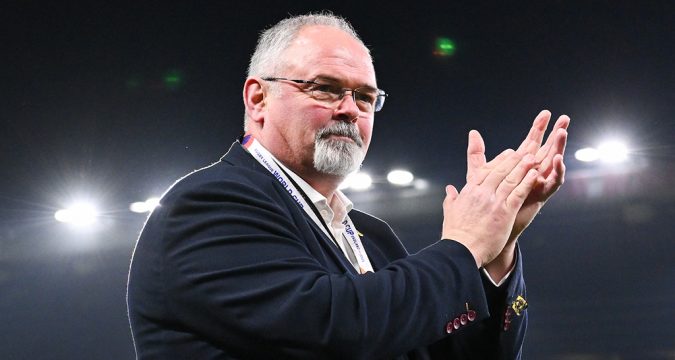
A MAN with a mission!
That has to be Martin Coyd OBE, who is determined to propel amateur Rugby League into a brighter future. And, importantly, without wasting any time.
Coyd certainly has a strong pedigree in place to lend credence to his ideas.
A driving force behind the vibrant world of Wheelchair Rugby League, he has also fulfilled a similarly inspirational role in spearheading Medway Dragons to notable success in the south of England.
Pertinently, the Dragons’ growth has been sustained over many years and, very relevantly, the club’s open-age team comprises players who, in Martin’s phrase “speak with southern accents”.
That’s a point of which he is justifiably proud, as is the fact that Medway provided six men in last week’s London side who featured in the Southern Carnival at Brentwood Eels.
So Martin Coyd, who is chair of the community board, knows much of what he speaks and is certainly worth listening to.
I agree with most, perhaps all, of his ideas, in fact I’ve written much the same on a host of matters, not least more regionalisation, over many years. So it would be very perverse if I was now to change tack and argue against those notions.
Having said that – and coming back to a point I made last week – Coyd could face trouble in pushing through his agenda, purely through the timing.
He wants everything to be in place for the 2026 season, and I get that, I really do. Things have a habit of drifting, don’t they, in any aspect of life, and Rugby League is no different?
Nevertheless there are several clubs who are members of the NCL partly, in some cases largely, because of the opportunity it gives them to play teams from further afield.
And there are certainly a few who have earned promotion this year and who won’t be happy (and you can’t in all honesty blame them) if such an achievement is to be denied.
But next year, if everyone knows exactly where they stand come the kick-off, could be very different.
So the issue, in the main, could turn out to be timing (although other aspects of the National Community Game Strategy may well also inspire debate).
I anticipate quite a reaction – in fact many clubs had already replied to my request for their thoughts by last weekend and I have those, which include a couple of other areas of alleged concern, ‘on hold’ right now – and any debate needs to be quick if everything is to be in place by next spring.
I have to stress, though, that most of Coyd’s notions, when set out in black and white, are ‘examples’ of possibilities rather than ‘blueprints’. There’s quite a lot of water as yet to run under this particular bridge.
Meanwhile, congratulations to West Hull on winning the NCL Grand Final on Saturday, and commiserations to Siddal.
This was, for me, Rugby League at its best in many ways, with few tries scored and defences on top.
Wests deserved their win (and who would bet against many more glories to come under their enthusiastic young coach Ryan Steen) although I have to feel for Siddal coach Gareth English, who had already announced that he is stepping down, as he has twice in succession proved his team to be the best in the NCL throughout an entire season by finishing at the top of the table, only to be denied at the final hurdle by Hunslet ARLFC in 2024 and, now, by West Hull in 2025.
Doffed titfers, too, to Ince Rose Bridge on securing elevation to the top flight by beating Stanningley in the Division One Promotion Play-Off Final.
Much debate will be on the post-match scrap between players (and, possibly, others) of both sides, with NCL bosses investigating, so I’ll leave that in abeyance for now.
At least Ince know that, regardless of how the National Community Game Strategy debate goes, they’ll be in the Premier Division next year (and let’s not forget that they were very unlucky to lose last year’s Promotion Final against Dewsbury Moor Maroons.
The same cannot, I think, be said of Pilkington Recs, who accounted for Hensingham in the Division Two play-off final.
In quite which league they will be operating depends on the outcome of the ongoing deliberations, although I reckon two ‘national’ divisions are likely, and that aspect can perhaps only strengthen the argument for wholesale changes to be made for the 2027 campaign, and not 2026. But that’s for others to decide of course.
Another vibrant competition will start on Wednesday, when the Student Rugby League’s National League swings into action.
Northumbria have been dominant in recent years. It will be interesting to see if that pre-eminence continues.