

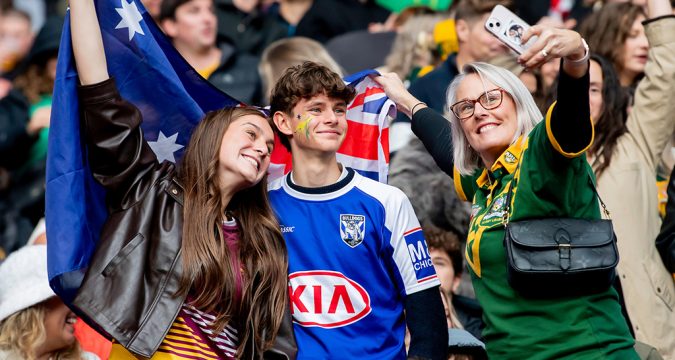
HAS there ever been a weekend when international Rugby League was so popular?
A record crowd for an Ashes game in England of 60,821 at Wembley on Saturday was followed on Sunday by a crowd of 44,682 for the Pacific Cup game between Tonga and Samoa at Brisbane’s Suncorp Stadium on Sunday, and preceded by a crowd of around 15,000 in Port Moresby for Papua New Guinea’s Pacific Bowl clash with the Cook Islands, while in France there was a crowd of 6,200 in Albi for the World Cup eliminator match against Jamaica.
So let’s not get too downhearted about the fact that England didn’t beat Australia.
When more than 125,000 people turn out around the world to watch top-level international Rugby League, I think we can conclude that the game isn’t doing too badly, particularly when we think back five years to the Covid era, when the international game looked to be almost on its death bed.
Now it has never looked stronger. And there were numerous other matches taking place in various locations in the various European competitions, as well as a Women’s World Cup qualifying tournament in Canada.
It’s easy to be critical of England for not beating Australia but the fortunate thing for Shaun Wane’s men is that there are two games remaining in which England can still snatch the Ashes, even if we think such an outcome unlikely after Saturday’s game.
And of course there are some people who insist on seeing the glass half empty as far as Wembley is concerned.
Much of the upper tier wasn’t occupied and of course it would have been terrific to have had a full house to celebrate the Ashes return to our capital city. But that was probably an unrealistic expectation.
Of course a crowd of that size would have produced a full-looking stadium at Tottenham or Arsenal, assuming that the same people would have wanted to attend the game in one of those locations.
But as someone who experienced the appalling transport connections to White Hart Lane at the time of the 2022 Challenge Cup Final, I wouldn’t want to return there in a hurry.
In terms of Saturday’s crowd, I would be curious to know where those 60,000 people all came from and how many of them were from London and the southeast – I suspect around 40 percent. And I’m sure some of those people could be attracted to watching the London Broncos next season.